
What composition competition judges look for
Most competition entries get eliminated before a judge hears a single note. You've probably been blaming the music, but often the composition itself wasn't even a factor in the rejection. I've been on 7 juries, including Copland House and the California Symphony composer-in-residence program, and these are the 5 things that actually decide who wins.
 By Saad Haddad, composer
Here's the video this post comes from (10 minutes), or you can read it below.
- A strong first impression
- A strong fit with what the contest is looking for
- A piece that's been performed and recorded
- Music that's both authentic and exciting
- A clear North Star idea
1. A strong first impression
Whenever you submit a piece for a composition contest, there's one thing working against your submission more than anything else, and that's time.
To paint you a picture of what I mean by this, when I was judging the California Symphony's composer-in-residence search, there were a couple hundred orchestral applications that came in. Each one of those applications came with 3 different orchestral pieces that were all around 5 to 10 minutes long.
- A couple hundredorchestral applications came in
- 3 piecescame with each one of those applications
- 5 to 10minutes long, each of those pieces
- Hundredsif not thousands, of minutes of music to sift through
If you do the math there, that's hundreds, if not thousands, of minutes of music that I have to sift through. It's literally, physically impossible for me, or any judge really, to listen to that much music.
So we have to come up with an alternative strategy to be able to adjudicate that much music and come up with a winner through all of those different pieces.
What I call the Falcon View test
If you want to give your music the best chance to be one of the scores that gets a detailed look, everything about your score needs to immediately tell judges that it's worth looking at for more than a few seconds. All that music gets thrown out immediately if it fails what I call the Falcon View test.
This is an initial quick scan a judge does of your title page, your program note and the first 1 or 2 pages of the music.
Any issues with those first few pages, from spelling errors to crowded notation, mean that judges will move on to looking for the pieces in their pile of hundreds of scores that just don't have those issues.
It's nothing personal at all. But those errors are a warning sign to judges that their limited time is better spent with other pieces.
How to fix it
Before doing anything else, make sure the scores you're submitting to contests are as professional looking as humanly possible, or the other factors in what wins won't matter for your piece at all.
2. A strong fit with what the contest is looking for
If your piece makes it past that first scan by the judges, your submission is one of a lot fewer being considered. But there's another quick check judges run next, which is contest fit.
This is particularly important for any type of call for scores where an ensemble is looking for pieces that fit their specifications exactly. Often those specifications are about the instrumentation and duration of the piece.
Submitting something close to what's asked for and hoping judges give you the benefit of the doubt just gives them an excuse to move on. If the contest guidelines say they're looking for an orchestral score with double winds that's a maximum of 7 minutes long, don't submit a piece that's triple winds and 15 minutes long.
- InstrumentationAn orchestral score with double winds
- DurationA maximum of 7 minutes long
- InstrumentationA piece that's triple winds
- Duration15 minutes long
An excuse to move on
When a contest is looking for a particular theme
Beyond the more objective side of things, contests might also be looking for music that explores a particular theme. If your program note doesn't make your piece's connection to that theme immediately clear, judges will have no reason to keep going.
I've also seen this same issue of contest fit come up in much more general contests for composer-in-residence positions and artistic residencies.
For example, I was on the jury for the Gilgamesh Foundation's call for scores, and their specific mission with that call for scores was to highlight the culture of Mesopotamia in some specific way. So unless your piece had some kind of tie into that, it wasn't going to be considered, no matter how good that piece was.
In other words, everything about your submission, from the score itself to your personal information, should give the judges a reason to look more closely at your work.
If your submission raises any questions or concerns at all, it's safe to assume that there's another piece out of the hundreds of candidates that checks all the boxes better, and that's the piece that will get the closer look instead of yours.
Finding contests that actually fit the pieces you've already written is exactly what my monthly contest list is designed to do. Every month I update it with new opportunities, so instead of spending hours searching yourself, contests just come straight to you.
3. A piece that's been performed and recorded
These 2 first checks, a strong first impression and a strong fit with what the contest is looking for, are where 90% or more of submissions get eliminated, and it happens very, very quickly.
From that point on, the judging process becomes a lot more about what a composer has to say. But a lot of composers still end up knocking themselves out at this stage, and it usually comes down to what they've chosen to submit.
With pieces that have made it this far, judges are looking through the score and listening to any audio included in the application. This is the chance for the music to speak for itself.
But if you submit a brand new piece that's never been played, with a MIDI playback audio file, you're giving the judges a prototype. Your ideas aren't proven to work in the real world, and judges can't hear how those ideas sound when a real musician plays them, either.
- A brand new piece
- Never been played
- A MIDI playback audio file
Ideas aren't proven to work in the real world
- Performed
- Recorded by live musicians
Judges can hear exactly how your music exists in the real world
This is another one of those moments where a judge can lose interest very quickly, because there will be other submissions of pieces that have been performed and recorded by live musicians.
What I always recommend
Unless a contest is asking for submissions of unpremiered pieces or MIDI recordings, I always recommend submitting a piece that has performers.
Submitting a piece that's been performed and recorded means judges can hear exactly how your music exists in the real world, not just how it looks on the page.
4. Music that's both authentic and exciting
By this point, your score is probably one of only a handful left in consideration. But this is where submissions can run into a totally different problem.
That's because contest judges aren't just looking for a well-written piece that has a polished presentation and the proof of having already been played. They're looking for music that excites them.
For example, while I was on the jury for the California Symphony's composer-in-residence program, Donato Cabrera, the artistic and music director of the symphony, shared with me what he looks for in new orchestral pieces. He doesn't want something that sounds like a redone version of popular concert music pieces like John Adams' Short Ride in a Fast Machine.
What excites him is a piece with things like a unique combination of instruments, a unique way of approaching rhythm, or an individual style when it comes to form and structure for the piece.
What I look for as a competition judge
More than being innovative just for the sake of doing something new, what I look for as a competition judge is a piece that feels authentic. It's really easy to tell when a piece is chasing trends. It just comes off as sounding generic.
I really start paying attention to a piece as a contender for the winning spot if it manages to do something unique that also feels like it totally fits into the piece, instead of just being an addition.
How do we create pieces that are both authentic and exciting?
This is something I struggled with myself for a very long time. Back when I was in high school and in college, I was writing pieces left and right with all sorts of different aesthetics.
I was writing music that sounded like Eric Whitacre. I was writing music that sounded like Holst. I was even writing music that sounded like Michael Jackson at some point. I was taking influence from him.
It just felt to me like I wasn't finding something that was uniquely mine and uniquely personal to me.
Then I started figuring out that what I really wanted to write about was my relationship with my family, and my relationship with what it would have been like for me if I was born where my family is from, which is Lebanon and Jordan.
I was thinking to myself, what would it have been like if I was born over there? What would have been the influences I was exposed to? How would that change, knowing all the Western music training that I know now? That's what really sparked the voice that I write in.
That was in combination with me finding these VHS tapes that my mom just piled on for me one summer in college, asking me to put them into a digital format. I was seeing my uncles and my other family members 20 years younger and hearing all the music that was in the background, all this music that was from my heritage.
- Music that sounded likeEric Whitacre
- Music that sounded likeHolst
- Music that sounded likeMichael Jackson
All sorts of different aesthetics
- My relationship with my family
- Where my family is from, Lebanon and Jordan
- The music from my heritage
My own unique personal aesthetic
This really inspired me to go down that path, and as you can hear, there are many reasons for it, many personal reasons.
This was the thing that really catapulted me to coming up with my own unique personal aesthetic, and being really motivated and excited to pursue it very, very deeply from one piece to the next.
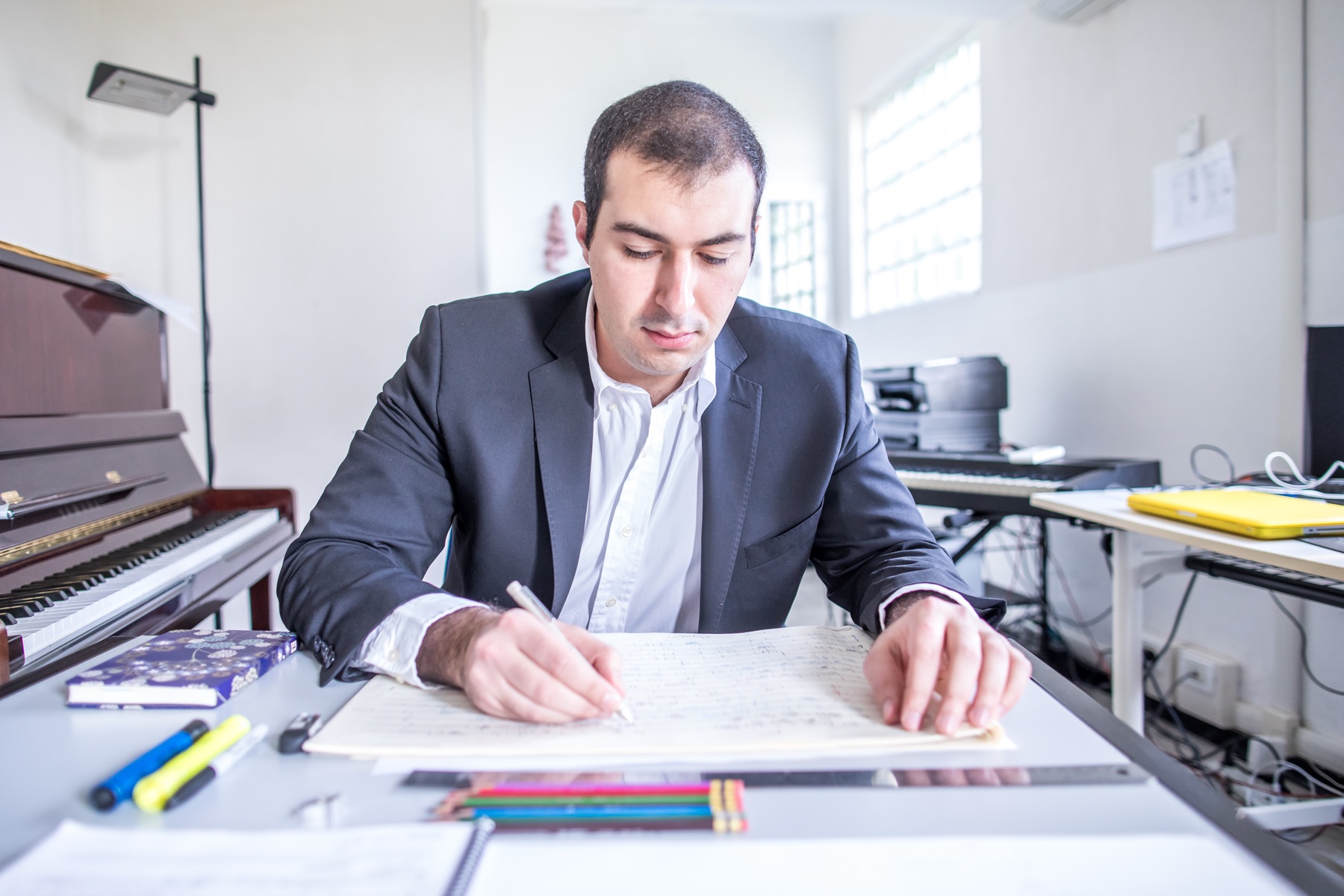
A great new piece of music doesn't need to do something no one has ever thought of before. It just needs to combine your genuine musical influences in the way that only you can.
5. A clear North Star idea
If your piece does everything else I've talked about in this post, there's still one more thing that some pieces miss, and it keeps them from being seriously considered for a contest win.
A piece can do everything right but still leave judges cold because I can't tell what it's trying to say. Without a clear North Star idea that a piece is shaped around, even great music can feel hard to understand to the people evaluating it.
This is often the decider between first and second place. By the time you're looking at the top 3 to 5 pieces as a judge, you're dealing with really great music. So the final step in selecting the winner is often seeing how clearly the piece communicates its North Star idea.
How a piece communicates its North Star
A piece communicates its North Star through 2 things working simultaneously: both the musical decisions themselves and a program note that makes your artistic intent clear to the judges before they've even looked at the score.
- Every compositional decision connects back to that bigger idea
- Makes your artistic intent clear to the judges
- Before they've even looked at the score
When judges know how to listen to your piece, they can hear how every compositional decision connects back to that bigger idea, and that's what pushes a piece from finalist to winner.
What to do next
Submitting pieces that fit all 5 of these criteria doesn't mean you're going to win every contest you apply for, and I know this personally. I've submitted to more than 600 contests across the last 10 years of composing professionally, but I've only won or been a finalist in about 10% of the contests I applied to.
If you haven't already grabbed it, download my list of composition contests, so you always have somewhere worth sending your music.