
How to develop a musical idea into a finished piece
Maybe you struggle to develop your ideas, or you do have ideas but you're not sure how to get them from start to finish without hitting a wall. That happens quite a lot as a composer. Here's the groundwork I lay down for developing a musical idea into a finished piece, step by step.
 By Saad Haddad, composer
Here's the video this post comes from (5 hours), or you can read it below.
- Every composition starts with an idea
- Develop that idea without hitting a wall
- Get your essentials: writing tools and a workspace
- Build feedback loops
- Study scores and apply them to your piece
1. Every composition starts with an idea
Every single composition that you've ever heard in your life started with an idea. I know it sounds basic, but we really have to go to the heart of it. What makes an idea an idea?
An idea is just 2 things: an extra-musical concept or a musical thought.
- Emotions
- Stories
- Visual art
- Nature
- Literature
Your experiences as a human
- Rhythm
- Melody
- Harmony
- Timbre
A process that guides the creation of music
An extra-musical concept is inspiration from outside of music that can influence a composition: emotions, stories, visual art, nature, historical events, literature or philosophical ideas. So you can start with an idea that has nothing to do with music.
I have many pieces that don't have anything to do with music as the impetus for their creation. The piece I composed for the Los Angeles Philharmonic is called Aysheen, which means living in Arabic. Another piece for orchestra, Mishwar, had to do with a trip that I took up and down the coast of California. Something from your own life experiences can be the jump start to your composition.
Or start with a musical thought
A musical thought is a process that guides the creation of music. It involves how composers think about rhythms, melodies, harmonies and timbre.
Sometimes when we're composing we have tunnel vision. We think, what's going to be my melody? And sometimes you can't come up with a melody. Maybe you can only come up with a harmony at that particular moment, or a timbre, or something as simple as a rhythm. So we don't want to think about everything all at once.
Look at the left hand in one of Chopin's preludes. He's not thinking, let's pick this chord, then this chord. He has this problem in his head: how do I make a harmony just descend, gradually, over time? And Sky Macklay built an entire string quartet from 1 musical thought.
That last one is the problem I was trying to solve in the version of Duetto for flute and alto saxophone, which really are very different instruments. I call this a super instrument.
Each of these ideas is simple. You can say it in 1 sentence. These musical thoughts change over time, but there has to be some kind of musical thought that starts it.
2. Develop that idea without hitting a wall
Most composers struggle not with generating ideas but with 3 common mistakes. Often it's this: once they have that idea, how do they develop it? And the problem is they feel they have to have inspiration to develop those ideas.
I know what it's like to struggle. I used to have paralyzing writer's block during my undergraduate years at USC. It took me 7 months to complete a 7-minute piece, an orchestral piece called Maelstrom. This led to an all-nighter fueled by energy drinks before the deadline, and it made me realize I couldn't keep composing that way.
I was very lucky to learn something very early on, when I was around 15 or 16 years old. I heard the conductor and composer Esa-Pekka Salonen say that composing is 1% inspiration and 99% perspiration, and that line has stuck with me ever since.
Composing is a skill that can be learned through practice. Here are the 3 mistakes, and what I do about each one.
Mistake 1: writing initial ideas directly into music notation software
Writing initial ideas directly into notation software, instead of on manuscript paper, limits imagination and traps ideas in a rigid rhythmic grid. Handwriting music helps develop a better mind-muscle relationship with musical ideas.
I always start everything with manuscript paper, and it's always nearby even when I start putting stuff into my notation software. Of course, this is not going to be the final product. But for you to develop your own ideas throughout an entire piece, it's crucial that you form this mind-muscle relationship from the onset.
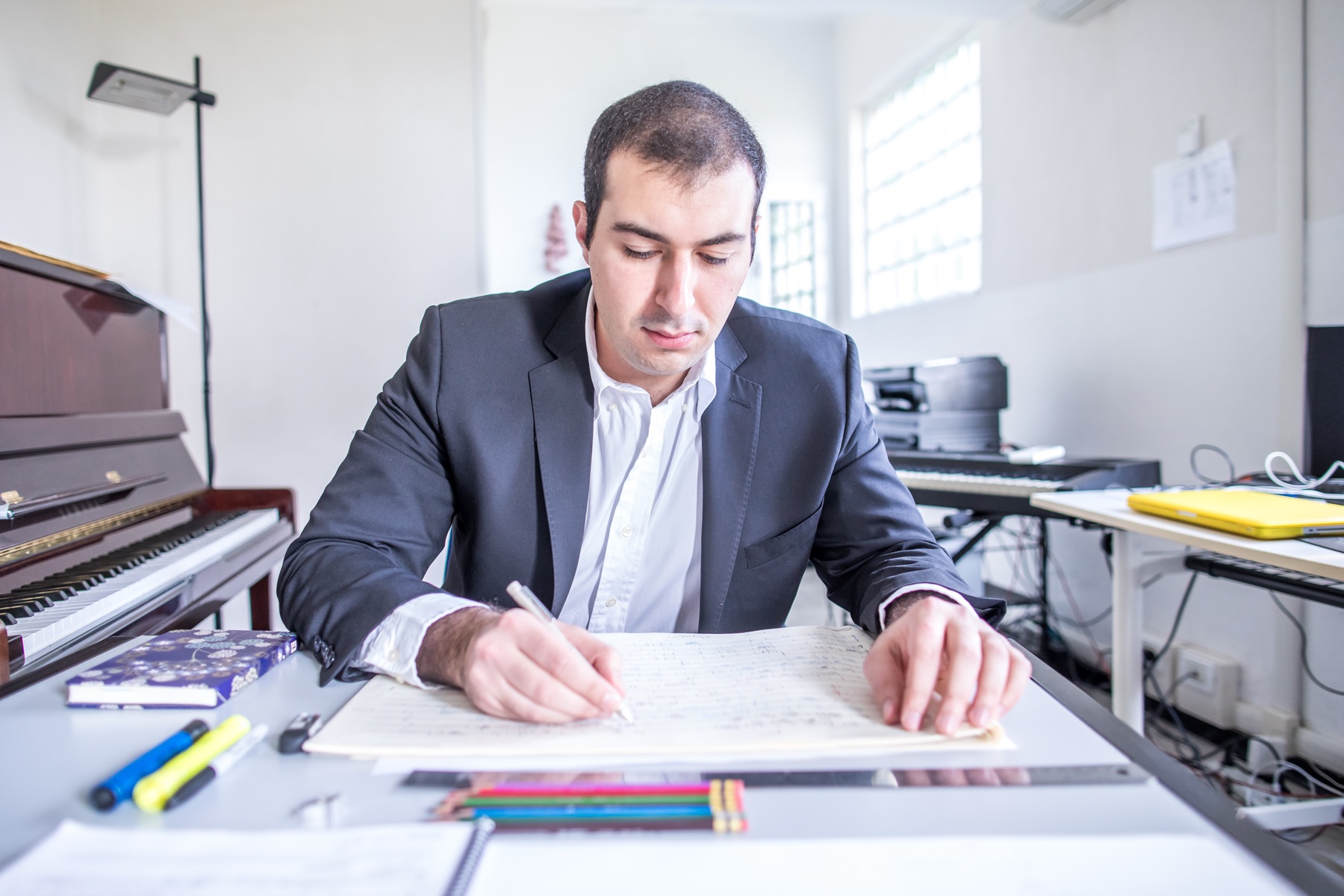
One of my students did a lot of stuff on the computer at first. Once he started writing music by hand, he was having fun, and ironically he was producing more music per week than when he was writing in the notation software. His task for the day was to fill out the page, no matter what. Within the span of a week, there were 4 pages of music.
Mistake 2: adding too many underdeveloped ideas to your piece
The way I tackle this mistake is to conduct what are called thought experiments, a technique taught by Dr. Steven Stucky. He would say this all the time: have you done your thought experiments?
Once you have 1 idea you like, start tweaking it in various ways. A thought experiment is basically a what-if question. What if I did this? And instead of just having that be in your brain, write it down. You've got your manuscript paper.
Make another version of that idea that's slightly different, still related. Then do it again, and again. Before you know it, you have a whole page of ideas based off of that 1 idea, and you can use all those variations as developmental fragments to create your entire piece. This is part of the perspiration part. It has nothing to do with inspiration.
There are certain thought experiments I tend to gravitate towards. As soon as I have an idea, I transpose it to every single key. What is it in C sharp? What is it in D? Doing certain things in every one of my pieces is part of what creates a voice.
One of my students, Bailey, put it this way: "One of the struggles that I had is not knowing what to do with material in order to make a composition have forward movement, and this idea has helped me turn a musical idea into actual music."
Mistake 3: not breaking composition into small tasks
I call this approach don't go crazy. There are so many things you have to do when you're composing a piece of music, no matter how short or long. So focus on 1 small task during each writing session and don't worry about future tasks.
Say you came up with a rhythmic idea yesterday that you really like. What are 10 versions of that rhythm? That can be your small task for the session. You don't need to think about melody or harmony or what instrument is playing that rhythm. The next day you say, these are the 10 I came up with. Can I assign a melodic interval to that rhythm? Can I do that for all of them?
- Yesterdaya rhythmic idea you really like
- Today10 versions of that rhythm
- The next dayassign a melodic interval to that rhythm
- Thenthe inspiration part comes in, that 1%
Before you know it you say, I know what to do with that line. It's going to be played by the violin in this register, and it's going to be in the beginning of the piece.
Those are your moments of inspiration, but they can only happen after you do a series of small tasks.
When you finish a small task, you start to say, hey, I can actually do this. That gets you to the next small task, and then the next. And before you know it, the piece is done.
3. Get your essentials: writing tools and a workspace
We're very lucky to be living in a time where we have a plethora of tools to compose music. A lot of what you need is quite basic. Really, the most important thing is your workspace, and I feel like this gets overlooked.
- Manuscript paper
- About a dozen wooden pencils
- A clear ruler on the shorter side
- Not 100% neededA small notebook
- Before anything elseThe chair
- As deep and wide of a desk as you can get
- OptionalExtra monitors
The 3 most essential writing tools I use
The first thing you're going to need is manuscript paper. The one I use is Hal Leonard's number 27 Carta manuscript paper. It's got 16 staves per page and it's about 18 inches long, so I can see a ton of music on 1 single page.
Any type of pencil will do. I use very basic number 2 wooden pencils. The key is to have about a dozen by your side, all sharpened before you start, so you don't have to interrupt your workflow whenever a pencil gets dull. If you went through 6, 7 or 8 pencils in a session, that's a pretty good indication that you did a lot of good work that day.
Then a clear ruler on the shorter side, to make straight lines like stems on notes and bar lines.
Your workspace
We're going to be sitting a lot as composers, and we need to do this in a healthy way. It starts with the chair. The one I use is the Steelcase Leap version 2, which you can get refurbished. Before this chair I could really just compose for 20 or 30 minutes in a row before I had to get up, because my back was hurting so much. With this chair I can sit here for 2, 3, 4 hours.
For the desk, get as deep and wide of a desk as you can get your hands on. You don't need a fancy one.
As for the computer, don't go crazy. Most likely whatever you have right now, even if it's just a laptop, is completely fine. Eventually you're going to have to put everything into notation software, because that is the standard these days for professionally produced scores and parts. Try Sibelius, Dorico and MuseScore and see which one fits you the best.
4. Build feedback loops
Most people imagine composers as solitary figures working alone in dark rooms, or out in huts by the lake. This is what we think of as the hermit composer. Does it need to be this way? The short answer is no.
A feedback loop is the act of receiving and giving criticism, both positive and negative. It can't just be positive all the time, and it can't just be negative all the time either.
Internal feedback comes first
Internal feedback involves a belief in your own work, first and foremost, even if it seems irrational. Without self-belief, no amount of external feedback will help you succeed. You can have people praising you, and if you don't have belief in your own work, you're not even ready to receive that positive feedback.
Cultivate intrinsic motivation by focusing on the joy and satisfaction of the process of creating music, rather than solely on external validation. And put pen to paper quickly, because we can't even have any internal feedback if we're not working.
Then embrace the mindset of being a lifelong student. There's never going to be a moment where you feel like, hey, I arrived. The next day after my performance with the LA Phil, I was like, all right, let's get back to work.
Then external feedback
When I was 15 years old, I was part of the late Dr. Steven Stucky's Composer Fellowship Program out in Los Angeles. There we met as 4 composers and 2 composition teachers, all giving feedback to each other. That's when I was first introduced to this idea that we are a community of composers.
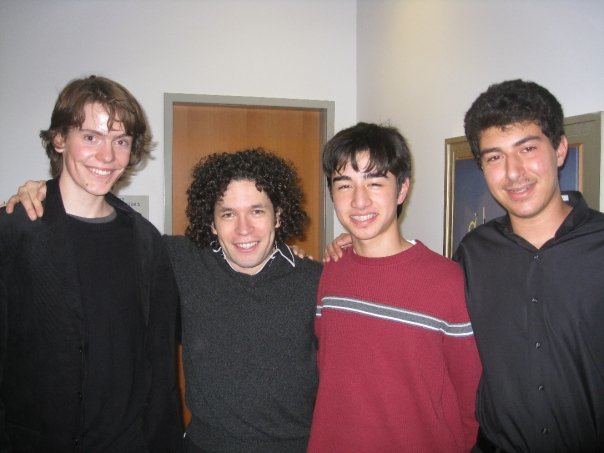
Initially I remember feeling very skeptical of group sessions over one-on-one meetings. But there are intangible qualities of a group session that you cannot get in a one-on-one.
- Way more individualized
- Personal
Limited in the intangibles
- You see what other people are working on
- You can be motivated by it
- You create camaraderie
- Questions you wouldn't have thought of get answered
This idea is not new. Even Gustav Holst, the composer of The Planets, called Ralph Vaughan Williams "a lifelong friend and critic offering invaluable feedback on my compositions." So it's crucial to have people that you trust around you.
5. Study scores and apply them to your piece
I've started so many pieces because I was inspired by 1 or 2 very specific pieces, even lifting some things from those pieces and then reworking them in my own way.
Studying scores also helps us solve musical problems. You have a problem in mind when you're writing a piece of music, and the more scores you study, the more solutions you're going to have.
Analyzing a score: don't try to do it all at once
Don't go crazy. You don't even have to do all of these for every score. There might just be 1 parameter that you're especially drawn to.
Look at the first page of Beethoven's Symphony No. 5. He has the first iteration of his rhythmic idea, then a gap. In the second iteration he immediately goes to the next one and doesn't wait like he did before. When we think about development of ideas, this is what we're talking about, and you can do the same kind of thing with your own rhythmic motifs.
You are, in a way, composing when you're doing this, so that when you go to compose it's not going to be so difficult to figure out ways of developing your ideas.
Quote, paraphrase or map
These are the 3 ways I've found to apply the music you already love to the music you're writing now.
- Quotationliterally lifting it out, and acknowledging the source
- Paraphrasereworking it while maintaining the essence of the original
- Mappingtaking a parameter from another work and applying your own set of parameters to it
Mapping is the one I probably use the most often in my own work. In one of my pieces, I wanted to evoke some kind of rhythmic vitality, because in a lot of my pieces I don't really have this parameter. Instead of coming up with it on my own, I went to an excerpt from a book on African polyrhythm by the ethnomusicologist Simha Arom, with music notation for a group of 18 instruments from central Africa.
My flute part basically is a quotation of the first rhythm. Then I mapped the next one to the oboe, a different pitch but that exact rhythm, and so on with the clarinet. I mapped it to my own scalar system and to different timbres of instruments, and then changed the rhythms and the harmonies over time.
Aaron Copland said that listening to great music and studying great scores is the best way to learn composition. You have hundreds of teachers, and you'll have a different set of 100 composer teachers than another person. That is what eventually creates personal voices.
What to do next
If you have ideas but keep hitting a wall when you try to develop them, start with my free guide to overcoming composer's block in 3 simple steps.