
Orchestrating a small piece instead of starting from scratch
Most composers think that writing more orchestral pieces from scratch means better orchestrations, but that usually takes an incredibly long amount of time, and it mostly doesn't even work. Here's my 3-step orchestration method, with 4 real sections from my piece Kaman Fantasy.
 By Saad Haddad, composer
Here's the video this post comes from (58 minutes), or you can read it below.
- Picking a piece to orchestrate
- My 3-step process
- Step 1: map the ideas
- Step 2: a short score, one layer at a time
- Step 3: full orchestration in the notation
- A big tutti, with the same process
- The sound argument
- Lots of color, and a sound that's felt
- What came out of that little piece
1. Picking a piece to orchestrate
Most composers assume that when they write for orchestra, they have to write it from scratch. I did this myself back in 2012, when I wrote an orchestral piece called Maelstrom to prove that I could do it.
This 7-minute piece turned out to be a 7-month nightmare, where I was just writing and writing and writing without any end in sight. Although this piece got performed a couple of times, I was exhausted by the process, and I didn't write a new orchestral piece for another 3 years.
That next orchestral piece ended up being a 12-minute work called Kaman Fantasy that only took me 6 weeks to write.
The big difference wasn't that I was all of a sudden really fast at orchestrating. I decided to adapt a smaller work for a larger orchestra: a work for violin and piano that I was already really proud of, and that was already done and recorded.
By adapting that small ensemble piece, I cut the difficulty level of what I was doing by more than 50%. I already had musical ideas on the page that I knew already worked. All I had to do was figure out how to make them work for a large orchestra.
2. My 3-step process
Here's how I get from the violin and piano version to the orchestra.
- 1MappingWhat in general I want to do with the music: families of instruments, dynamics, texture.
- 2Short score8 to 12 staves, divided into woodwinds, brass, percussion and strings.
- 3Full orchestration in the notation20 to 30 staves, encompassing the entire orchestra.
I repeat this process over and over and over again throughout the entire orchestration. And I want to start off with a part of the piece that's more clear in my head, which gives me what I call confidence to keep going.
Oftentimes, that's going to be the beginning. Because the piece is already fully formed, I have a really good idea of what the beginning could sound like. So let's get started with the first 7 bars.
3. Step 1: map the ideas
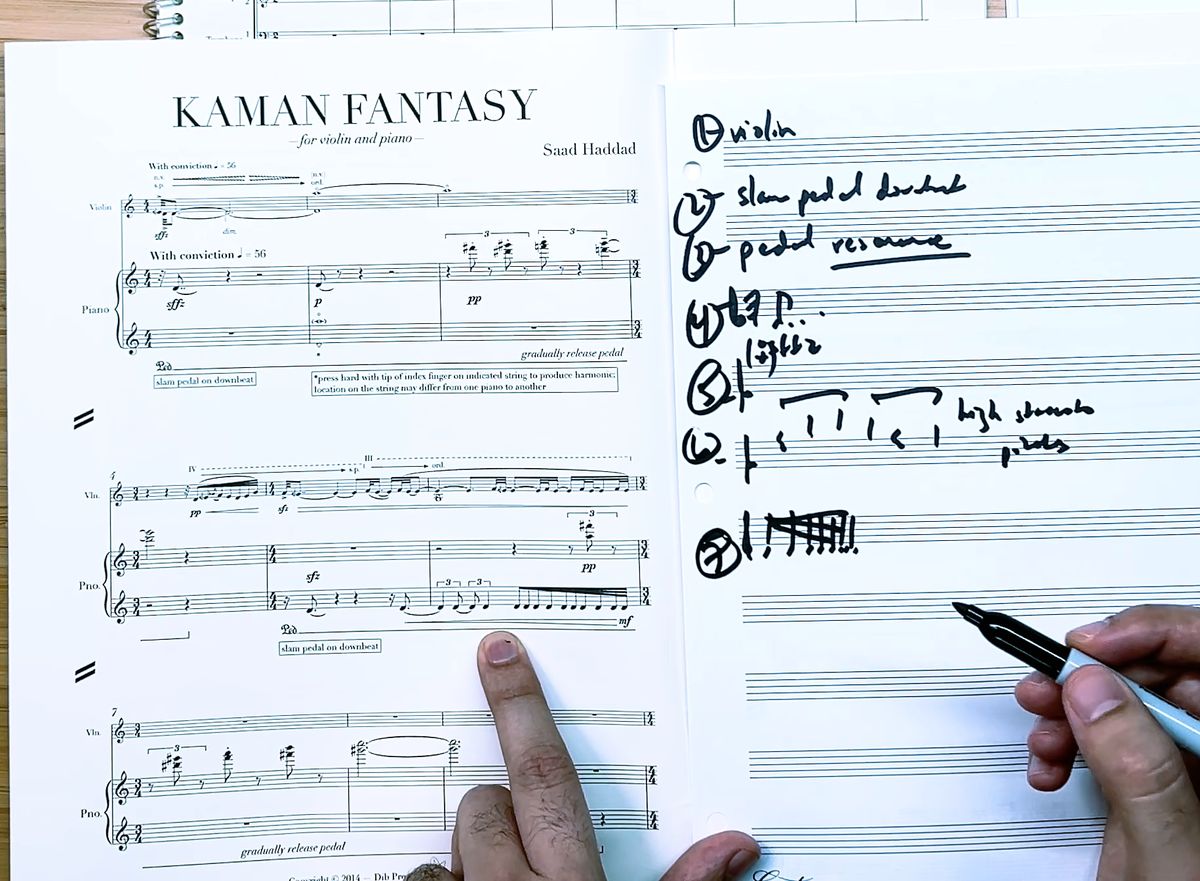
When I take a look at the opening, there are a lot of immediate things that I start to notice. The violin line really feels like it's encompassing the entirety of the texture. The piano has these very timbral kinds of moments, like the slam pedal on the downbeat.
So I start mapping out the general parameters that I want to think about. If I see how many ideas are actually here in these first 7 bars, there are really just 7:
- The violin writing
- The slam pedal on the downbeat
- The pedal resonance from the piano, which is very, very difficult to try to mimic in an orchestra
- The 32nd note figure on D, with a sforzando
- The harmonic on A
- The triplets, on high staccato pitches
- The feathered beaming gesture
4. Step 2: a short score, one layer at a time
Next, I identify which families of instruments I think are going to work well with these 7 bars. The strings are going to be the first thing that I do, because I can already see clearly what the string writing will be.
This is something that people get hung up on a lot. They look at everything they have to do and try to do it all at once. I focus on the thing that's most obvious to me, which here is the violin part, and I basically ignore the rest until I get there.
I don't know about you, but I can't multitask.
In my violin part, I see a lot of double stops. When I'm working with a large string section, I want to limit the use of double stops, because generally speaking, the double stop has a very specific timbral texture that doesn't normally lend itself to orchestral writing. Obviously, there are going to be big exceptions to that.
With this kind of writing, I feel like it'd be a lot smoother if I separated out these pitches, so I write them on separate string lines.
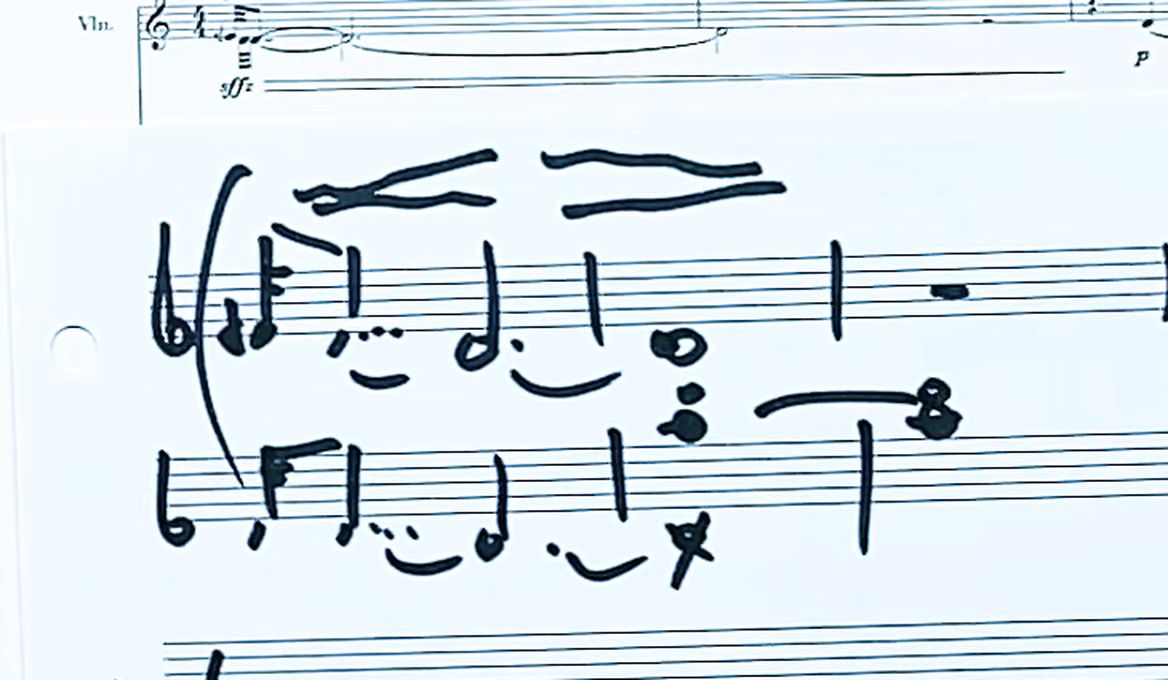
Once I'm kind of okay with the sketch, I go into the notation software and start exploding it out to see what else I can come up with.
5. Step 3: full orchestration in the notation
Some of the sketch made it into the final orchestration, while some of it simply changed. You basically have to allow yourself to do that.
I decided to double the note values
The original piece is in 4/4, with quarter equals 56, a pretty slow tempo. I changed it to 2/2, in other words, cut time, so half note equals 56. We're still going at a slow pace, but each beat is a half note instead of a quarter note.
Why would I do this? When I was writing these 32nd notes with all these dots, this is really virtuoso kind of reading. For sight-reading purposes, it's quite difficult to do. And at this tempo, the 32nd note wasn't really helping me achieve hearing that E half flat with clarity.
In 2/2, this would be an E half flat 16th note and then a dotted D. In my final orchestration, I simplified it further and made it 2 eighth notes instead.
So in the adaptation, I sometimes do take liberty with the rhythm, so that it can be more easily achieved in an orchestral environment, where I have multiple people playing the same lick.
I let the A harmonic sing on its own
The first violins have the main line. In the second violins, I just omitted it completely. I realized that if I wanted that A harmonic to sound, it'd be much better to have the players prepare it, instead of playing something else before and then all of a sudden having to cut to it.
The violas have the D's, and the celli have the E half flat and the D. That way, I get a fuller string sound than the solo violin sound that began the original version of the piece.
I created a whole different sound for the slam pedal
There was no way for me to actually create that slam pedal sound without using a real piano. And I didn't want to have a piano in the hall slamming the pedal. I thought it was too on the nose and too similar to the original version.
What I did instead was create a whole different sound that still gives you the atmosphere of something kind of surprising you at the start of the piece. I have a rim shot on the field drum with the snares off, and I dampen it immediately to make way for the sizzle cymbal, which is a suspended cymbal with holes in it.
The harp is also doing a pedal buzz, which is basically keeping the pedal between D and D sharp. Once you pluck that D, it creates this buzzing effect.
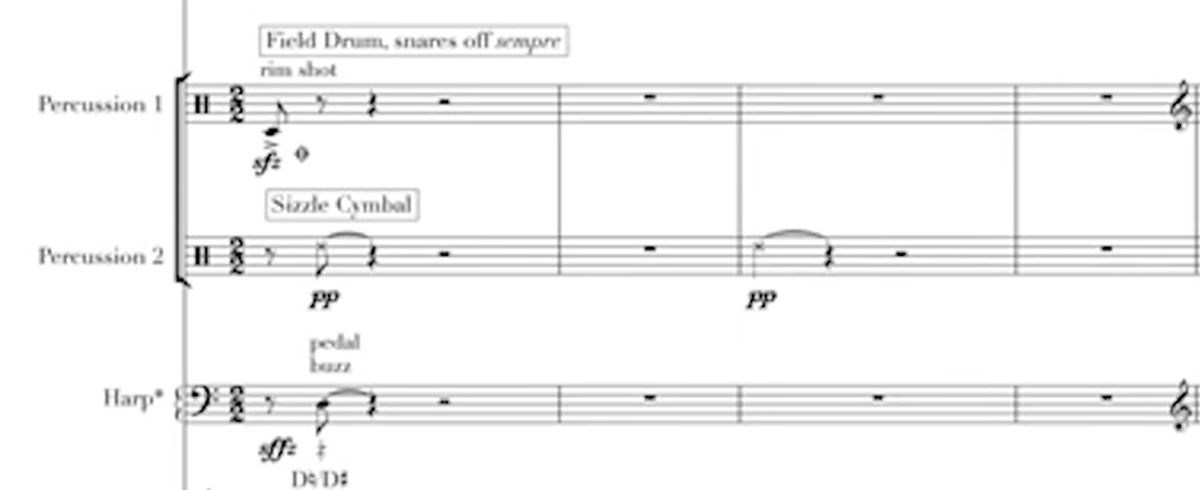
If we think about these 2 layers as attack, decay, sustain, release, the slam pedal part is the attack, and the pedal resonance part is really the sustain and then the release. So we're combining all these different facets of electronic music when we're writing for orchestra as well.
I'm already using the strings and the percussion to set up the piece, so for the high staccato triplets, I want to stay within these families. The glockenspiel and the harp take over along with the celesta, which is new in this texture, and I basically orchestrated it one-to-one with the piano part.
One piano line became a super instrument
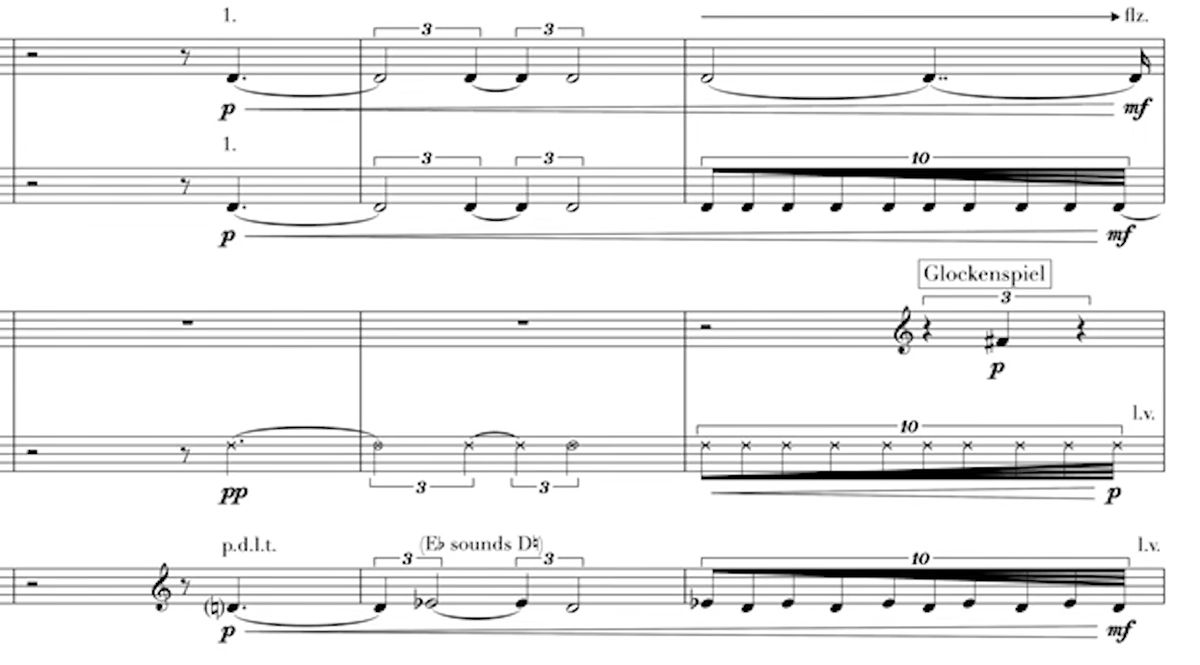
By the time we get to the feathered beaming, I felt I should start bringing in more depth besides just the percussion and the strings. That happened to be the flute and the clarinet.
I didn't just copy and paste the feathered beaming. I have that exact thing in the clarinet, but in the flute I add another layer of depth: a held D that gradually starts flutter tonguing, at the same time as the tongued pitches on the clarinet and the attacks on the sizzle cymbal and the harp.
6. A big tutti, with the same process
The next section is quite the opposite of that very soft opening. It's a large, climactic moment for tutti orchestra, and we go through the same process.
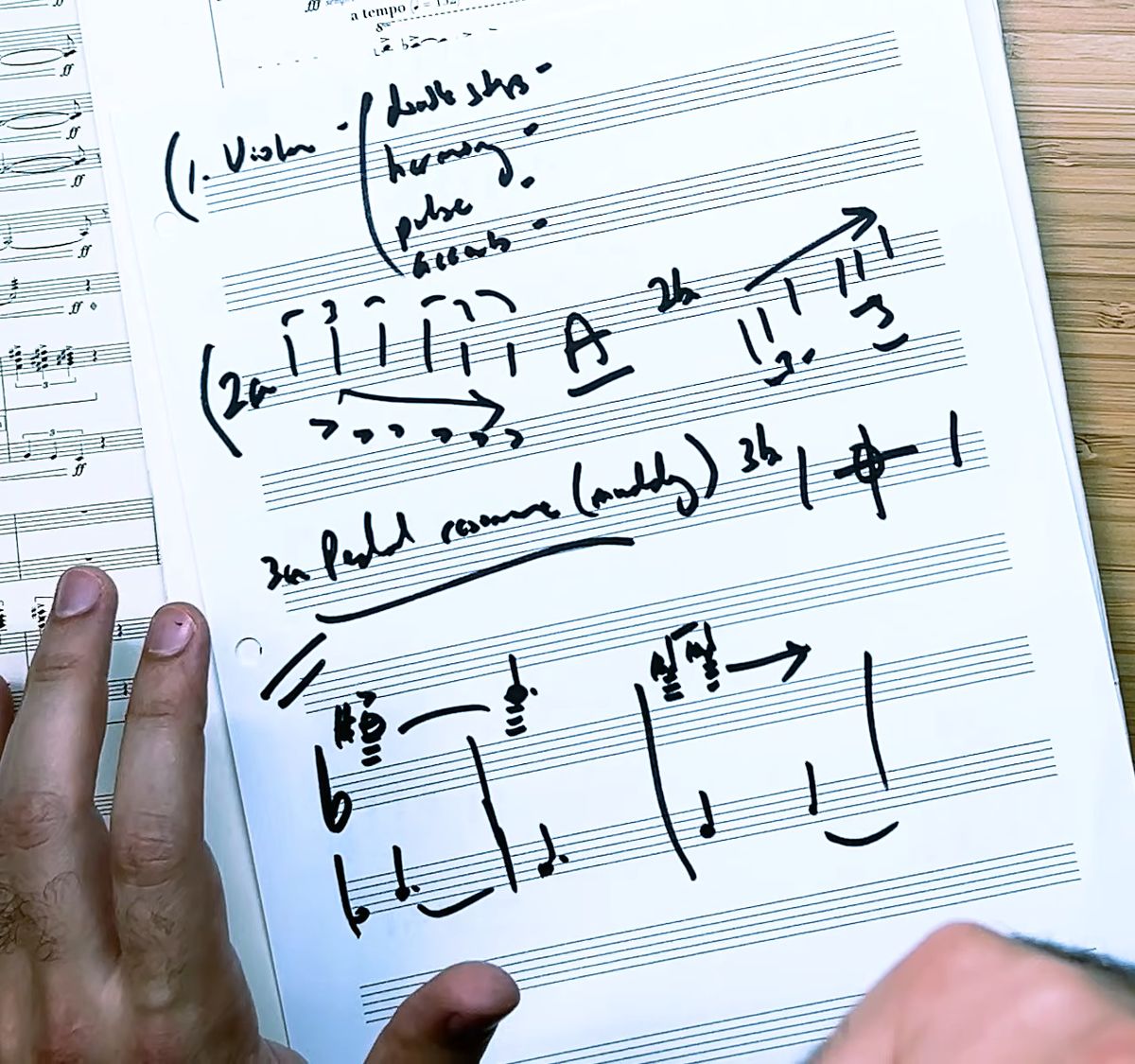
I map 3 main ideas. There's the violin line, with its double stops, harmony, pulse and accents. There are the triplets, from the top down and from the bottom up. And there's the pedal resonance, which dampens on the rests. It has this dirty, muddy quality that I want to find out how to capture as well.
The violins
These G sharps are going to be really thin in the orchestra. When violins play this high, if too many of them are playing it, it's hard to keep in tune. And if you don't have an octave G sharp below this high G sharp, it's going to sound really, really thin. I want a much thicker, stronger sound.
So I kept the line in the first violins, and in the second violins I just took it down an octave. Then I decided, why don't we put it in 3 octaves, and had the violas play G sharps too, so that we really get a strong G sharp sensation in the strings.
The triplets and the resonance
The piano triplets come from the top and the bottom at once.
Getting these triplets to sound is quite straightforward. Flutes, oboes and clarinets can all be closely voiced, no problem. Trombones, tubas and contrabasses in close voicing will sound really nice and muddy. But how do I do the pedal resonance without a piano?
The answer came from a process of elimination. Notice the instruments that I didn't mention. Those happen to be the horns and the trumpets, so they get held notes that aren't in the original version.
I ended up having trombones, tuba and timpani in the mix there too. Then everybody is basically off, which creates a kind of dampening effect.
7. The sound argument
Just because it says forte in the original version doesn't mean I want it to be blasting in my face. So I think about what my overall sound argument is for a section.
The next section has an ostinato in the piano and a very prominent, repetitive melody in the violin. I didn't want a huge tutti texture here, but I wanted a lot of timbral color changes happening. I wanted to make sure that each time there was a new motivic cell, we could hear it immediately and it's not buried.
The glue
There's a held note, D sharp and F, that's like the glue between the violin line and the piano line. I remembered the glue from the previous section was in the brass. Because this is a smaller kind of texture, I just incorporated the horns.
I had them stopped and put a forte piano crescendo there. There's no way to put that on the piano line, but I could highlight the attack, then the decay happens really quickly to piano, and then that sustain increases to forte along the entire bar.
Then I check off the map and work my way bar by bar, so that I don't get sidetracked and have shiny object syndrome about things that aren't part of the overall sonic argument.
8. Lots of color, and a sound that's felt
The fourth section is a soft texture, but extremely complicated. For my sonic argument, I wanted lots and lots of color. And sometimes you don't need to be as strict with these 3 steps. Here I went straight into the notation phase, because the way the voices fit together needed to be seen on many different staves.
Every gesture gets a new instrument
Process of elimination is really important with your orchestration. What I knew I didn't want was 1 flute line playing this all the way through, and then an oboe playing this all the way through.
So every time a gesture started in the piano, a new instrument would take over that gesture. The second oboe has it, then the first oboe, then the first clarinet.
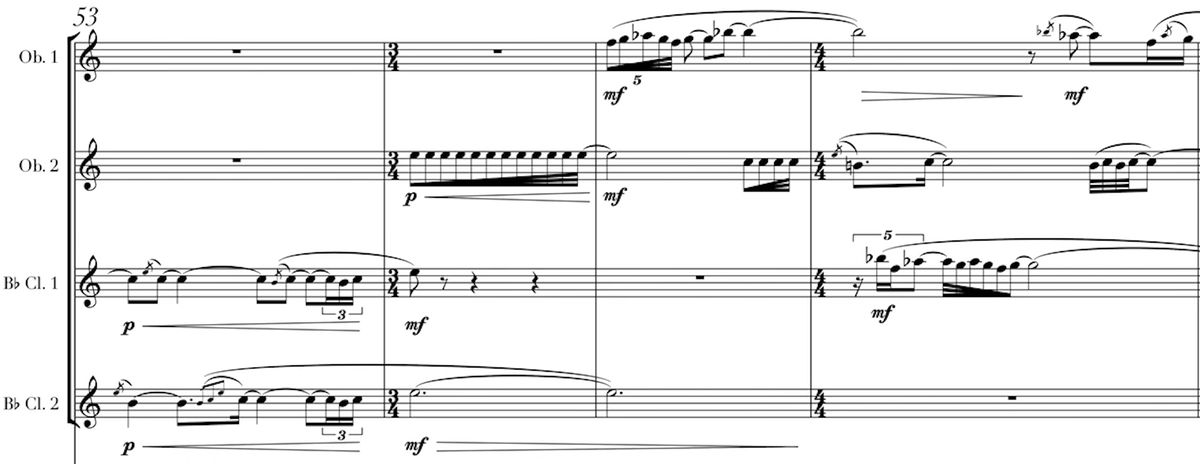
It's never all the woodwinds playing. It's always this cascading thing that happens.
Match the register of the resonance
Pedal markings like 1/8 and 1/4 would make more sense in a chamber music environment. In an orchestral environment, with 3,000 people in the hall, you're not going to get those subtle differentiations. So I just tried to mimic the sound of the resonance.
When you think about resonance, you have to think about register a lot. The original is very high, so it doesn't make sense to have the resonance in a low instrument like the timpani or the bass drum. Almost by process of elimination, I came up with the suspended cymbal, at pianissimo, all the way through.
One of my composition teachers told me many years ago that you're going to write things for the orchestra, they're going to be playing it, but it's not going to be heard. I thought to myself, what the heck does that even mean?
It's not going to be heard, but it's going to be felt.One of my composition teachers
That really changed how I approach resonance in an orchestra. The way that the air molecules are moving really changes if you have a suspended cymbal rolling, versus a bass drum, versus a tam-tam, versus nothing rolling in the background at all.
9. What came out of that little piece
Adaptation is to me a very underutilized skill set. I was able to win at least 3 contests for Kaman Fantasy: the EarShot readings, performed by the Columbus Symphony, plus Symphony in C and the Milwaukee Symphony. I also had it played by the Juilliard Orchestra.
Most of these calls for scores only accept 1 to 4 composers for their readings, and it's very hard to get better if you're only writing 1 or 2 orchestral pieces a year. If you're adapting pieces and sending them out at a regular pace, the likelihood that you'll be one of those composers goes dramatically up.
Just because you win a bunch of orchestral contests doesn't mean that you'll have opportunities to work with every orchestra afterwards. I haven't worked with 3 of those 4 since.
However, I worked with the Columbus Symphony many times after I had this piece played, because the conductor really, really resonated with the piece. He ended up having me commissioned to write 2 other pieces: Risala, and my Clarinet Concerto, which was premiered by the clarinetist Kinan Azmeh.
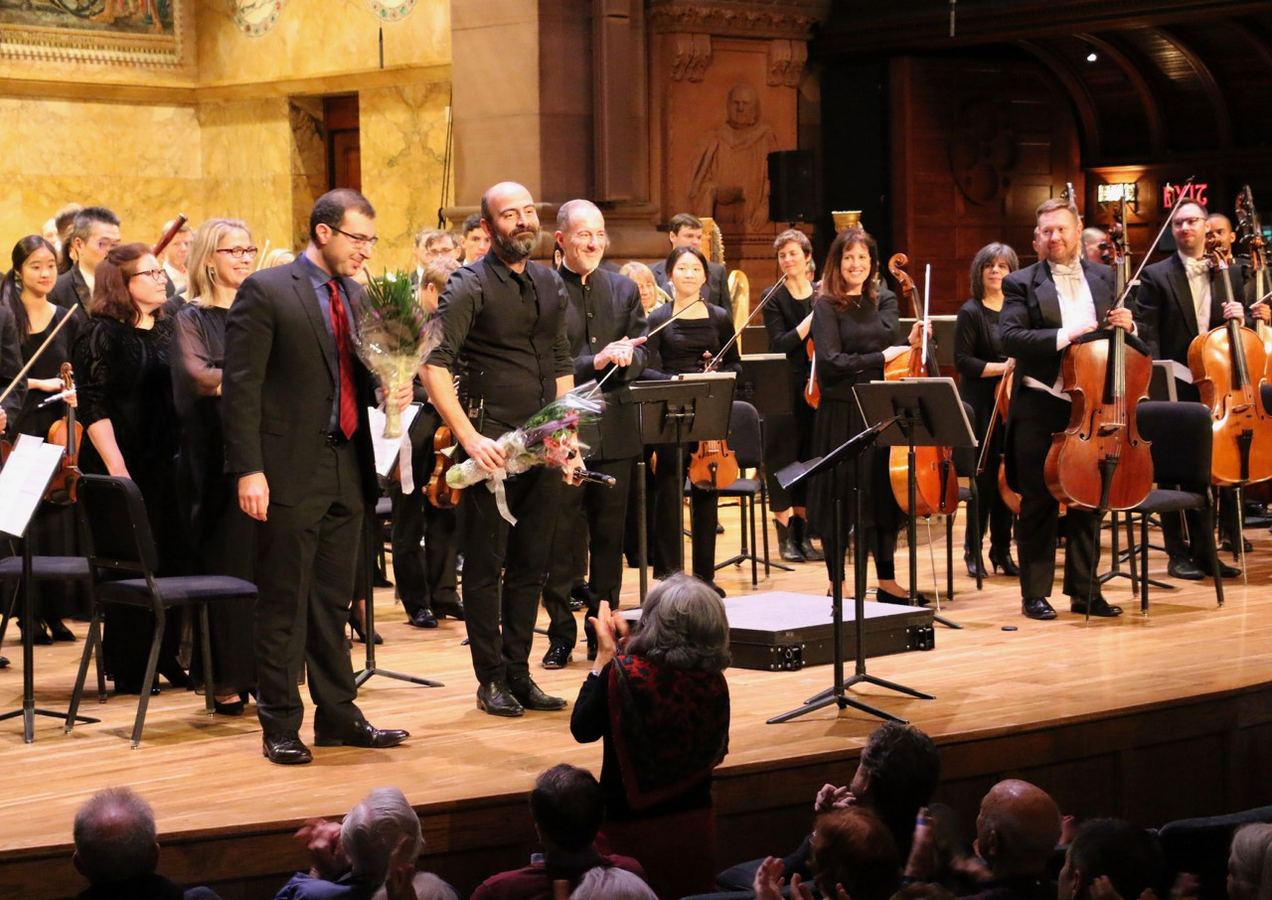
All of this came from just writing this little itty bitty piece for violin and piano, and trusting that I could come up with the types of sonic arguments that excite me as a composer.
What to do next
Pick a small ensemble piece you already have, and follow along with my free 3-step orchestration guide.