
Why a piano score won't work as is for string orchestra
The string section is one of the most misunderstood sections of the orchestra. I'll go over a few basic tenets of how a string section operates, and then orchestrate the opening of one of Chopin's piano preludes for strings.
 By Saad Haddad, composer
Here's the video this post comes from (22 minutes), or you can read it below.
- How a string section operates
- Where the players actually sit
- The setup of the score first
- The melody, and why I take off the slur
- The bass line, in octaves with the cello
- Leave room for the inner voices
- A slur on every 3 pitches
- The viola and second violin as a unit
1. How a string section operates
The string section is most often divided into 5 distinct groups: the first violins, the second violins, the violas, the cellos and the contrabasses.
At its maximum size, we usually have 16 first violins, 14 second violins, 12 violas, 10 cellos and 8 contrabasses. Big budget symphony orchestras like the Berlin Philharmonic, the New York Philharmonic and the Los Angeles Philharmonic all use string sections at about this size.
On the other side of the spectrum, the usual minimum number of string players is 5 first violins, 4 second violins, 3 violas, 2 cellos and 1 contrabass.
String section sizes can also exist in the middle of that spectrum. For example, Mishwar, or "trip" in Arabic, which I wrote for the California Symphony, uses 13 first violins, 11 second violins, 9 violas, 8 cellos and 6 basses.
As long as we have a descending number of instruments as we go from the higher pitched to the lower pitched instruments, we should have a well-balanced string section.
2. Where the players actually sit
We most often find ourselves in one of 2 situations.
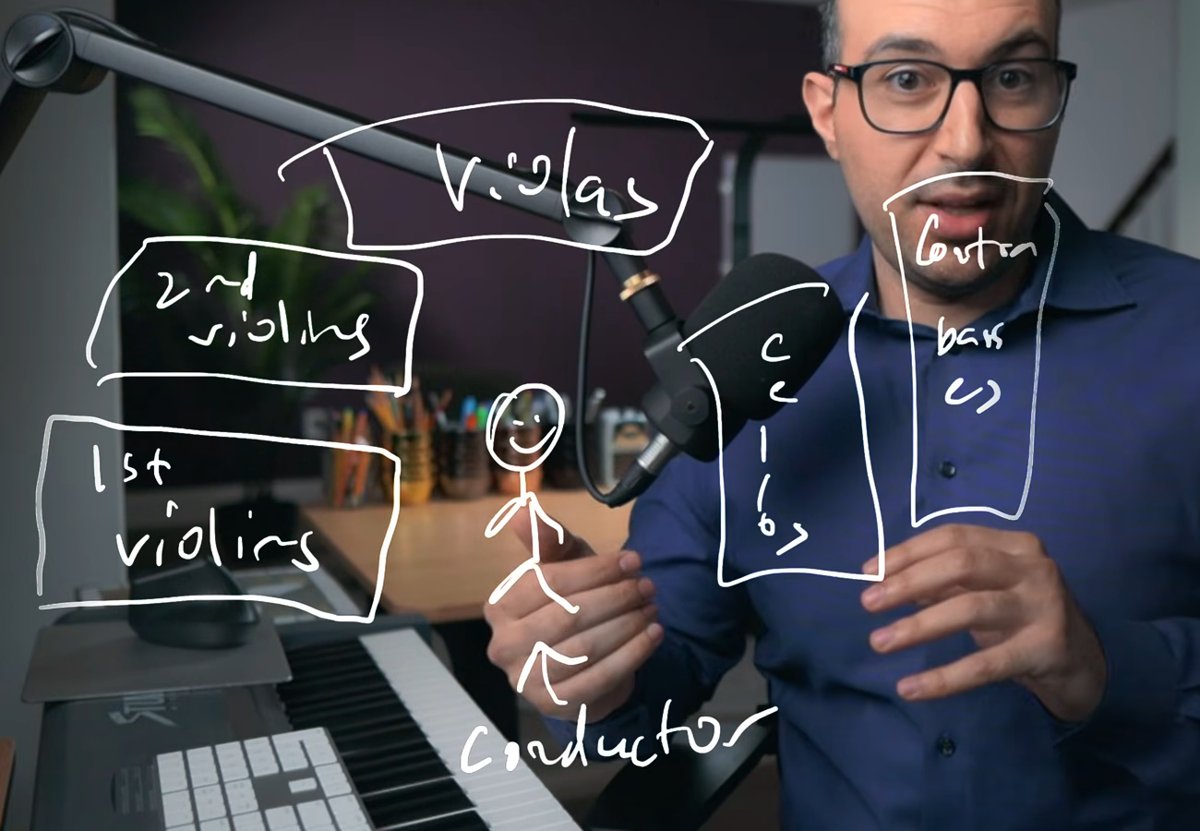
In the first and most common configuration, starting from the left-hand side of the conductor, the first and second violins are seated together. Right in front of the conductor are the violas, and to the right of the conductor we have the cellos. The contrabasses stand or sit on high stools right behind the cellos.
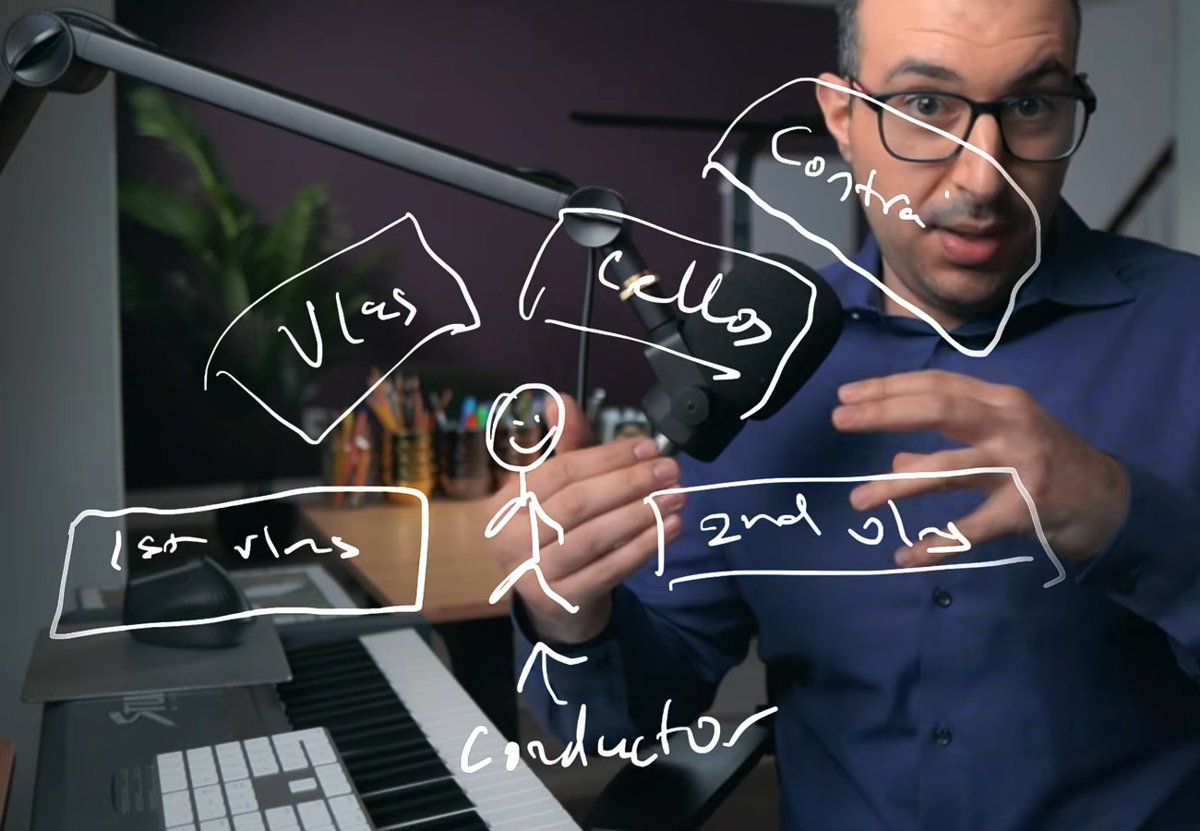
The second configuration features a more antiphonal setup, with the first violins seated on the left-hand side of the conductor and the second violins seated at the right-hand side. The violas and the cellos fill the gap in between, and the contrabasses would be right behind the second violins.
When I'm writing for an orchestra, I personally prefer to use the first configuration, because I find I get a more confident and in-tune sounding string complement with all the violins sitting together. But there are plenty of examples in the repertory that work well with the second configuration too.
Every pair of players shares one music stand
An often overlooked part of string writing is knowing exactly where the physical music stands are within each section. Typically speaking, every pair of players shares one music stand.
The concertmaster, or in other words the first chair player in the first violin section, shares their stand with the second chair player. The next stand is shared between the third and fourth chair players, and this pattern continues all throughout the rest of the strings.
The odd-numbered player is typically called the outside player, while the even-numbered player is called the inside player. This becomes important when there are moments in the music that call for divisi, and the players are tasked with dividing 2 simultaneous pitches amongst themselves. The way this typically gets solved is that the outside player takes on the top voice, while the inside player takes on the bottom voice.
The inside player also serves as the unofficial page turner of the pair, just in case you're wondering who tends to end up doing that job.
3. The setup of the score first
The task at hand is orchestrating the first couple of bars of Chopin's Prelude No. 9 in E major.
- 1Get a hold of the scoreYou can easily find it for free on IMSLP.
- 2Listen to a recordingWhile reading the score.
- 3Open up your notation software of choiceLook at the setup of the score first.
- ?What other things can we glean from the Chopin?The key signature, the time signature and the tempo.
From top to bottom, write out violin 1, violin 2, viola, violoncello and contrabass. It doesn't matter if you have the full string section like you do in the New York Philharmonic, or a very small string section like you would maybe on a film studio setup.
The important thing to notice is that we have a bracket on the very left-hand side between the first and second violins. The violins are notated in treble clef, the viola in alto clef and the cellos in bass clef. Note that the contrabass is going to sound one octave lower than what is written.
The key signature is E major, the time signature is common time and the tempo is Largo e grave. I even put a bpm at the very top: quarter note equals 50. That seems nice and slow.
4. The melody, and why I take off the slur
The melodic line in the piano, although it's notated in bass clef, is actually within the range of the violins. The violin's lowest note is your G below middle C, which is also the lowest string on the violin.
I want to make sure that I have my dynamics in, so that's going to be forte. The next thing I want to do is figure out what is going to be the articulation.
I find that a lot of people put this at the very end, and I don't really understand why. I feel like we really need to know what the character of each of these lines is going to be as we're writing them.
I don't like to wait until the very end to put all these things down.
What a big slur tells the player
When I heard the pianist play this line, I heard kind of a more heavy feeling. So I want the notes to be very heavy and connected, but not slurred.
A big slur mark like what Chopin did is not really a thing that violinists or any string player does. When you notate a slur like this, you're telling the player to take their bow and continue playing in one direction over the entire slur.
When you have this first note B and then the next note B, you're not really going to get an articulation when you get to that second note. The way you get that articulation is by changing bow. So I need to take off the slur completely.
A couple of instructional words
Instead of doing any kind of articulation, I just put a couple of instructional words here so the violinists know exactly what to do. Legato just means connected, "e" is "and" in Italian, and pesante means heavy.
It drives home the fact that I want this to be connected, as well as have a heavy stroke every time they play each of these notes in the melody.
5. The bass line, in octaves with the cello
It feels fairly obvious that the bass line should go in the contrabass part first. Notice how I'm putting these pitches one octave higher than what we see in the piano. That's very much done on purpose.
When the contrabass players are playing these pitches, you're hearing them down one octave. So when you want to write a pitch for the contrabass, always think, okay, I've got to write one octave higher in the staff itself.
I take the same forte, legato e pesante, and copy and paste that here. But when I get to this doubly dotted eighth note, I don't really want to have that 32nd note re-articulated that fast. That seems to be a little bit messy, just changing the bow that quickly.
So now I'm going to actually utilize that slur. The G sharp is underneath one bow along with the A, and it's going to be a lot more smooth than if I just articulated these 2 notes separately.
Typically speaking, you're going to want to hear the contrabass in octaves with the cello, especially in a very functionally tonal passage such as this one.
When I copy and paste the contrabass line to the cello line, you see it down an octave from where you see it in the contrabass. This is actually going to be the same exact sound. When I put this up an octave from where you see it, it's going to be in octaves with the contrabass.
6. Leave room for the inner voices
Now that we've finished with these 3 lines, I'm starting to see a problem. Look at the inner voice in the Chopin. We have E, B, and then E. If we kept this B at this octave, it crosses into what the cello is doing, which I don't really want to do.
So I'm thinking about taking the cello and contrabass lines down an octave, so that I can leave room for these inner voices to flourish along with this first violin melody.
Up a minor second to F major
I take this entire thing that's in E major and transpose it up a minor second to F major. Then I take the line in the contrabass and the cello and move it down an octave.
Now we have a C in the cello line, which is within the range of the cello. If I didn't transpose it up a minor second, this C would be a B, which is not possible on the cello.
Normally speaking, in the double bass, we would have E, A, D and G as your 4 strings that are open on the instrument. But most string bass players in professional orchestras are going to have the C string extension, so we can get down to this very low C.
On the viola, the C is going to be the lowest possible pitch, so if we kept the inner voice at pitch, we couldn't get the B. And the F sharp in the second violin would not have been possible if I left it as is.
So transposing is a really good thing to do, especially when you're orchestrating for strings.
7. A slur on every 3 pitches
Now we can finally use these inner voices where they're seated in the original Chopin. The third voice is assigned to the viola, as triplets. I want to hear this back and figure out what the articulation should be.
I don't think it should be legato and pesante the same way the others are. So instead, I experiment with putting a slur on every 3 pitches, and that way I can get a more connected sound across the triplets.
You don't need to do it exactly like this. Another possible way to do it is bowing across 6 pitches, so don't think that there's only one way to do this.
8. The viola and second violin as a unit
Now we run into a problem. In the Chopin, the third voice, which we assigned to the viola, has a B which isn't reciprocated in any way in the second voice. So first I just write it as is, and leave a rest because there's nothing there.
I have to be honest, I'm not really that happy with the way this is laid out. You're going to have these 2 pitches playing together, then half the sound is leaving this inner voice when we get to this rest, which I don't want at all. And then we have another attack here, and then another attack right here.
To me, it seems like this viola and second violin part should act more as a unit, like it does in the piano part.
The first thing is, do we want the first note of the triplet to be longer, so it's a quarter note and then an eighth note? That's one thing that we can do. I copy and paste the forte, legato e pesante into both parts so we can keep it consistent. That's one way to do it.
Ignore this second note entirely
The other thing that we could do is just ignore this second note entirely, delete the triplet and put the A as a quarter note.
This avoids having the second violin bow against what the viola articulation is. I actually kind of prefer this, because there is a unified bowing action happening between the second violin and the viola.
I really like this because it helps make sure that the first violin melody stands out above what the inner voices are doing.
What to do next
For your own orchestration, start with my free guide to orchestrating your piece in 3 steps, and then read what 21 orchestras taught me about writing for orchestra.