
What 21 orchestras taught me about writing for orchestra
After performances by 21 orchestras around the world, I can tell you it's nothing like most composers expect. I'll walk you through 6 lessons that I've learned about writing for orchestra, from how to write so your piece doesn't fall apart in rehearsal to why a piece's second performance often comes down to who's sitting in the hall on the premiere night.
 By Saad Haddad, composer
Here's the video this post comes from (15 minutes), or you can read it below.
- Find the simplest way to notate an idea
- You don't have to start from scratch
- Push the envelope on one specific thing
- You never know who's going to be sitting in the audience
- Make your score and parts publisher-ready
- What happens after that first performance
1. Find the simplest way to notate an idea
This first lesson is about walking into rehearsals for your orchestral pieces and getting the maximum effort from the musicians, from the music that you wrote for them.
Even though we've written some music that came out of our head and onto the page, there are probably ways to re-notate it so that it's simplified for both the conductor and the musicians performing it.
It just completely fell apart
I'll give you an example. I have a piece called Kaman Fantasy that I re-orchestrated for a full orchestra. There was a section in that piece that was written in a crazy, Stravinskian time signature. It was something like 6 + 7 over 8.
In the original, it works really, really well. But when I tried to do the same thing for orchestra, at that first performance, it just completely fell apart.
When I re-orchestrated that for the second performance of the piece, I kept it in a very simplified time signature. I believe it was 3/4 that I used. And I was able to change where the accents landed.
It just completely fell apart
The piece just came together
The piece came together almost immediately, with the same exact music, just using a different time signature.
I was thinking of the piece in a more complex way that was more true to the original ideas of the music. But if I wanted a better overall outcome for the performance, I had to simplify things a bit more. This can happen with the rhythms, the meters, the orchestration itself.
That's the norm
There are so many different ways to make sure that the piece will sound its best with limited rehearsal time. And when I say limited, I'm talking about a maximum of 1 hour throughout an entire week of rehearsals.
So, as composers, we need to find the simplest way to notate an idea so that other people can realize it to the best of their abilities.
2. You don't have to start from scratch
My entire view about how to compose an orchestral work has completely changed over the years.
When I wrote my piece Aysheen for the Los Angeles Philharmonic, instead of starting from a completely blank slate, which is what I'd often be doing with my other pieces, I decided to borrow specific musical parameters from existing pieces in my catalog that I already enjoyed, and to focus on those moments alone.
Borrow specific musical parameters
Aysheen is all about breathing and heartbeats, and this idea of expressing the human condition, especially during the time of the pandemic.
I had written another piece during the pandemic called Aruah, a smaller work for octet. It had all these special effects that I was trying out for the very first time.
It had things like breathing. It had bow sounds on the wood of the string instruments. It had a crazy metal scraper, the kind that you use to wash the dishes, on a tam-tam to signify breathing sounds. I thought these would be really effective in a large-scale orchestral piece.
So instead of starting from complete scratch, I already knew that I had these elements that could fit into a larger orchestral tapestry. I was able to hit the ground running instead of spending months and months and months trying to figure out what I wanted to do.
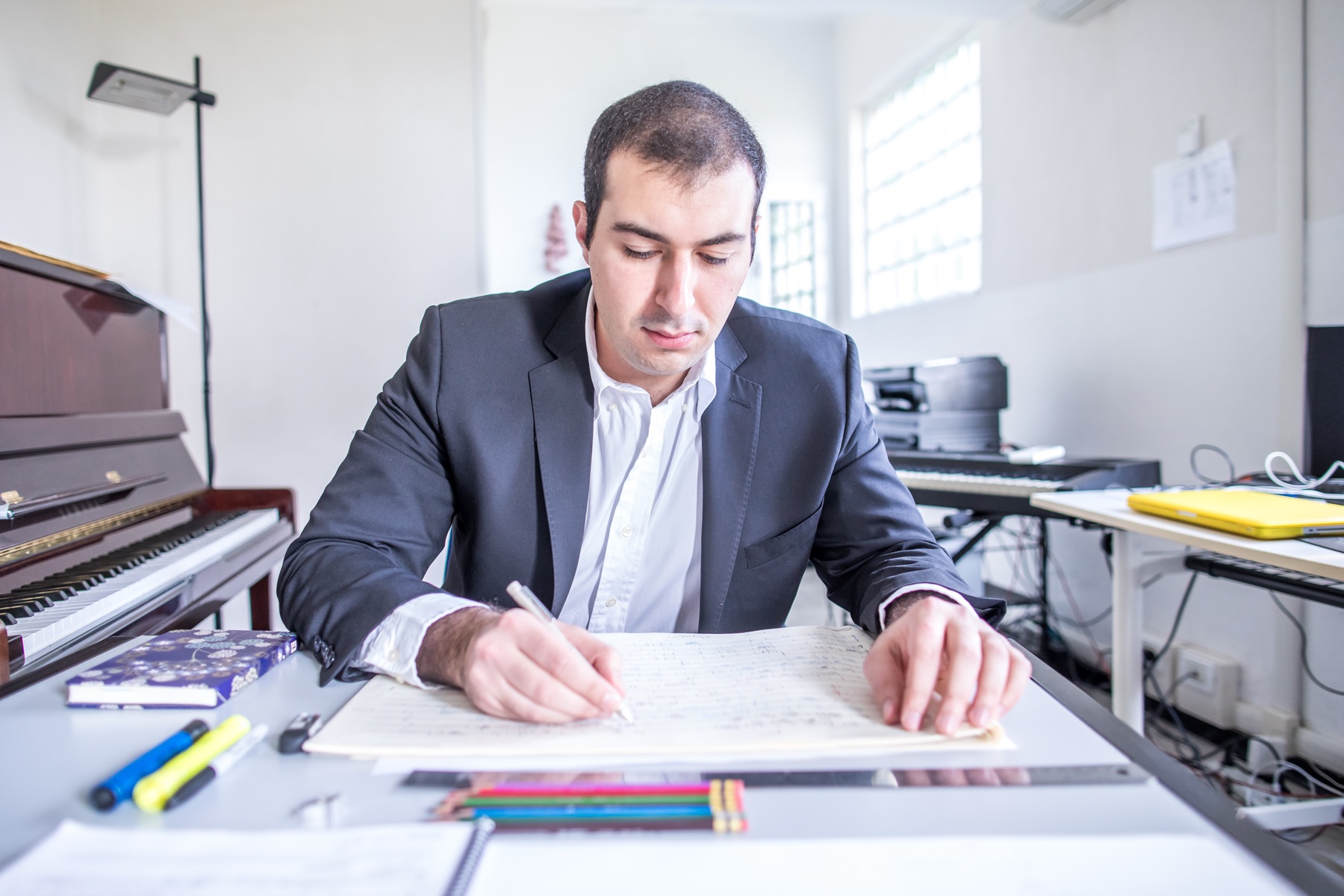
Adapt an entire existing piece
Another way that I do this is to adapt entire existing pieces that have already been performed, and that I already feel are a strong part of my aesthetic, into an entire orchestral piece.
Kaman Fantasy started out as a piece for violin and piano. When I adapted it, I took all the timbres, the melodies, the rhythms and the harmonies, and I used those elements as the skeleton for the entire piece.
The philosophy behind this is that we don't want to put too much pressure on ourselves to write completely brand new orchestral pieces from scratch. At the end of the day, they'll probably have just about an hour of rehearsal, with very few performances at the very onset.
At the same time, these pieces hold up to our aesthetic standards and our craft standards, because they're using elements from pieces that we've already done before and we're already happy with.
3. Push the envelope on one specific thing
This lesson is for those of you who want to push the boundaries of what an orchestra can do, which is the type of composer that I am, quite frankly.
If you want to do this, the best thing to do is to push the envelope on one specific thing, rather than on a bunch of different things that you've never done before.
Keep the new idea separated
In my Fantasia for Strings, a piece for string orchestra, I had this idea to have a dialogue between a microtonally infused string quartet and a very tonal string orchestra. Then at some point in the piece they collide together, where you get the microtonal shadings on top of the tonal orchestra.
I was thinking to myself, well, it would be really great if the orchestra itself could also play the microtones.
But for me, the new thing was this juxtaposition of these microtonal chords and these tonal chords. So I should try to keep these ideas as separated in the orchestration as possible, so that I'm not getting bogged down in issues that I've seen happen in the past, where I tried to incorporate a lot of microtonality in the full orchestra.
- 1A dialogueA microtonally infused string quartet with a very tonal string orchestra.
- ?Should the orchestra also play the microtones?It would be really great.
- 2Keep these ideas as separated as possibleSo that I'm not getting bogged down.
- 3They collide togetherMicrotonal shadings on top of the tonal orchestra.
Whether you're into microtonality or not, that part doesn't really matter. If you're trying to do something that you've never done before, it's best to incorporate those ideas slowly in a piece, rather than trying to do that and something else and something else.
Have one fire that you're putting out
When we try to incorporate too many new ideas, especially in a big orchestral piece, what ends up happening is that you go to the rehearsals and you're putting out a lot of mini fires, instead of just one solid fire that you knew would most likely exist when you wrote the piece.
So try to have just one fire that you're putting out throughout a rehearsal process. With lots of little mini fires, inevitably there are still going to be some fires burning, not even just embers, by the time you get to the performance. And most likely you won't be happy with the end result.
4. You never know who's going to be sitting in the audience
The orchestral landscape here in the United States is heavily unionized. Whether it's the LA Phil or the California Symphony or the Princeton Symphony, whether it's a regional or a big professional orchestra, they're mostly unionized.
What that means is that when you get the recordings back, you're not allowed to share them publicly on the internet. You're not even technically allowed to share them with your friends.
So the music isn't shared through the normal means that we have today. A lot of these pieces end up getting shared through word of mouth.
None of that is allowed
They want to have that piece played more
From Milwaukee to Beijing
I'll give you an example of this. Years ago, I had one of my pieces played by the Milwaukee Symphony. There was a magazine editor named Frank Oteri, a great guy, so knowledgeable about not just classical music, but literally every kind of music out there.
He heard my piece in the audience and, for whatever reason, it struck a chord with him, no pun intended. He invited me to have another orchestral piece featured at the Beijing Modern Music Festival, where it was played at the Forbidden City Concert Hall.
- Milwaukeeone of my pieces played by the Milwaukee Symphony
- In the audiencea magazine editor
- Invitedanother orchestral piece
- Beijingthe Forbidden City Concert Hall
That was the first time I ever had one of my big orchestral pieces performed out in Asia. So you never know who's going to be sitting in the audience.
5. Make your score and parts publisher-ready
You need a publisher-ready engraving presentation of not just your score, but also the parts to the music that you're writing for an orchestra.
A lot of composers complain about this. They're always thinking, why do I have to also be my own copyist? Why do I also have to engrave my own music? That's not my job.
The reality is, especially when you're starting out, or even as an early-career or mid-career composer, a lot of composers are engraving their own scores and parts. It becomes kind of a point of pride, myself included.
You get a really intimate look at what the performers of your music are seeing physically when they're performing it. It gives you that sense of collaboration with the musicians that's hard to get any other way when you're writing for the orchestra.
Cues in all the parts
Cues are these little tiny notes in the music that happen before an entrance. Let's say you're a trumpet player, and you have 50 bars of rest.
For you to be confident in your entrance, it's really important that before it, there are cues that show a nearby family of instruments playing something that you'd recognize, so that you know when you're supposed to play.
Percussionists, maybe infamously, kind of sit around for a while before they play, so this is really important for them too. And it's important for every single family of instruments, from the woodwinds down to the brass, down to the percussion, down to the string players.
Really good page turns
Orchestras are not like chamber ensembles or soloists. Soloists and chamber ensembles nowadays tend to perform on tablets like the iPad, where page turns are not really that much of a concern. In the orchestra world, it's much, much more common to have traditional paper scores and parts.
I've often seen rehearsals literally stop because the librarian has to find out that a page turn is not going to work, and whether there's a way to insert another page in there mid-rehearsal. It really slows down the pace of any rehearsal process.
So make sure that you print out the parts yourself and go through them. It's so, so crucial.
- 1Print out the parts yourselfPaper scores and parts are much, much more common.
- 2Go through themIt's so, so crucial.
- ?Is that page turn going to be a problem?Do they have enough time to turn the pages?
- 3A rest or a cueIs there one that they can do?
Especially when you get to the orchestral level, the scores and the parts have to be presented in a very professional manner. And you don't need a publisher to do this for you. Composers have been doing this themselves for dozens and dozens of years.
6. What happens after that first performance
What happens to that elusive second, third, fourth performance that everybody is always craving from their orchestral music?
From my own experience working with all of these orchestras, the highest chance of your music getting played after that first performance is if the conductor really, really not only appreciated the piece that you wrote, but also the human collaboration that you had.
It often just takes one performance
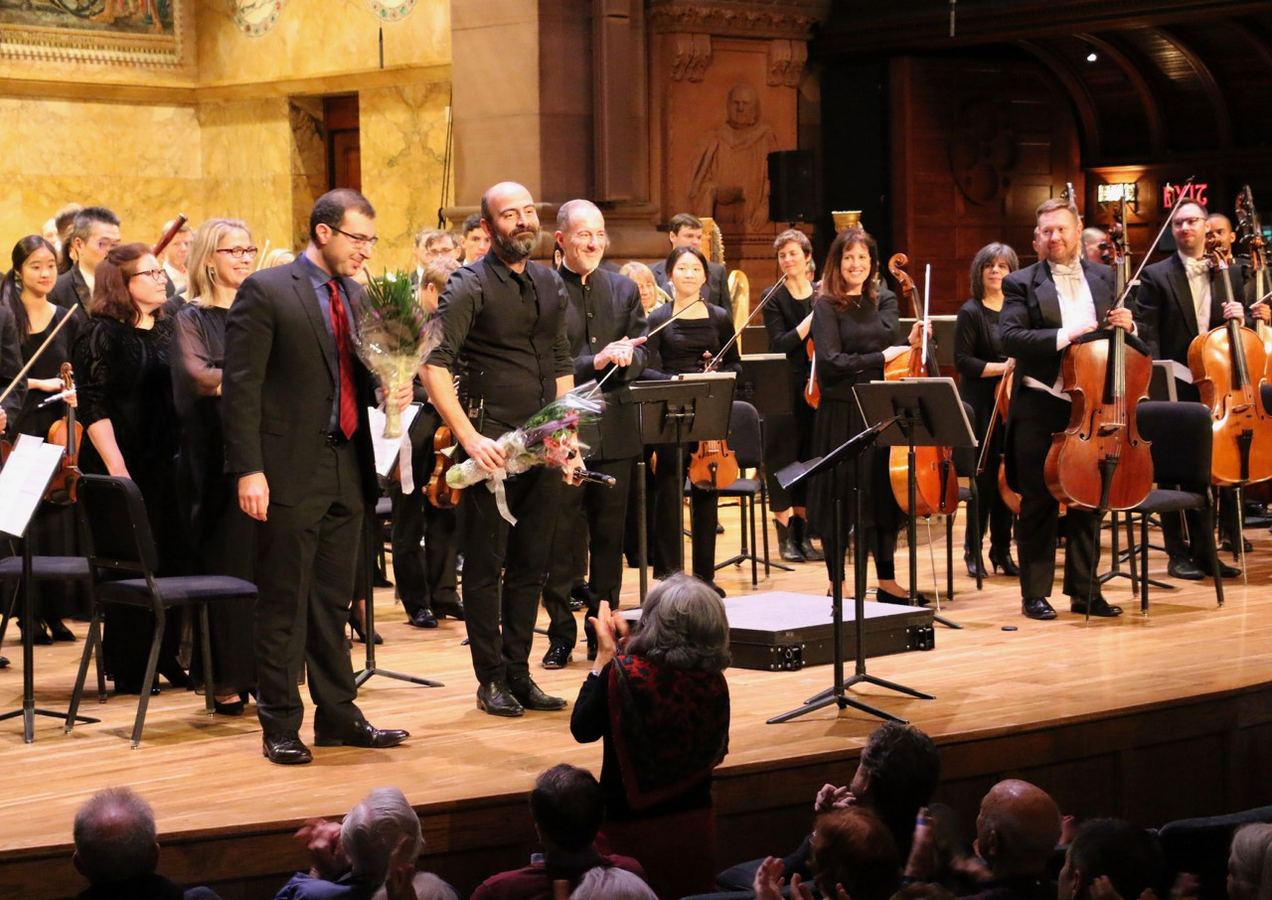
In my case, I worked with a conductor named Rossen Milanov. The first piece that we collaborated on was with the Columbus Symphony, out in Ohio. I remember that after playing that piece, he took me aside immediately and asked if I'd like to have a commission. Of course, I said yes, because who wouldn't want a commission with a professional orchestra?
After that commission happened, he asked me again:
"Hey, do you want to do another commission? And this time, can we do it for something a bit larger?"
Which ended up being my Clarinet Concerto. It was premiered by the Princeton Symphony.
You're prepared for that opportunity
This kind of collaboration with a conductor often just takes one performance. Is it going to happen with every conductor you meet? No.
But the idea is that you build up all of these skills to such a point that when an opportunity like that unfolds, you're prepared for it. When you're asked to write a commission, or to have a performance of another piece of your music, you're ready to go.
What to do next
To fully implement these 6 lessons, you need a foundational understanding of the art and craft of orchestration. If you want my 3-step process for how I orchestrate any piece of music, start with my free orchestration guide.