
How to write a melody and develop it over time
We as composers put a lot of pressure on ourselves to write a catchy or memorable melody. It's not necessarily the case that you have to create one for your piece to have legs. Here's the specific way I think about melody, and the exact tools I use to write a melody and then develop it over time.
 By Saad Haddad, composer
Here's the video this post comes from (97 minutes), or you can read it below.
- Start with the melodic pyramid
- Write a tone row, your 1% inspiration
- Play around with the prime form
- Use sequences, but don't abuse them
- Don't be afraid to change the intervals
- Humanize it with embellishments
- Dynamics are not an afterthought
1. Start with the melodic pyramid
I want to broaden our scope first of what a melody is, before we get into how to actually formulate a melody.
Leonard Bernstein has a very specific way of talking about melody, which is a way that I think about melody all the time. I really like his idea of differentiating between a melody, a tune and a motive, and his idea that a melody can be an inner line or a bass line.
This leads directly into the melodic pyramid, a kind of hierarchy that I created over the years.
At the very top is the motive. A motive is a very, very small set of notes, like the Jaws theme or Beethoven 5. It's just a small little fragment that recurs in a piece of music.
The next thing is the tune, which is usually what we think of when we think of a melody. A tune is singable and complete in itself, with a beginning, middle and end.
On the very bottom is what I call a melody: any number of successive pitches occurring in time, no matter how long or how short that set of pitches is, no matter how singable it is, no matter if it sounds complete. Not all melodies need to be a tune.
What am I doing in this moment?
When you think of a melody in terms of this kind of hierarchy, it becomes a lot simpler to figure out what you're trying to do in a particular moment in your music.
When you have it set up like this, a lot of clarity starts to happen, and it puts less pressure on you over what to actually create in terms of a succession of notes.
2. Write a tone row, your 1% inspiration
One of the ways I love to create a set of notes is by using a tone row. These things get a bad rap. They're usually associated with dodecaphonic music, in other words 12-tone music. But tone rows can be applied to any aesthetic that you may want to compose in.
In composing the tone row for this lesson, first of all, I thought of a scale. I wanted something that starts on C, kind of in C minor land. Then I thought, I want to include a lot of seconds. Then I thought, I also want to include some big leaps, so I included a minor 6th and a minor 7th.
I was trying to create a set of intervals that were kind of balanced. I didn't think of anything that was memorable in any way, and I wanted something a little longer than a motive.
The thing we have to do first is create a set of notes like this that we're happy with, that we can build off of. This is the inspiration phase. There wasn't really a rule for me to figure out these pitches.
If you don't know where to start
You can start from a scale and build the tone row off of that. Or you can start from a piece of music, and choose a tone row based on a part of a piece that you really like.
From here on, I'll call that set of notes the prime form: the main melodic idea that you come up with.
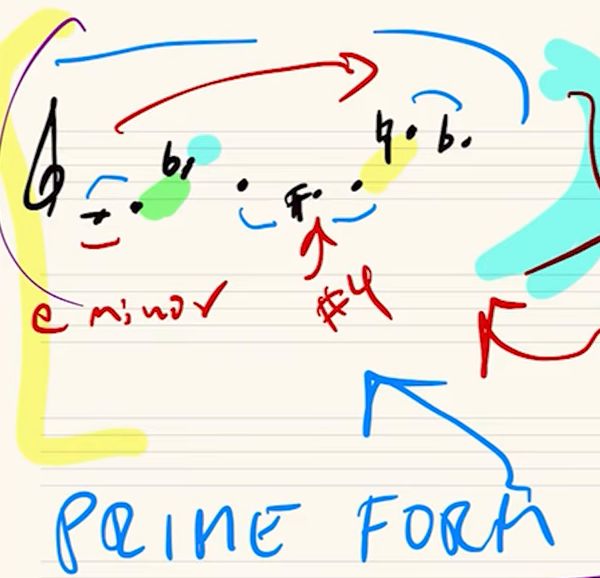
3. Play around with the prime form
After coming up with the prime form, what I really like to do is try to offload as many of the mental operations that we have as composers when it comes to figuring out what to do with the melodic idea.
Transposition
One of my favorites is transposition. This is the process of shifting pitches up or down to a different key while keeping the same intervals and melodic shape.
It's really hard to sit there and come up with, what does this sound like in F sharp? What I prefer you do is start writing down the transpositions by hand, so that you have them in front of you and you can access them without having to think about it.
I'm not necessarily coming up with something from scratch. I'm seeing the things that are already here and trying to find connections.
For example, I wrote out 2 transpositions, stopped the prime form at its first G, and looked for a G in each of them. I found 2 spots to change on a dime, options that I might not have thought about before, and they're related to what I already created.
Retrograde
This is a technique where a melody is played backwards, starting from the end and going to the beginning. The pitches remain the same but are in the reverse order.
With this specific tone row, the shape completely changes. Instead of going up like the original does, the retrograde goes down. There might be a moment in your piece where you want the shape to go down somehow. Am I going to create a brand new melody, or am I just going to take what I already have and put it backwards?
You don't need to use the entire prime form, either. I might just really like the last 3 notes of the retrograde, and that might be all I want to use in that particular part of the piece.
It's all about creating these situations where your brain can recognize things that you didn't see before. And that to me really is the heart of composition.
Inversion
This is a technique where a melody is flipped upside down, meaning that the direction of each interval is reversed.
My prime form starts by going up a major second, from C to D. In the inversion, we take that same exact interval and go the opposite way, from C down to B flat. Then you just keep going.
It's different, but there's something about it that's still similar. That's the beauty of using these techniques.
Retrograde inversion
This is a technique where a melody is both flipped upside down and played backwards. All you have to do is reverse the inversion. With my tone row, it probably sounds the most far away from the original prime form.
Modified
Modified is really any combination of the things we talked about and, I think even more importantly, flipping on a dime in the middle of one of these forms. It doesn't adhere to any strict procedures.
You can take any of these forms, then at a certain point jump to another form, transpose it, and so on. Before you know it, you have many seconds, many minutes of music that use just these sets of techniques.
Once you know these things are options, this becomes almost like an improvisational flow state. The only way to internalize them is if you're practicing composing. If you're just starting, I suggest a couple hours a day.
4. Use sequences, but don't abuse them
Sequences have been around for hundreds of years. But oftentimes when we're in the thick of writing, we forget that these things are at our disposal. They can be a really simple way to take something you already have and immediately vary it.
Exact sequences
This is a technique where a melodic pattern is repeated at a different pitch level, maintaining the exact intervallic relationships between the notes.
You don't need to start from the beginning of the melodic idea. I started on the third note of my prime form, because I like this little turn that happens there.
Then I decide which pitch I want it to be repeated at. In my inner ear, I kind of wanted the top note to be D next, so I went up a major third.
Sequences are really good at creating motion. They ramp up in tension, and then we want to resolve.
Usually I don't do more than 3 of these in a row. You can do more, but what ends up happening is you get on this merry-go-round of sequences that's really hard to get off.
So I like this idea of just having 3 and then getting on an off-ramp. Composers like J.S. Bach do this a lot. My off-ramp was going back to the prime form in retrograde, because there was a common tone.
Modified sequences
This is a technique where the original melodic pattern is repeated at a new pitch level, but some of the intervals or rhythmic patterns are altered slightly. A modified sequence is more flexible and allows for small changes.
I took the first 4 notes of the prime form and went down by a major second. Listening to it, I thought, I really would have liked to have it be in more of a melodic minor mode. Using an exact sequence, I can't really do that.
So do we just say, "It's an exact sequence, we can't modify it"? No. If I'm hearing that melodic minor sound in my head, why don't I just change that note? So I changed a B flat to B natural.
Now we have this interesting kind of crunch happening in the melody, with B flat at the top and B natural at the bottom. It adds a little bit of tension.
I kept going and ended on the tonic. Now I have a complete melodic phrase that has a beginning, middle and end. Once you assign rhythms to it, you could even say it could possibly be a tune.
5. Don't be afraid to change the intervals
What else can you do within that set of notes to vary it throughout a piece of music?
Expanding intervals
This technique involves creating larger gaps between certain segments of a melody. As a thought experiment, I asked, what if I kept the small intervals, but made the large intervals even larger?
I expanded just 2 intervals. It has a lot of similar qualities, but now I have a major third which gets revealed. We never had a major third before.
Do I know if it's something I like? I have no idea. But at least I'm moving a little bit farther away from the initial prime form, so I can figure out ways of developing the melody throughout my piece.
Contracting intervals
This is exactly like expanding intervals, except that this technique involves creating smaller gaps. Just for fun, I did the opposite. I contracted the small intervals and kept the big intervals, using quarter tones, a language that's closer to my own aesthetic.
What we created is almost like a shadow of the prime form.
Changing a few intervals here and there, even if you didn't initially hear them that way, may surprise you. You might even come up with a brand new prime form.
By this point in the video, I'd been talking for over an hour, and I hadn't gotten a second of writer's block.
6. Humanize it with embellishments
Not every single piece of music you write is going to have embellishments. But if a melody is just plunking out notes, it can get very robotic very quickly.
Adding things like trills, grace notes and glissandi really helps to what I call humanize the music that you're writing, especially if it's music that you'd like to get played by a real player at some point down the line.
Trills
These are rapid alternations between 2 adjacent notes, usually a step apart. But you can have trills with really any interval. Trills can also help morph the melody into a harmony or into a texture, and vice versa.
Grace notes
These are very fast notes that occur either right before or right on the beat. It's a very quick turn, and it's less pronounced than a trill. If you want the grace note on the beat, it will need to be specified in the music.
Glissando
This is a smooth and continuous glide from one pitch to another. With my prime form, I could see a glissando happening between the large intervals. It adds a singing quality, and a little bit more emphasis on the high note.
Vibrato
This is a slight and rapid oscillation in pitch, used to add warmth, expression and richness to a sustained note. It's easily forgotten, because it's usually added at the very last step by a performer. If you want something a little more than what they would normally do, I'd notate it.
You can attach any of these embellishments to any of the other forms. Just don't overuse them.
7. Dynamics are not an afterthought
You have no idea how many times I've seen students' scores where they're writing something and they don't really know what to do with that melody. I simply ask them, "Have you tried repeating it softer?" They look at me like I'm crazy. Then they try doing it and say, "Actually, that's all it needed."
Another thing I ask is, "Have you thought of the dynamic level at all?" Oftentimes I get a blank stare and, "No, I do the dynamics at the end." I think this is a crucial mistake. If you put that all at the end, you're not helping yourself in determining the structure of the piece.
Dynamics are not an afterthought.
How loud or soft something is is a very visceral thing. We as humans immediately perceive it. If it's too soft, you get to the edge of your seat and say, "I can't hear that. Let me get a little closer."
- Repeatmelodies at different volumes
- Subitoa sudden change in volume
- Gradual changeincremental increase or decrease in volume
If the whole thing is mezzo forte, it's very flat. But if I do the whole thing in piano, and then the second time in forte, it completely changes the character of the music.
Give dynamics a chance, and do it early on in the process, so that it can affect later decisions you make while you're creating your piece.
Use these one at a time
Each one of these things by itself is obvious. The main thing is that when you're composing, they become top of mind.
Don't try to do them all in one session. Do them gradually over time. I promise you that the creation and the development of your melodic ideas will get easier and easier.
What to do next
Melody is only one piece of the composing puzzle, along with rhythm, harmony and timbre. If you want a framework that pulls everything here together, grab my free guide to composing any piece in 4 steps.