
How to compose a piece of music in 4 steps
Ever feel totally stuck trying to get the music in your head onto sheet music? I struggled with that all my life until I developed a 4-step composing process, which helped me write works that were premiered by the LA Phil, Kansas City Symphony and International Contemporary Ensemble. Here's my entire 4-step process, step by step, on a commission I wrote for solo cello.
 By Saad Haddad, composer
Here's the video this post comes from (41 minutes), or you can read it below.
1. Pre-composition: 6 questions before writing the piece
My 4-step process looks kind of like this. We have this exponential curve that describes the start of our writing process and the end of it.
At the very start, we want to spend a lot of time in what I call pre-composition, which is setting up all the various parameters of how you're going to compose a piece. Then comes low-resolution composing, then what I call medium res, and at the very end, high-resolution composing, which takes us all the way to a finished score that we can present to a musician.
Why spend all this time on pre-composition? What I often find in my students is that they're not even starting from low res. They're starting from high resolution. In other words, they're writing out music from left to right without thinking about any of the previous steps.
They lose out on all the possibilities they could have had if they just slowed down a little bit and focused on these 6 questions before writing the piece.
Question 1: Why am I writing the piece?
I refer to this with my students as my North Star. What am I always shooting for when I'm writing any particular piece of music?
This piece has poetry in Arabic that talks all about a dad that is toiling. At the end, it shows that the dad is being appreciated.
This poem personally touched me. When I wrote this piece, I'd become a dad less than 2 years before and I was about to become a dad again. It also made me reflect back on my own dad toiling when I was younger, and me not really appreciating that.
Your why could be anything. But I urge you to think really personally and vulnerably about what your why is, because the stronger your why is, the easier it will be for you to go through this entire process. I guarantee you, you will get stuck a little bit if you don't have a strong why for writing the piece.
Question 2: Instrumentation
Mine is solo cello and narrator. This was a commission, so that was already given to me from the start.
If you're not someone that is being commissioned regularly right now, I urge you to pick an instrumentation that is a little bit more practical. Solo, duo, trio, quartet, something that you can get played a little bit more easily. If you start writing something for orchestra or wind ensemble without having an ensemble lined up for that, it'll be really hard to finish out these steps.
Question 3: Length
This commission is 1 minute long, so it's very, very short. For you, if you're writing a solo or chamber piece, I would try to keep it under 10 minutes, preferably somewhere near the 5-minute mark, because it will be easier to express all the ideas that you want to express in that time frame.
I don't even write that many pieces longer than 15 minutes these days. Commissioners don't ask for pieces that long as much, and I get to have more reps.
If I write a bunch of shorter pieces, especially for diverse instrumentations, I grow a lot faster as a composer. I get to know a lot more instruments, and I can potentially have a lot more performances and commissions of my music.
Question 4: Inspiration
What I mean by inspiration is not that you're going to be sitting at the window, just waiting for something to hit you. What I mean by inspiration is actually score study.
And what I mean by score study is taking 2 or 3 really specific pieces or influences of yours and being very critical with those pieces. Each one matches your why, the instrumentation or the length very closely.
This is a piece for solo cello, so the Bach cello suites are going to be one of my score study pieces. My other 2 are Giacinto Scelsi's chamber works, which are really centered on 1 note and little microtonal inflections of those notes, and Farid al-Atrash, an oud player that I really like, who has these really interesting ways of ornamenting figures.
- Cover the cello in an arpeggiated wayThe Bach cello suites
- Centered on 1 note, with microtonal inflectionsGiacinto Scelsi's chamber works
- Interesting ways of ornamenting figuresFarid al-Atrash
- Frank Zappa
- EDM
- Rock and roll
For you, they don't have to be scores per se, with sheet music. One of my students' big influences is Frank Zappa. Another has influences in EDM, another in rock and roll.
And I would urge you not to go crazy and identify 8 or 9 or 10 different scores to look at. If you keep it at 2 to 3 scores, that's going to give you enough.
Question 5: Form
You can think of form in a very traditional way, like sonata form, theme and variations or a rondo. You can also write basically left to right. I take a slightly different approach. I'm not married to it at all, but I like to have some kind of macro view of where I'm going to go in a piece.
Because this piece is based off of a poem, I analyzed the text, and what I noticed was the number of times it mentioned certain people. We have Baba, or dad in Arabic, twice, then me, then Baba twice again, then us, then your and you, which refers to Baba, and at the very end, we.
All the Babas are A and the other ones are B. It's the classic ABABAB form. We ended up on a very traditional form, but we did it by actually looking at the original source material.
And now that we know the length of the piece, we can guesstimate how long each section is going to be. We have 6 sections in 1 minute, so each one is just going to be 10 seconds. I can see how much material I need per section of the piece.
Question 6: How are you going to write this piece?
The how is our bridge to the second step. What we're trying to figure out is the musical techniques that we're borrowing from the inspiration pieces, and they should tie into the why that you established before.
Thinking about my dad, one word that kept popping into my mind was how steady he is, and how grounded he is. Steady, grounded, fundamental. When I think of these 3 words in music, I think of the perfect fifth. A lot of the Bach cello suites heavily use the perfect fifth too.
Another big thing was the use of microtones, these shades of pitches, which all relate to the harmonic series, something Scelsi uses a lot. For me, this connects to the why, because I'm not like my dad in these ways. I'm a messy individual.
Farid al-Atrash is using all these pitches in his music too, with different kinds of grace notes and a little bit of glissandi, which I want to use as well.
That's 3 different hows, all built up from the initial why question. Don't skip any of these. Try your best to go through all 6, so that when you get to the rest of the composition process, you'll feel motivated and inspired to finish what you started.
2. Low-resolution composing
What low-resolution sketching really means is that we're going to start thinking about 1 parameter at a time: melody, rhythm, harmony or timbre.
And the key thing is, please, for the love of all things holy and good in this world, do not think about all of them at the same time. That's where we're going to get stuck.
What parameter should it be?
It should be the one closest to your why, to what we already set up in pre-composition. For me, it's melody.
I'm writing for the cello, an instrument with 4 open strings: C, G, D and A. And for this piece, the perfect fifth is the interval that I'm most concerned with.
The first notes I'm writing down
Thinking about my dad as this fundamental, steady figure, it's obvious to me that the piece should involve the 2 pitches on the bottom, C and G. That's my first interval, a perfect fifth.
I also want to represent myself, this messy figure that didn't appreciate his dad until much later in life. So as a thought experiment, what if I'm represented by the 7th partial of the harmonic series? Based on C, that's B flat minus 31 cents, a B flat that sounds a little bit under in terms of pitch. Then I put a perfect fifth above that, F minus 31 cents.
With that B flat, I create what's called a neutral third, which in Arabic music is one of the really fundamental intervals. That's D flat plus 19 cents. I bring it back to my pitch set and write another perfect fifth above it, A flat plus 19. This one could represent my son, who was about to arrive when I wrote this piece.
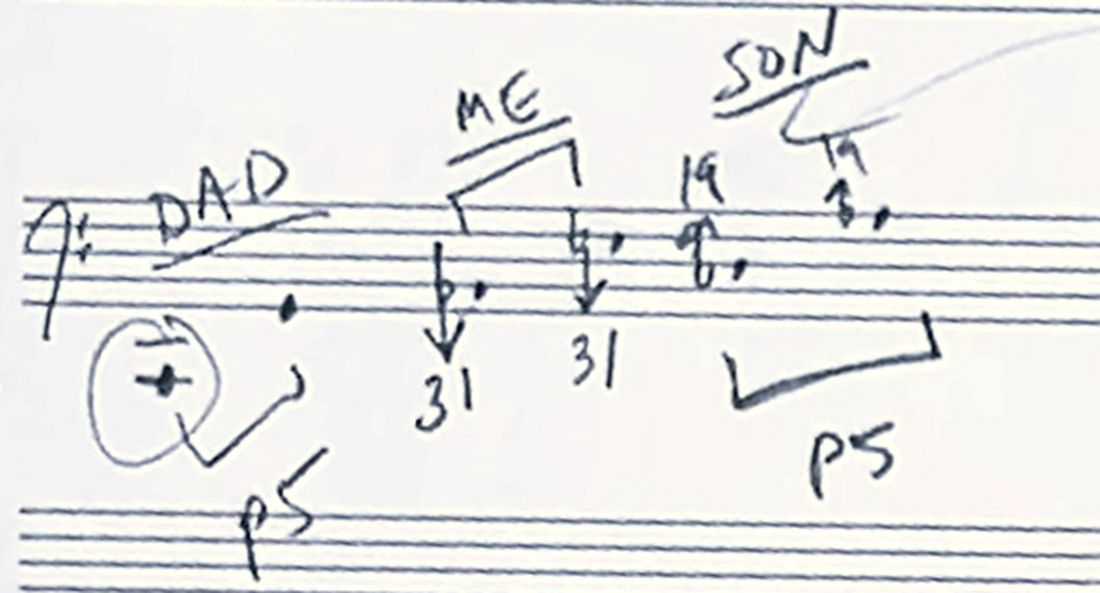
This is where the improvisation happens. It's not completely planned, but it's intrinsically related to everything I wrote beforehand. I have no idea what the rhythm is. And that's perfectly okay at this stage.
Then my mind goes to rhythm
The narrators in this case happen to be grade school children, so the cello part shouldn't have a very complicated rhythm going on. A lot of the Bach cello suites have very steady rhythms, so straight eighth notes could be a good idea to start out with.
Depending on the piece you're writing, just 1 or 2 of these parameters may be enough for you to get started.
3. Medium-resolution sketching
In medium-resolution sketching, I start combining things together so that I can have a fuller picture of the gestures I'm going to use, irrespective of meter. I take these pitches and these rhythms and just combine them: C, G in eighth notes, then my B flat minus 31 and my F minus 31. There's my first gesture.
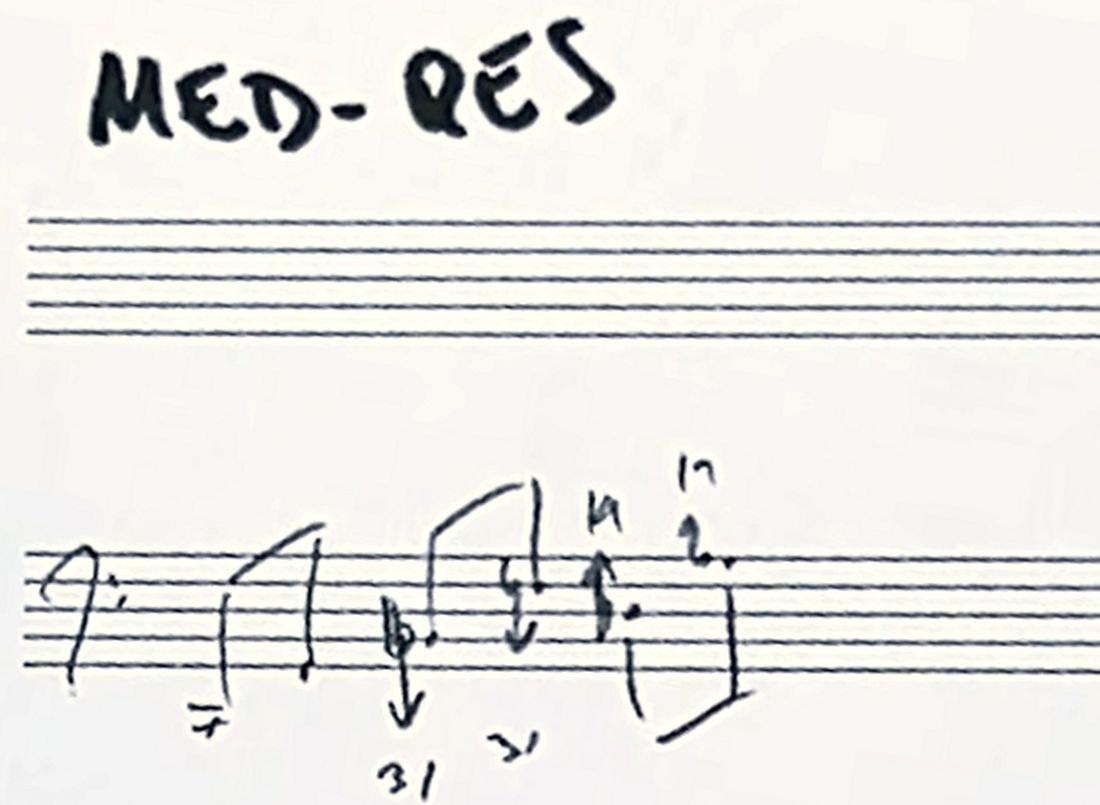
I would play these on the piano, or sing them, and try to hear these ideas in my head. I would hold off from putting things into Dorico or MuseScore or Sibelius at this point, because you get stuck into the program and what the program tells you to write.
- Play these on the piano
- Sing it
- Hear these ideas in your head
- Dorico
- MuseScore
- Sibelius
You get stuck into the program
Write out 5 to 10 different variations
A common thing I share with my students is the idea of a thought experiment. I started on the lowest string, the C string. The cello doesn't have much to go on the bottom, but there's a lot if I keep going up and up. So what if we started on the A string, kept the eighth notes and followed this exact same logic?
I'd recommend you do this a bunch of different times with whatever first parameter you did in your low res. Experiment with at least 5 to 10 different variations or versions of that, and don't stray too far off from what you did initially.
The reason we're doing all of this is so that later on we can develop the material in a simple and low-stress way. If you're trying to develop material without having the material already developed, then you're trying to develop it while you're composing out a literal piece. That's why it doesn't really work.
4. High-resolution composing
In the high-resolution phase, we assign everything to locations on staff paper and start making some decisions.
I write out the C, G little motive again, and I want a note to hold out. Remember the grace notes and glissandi from the pre-composition phase? I put a really short glissando that refers back to the B flat, and a grace note right at the beginning.
Then I add dynamics. I want to start really strong, like a sforzando, and diminuendo to basically triple P. I want it on the slow side, because I want to really hear all these pitches, so quarter equals 56. And I put 1 big slur.
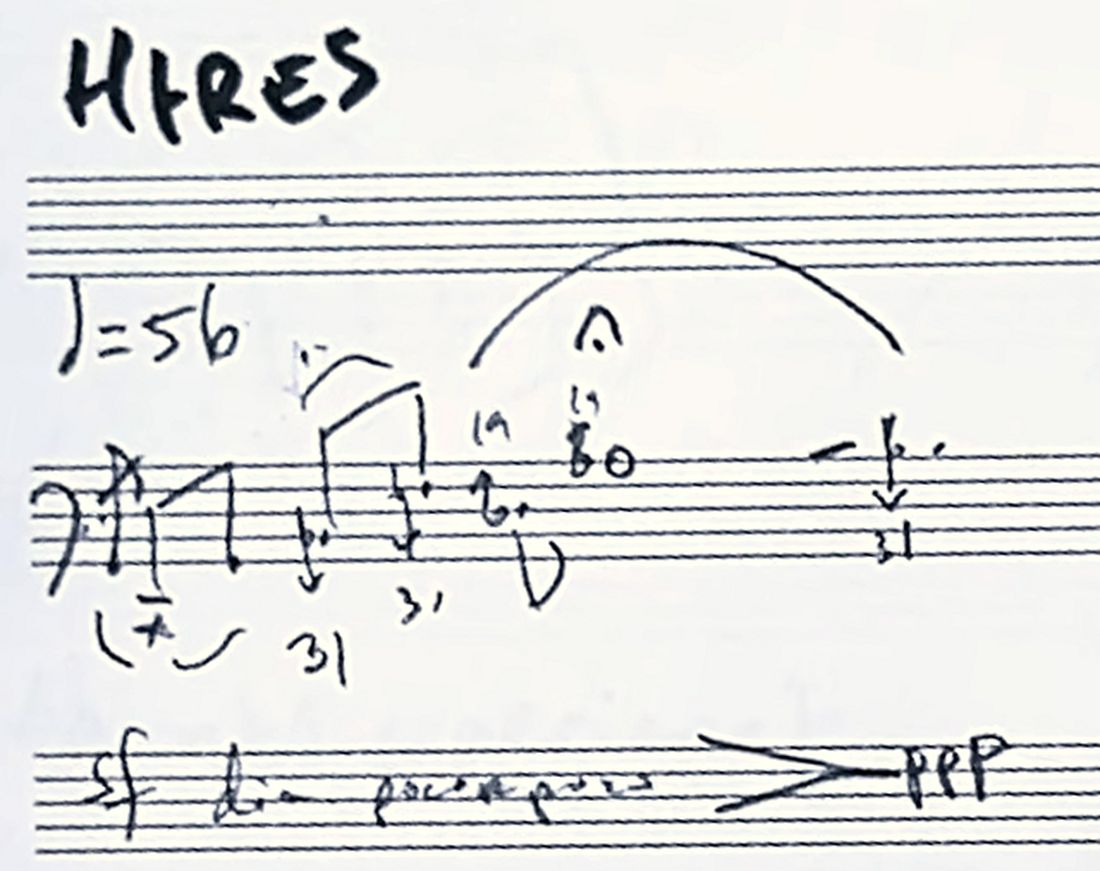
That's what we mean by high-resolution composing: we're getting to a state where the player really knows what they're playing.
I don't have any bar lines written out at this point. I don't like to put bar lines and restrict myself until the very end.
Then I want the gesture to happen again, but slightly different. Repetition is my best friend, by the way. It should be your best friend too.
It's okay if the process is messy
When I talk about a system, I don't mean that everything should be written out very strictly. I'm just saying that the more you have the pre-composition stuff, the low-res stuff and the medium-res stuff written out, the more you can make these decisions in real time, in a very organic way.
And the best thing about it is it makes it all sound like one unified piece, without scattered ideas.
What stayed the same and what changed
In the finished piece, that little gesture from the high-res sketching pretty much stayed exactly the same. The form changed.
The plan was ABABAB, with the music starting where the poetry is. But I wanted the cello to introduce the musical material first before the narration came in, and I decided that the poetry, just to be symmetrical, should also end before the end of the piece. So the form changed from ABABAB to ABA.
- A B A B A B
- The music starting where the poetry is
- AThe cello on its own
- BThe poem with the cello
- AThe cello on its own
And the variation from the medium-res section, where we started on the A string? I thought that could be amazing as B material, so that's where the poem starts.
Without having this whole process, there's no way I can make these kinds of spontaneous decisions. I wrote this entire page in less than an hour, which shows you, I hope, the power of what this kind of pre-planning can do for your compositions, for your artistic voice and, ultimately, your career as a composer.
What to do next
Now you know how to compose a piece from scratch using this system. I encourage you to follow along with my free guide to composing any piece in 4 steps.