
How to develop a rhythm throughout an entire piece
Most composers spend years learning harmony and counterpoint and almost no time on rhythm. If you agonize over every note choice but throw your rhythms together, here's exactly how I come up with a rhythm, and how I develop it throughout an entire piece.
 By Saad Haddad, composer
Here's the video this post comes from (2 hours), or you can read it below.
- Think about rhythm first
- Take your rhythmic profile through 4 steps
- Ties are your friend
- Change where the rhythm happens in the meter
- Just add a couple of notes
- Superimpose one meter on another
- Ask yourself: does there have to be a pulse?
1. Think about rhythm first
Rhythm is visceral. It's the most fundamental of all musical thoughts and often the most neglected. We as composers love to dream of melodies and harmonies. Rhythms, not so much.
I have personal experience with this. For the first 10, 15 years of writing music, I didn't really think of rhythms as something I should be working out myself. I was always thinking of melodies and harmonies, and whatever felt right were the rhythms I was going to use. That turned out to be a big mistake.
As you're developing your ideas, you're going to realize that the easiest thing to change in anything you're writing is the rhythm. And the easiest thing to keep track of is also the rhythm.
Much harder to keep track of
The easiest thing to change, and the easiest to keep track of
We can tap a rhythm on the piano, we can clap it, we can talk it out. It's a little easier to digest in your inner ear than melody, harmony and timbre are.
The beginning of writing a piece is always the most difficult, and thinking about rhythm has helped me get across that initial wall. Once I have some of the rhythms in my head, some notes naturally start to emerge. But I have to have the rhythms down.
2. Take your rhythmic profile through 4 steps
The rhythmic profile is a term I coined as I've been composing and teaching composition throughout the years. It's the distinct durational pattern and characteristic of a single musical phrase.
There are 4 fundamental things that go into it, and they go in this order.
- 1RhythmThe most basic one of all these things.
- ?Do we want it to be part of a beat pattern?There's a spectrum between pulsed music and non-pulsed music.
- 2Beat, or lack thereofWhat beats is this going in?
- 3Tempo, or lack thereofIs this going to be something slow, or something on the faster side?
- 4Meter, or lack thereofWhat meter is this going to fall in?
Let's say we're thinking of this rhythm: dotted eighth, 16th. That's just one rhythm.
Let's say that we do want it to be part of a beat pattern. Then we have to think, what tempo is this going to be? Maybe slow is quarter equals 50, or maybe it's on the faster side, quarter equals 152.
It's not discernible yet what meter that could be. So let's say we add a rest, and then put that exact rhythm again. Now we have to make a decision: is it in 3/4 or 4/4?
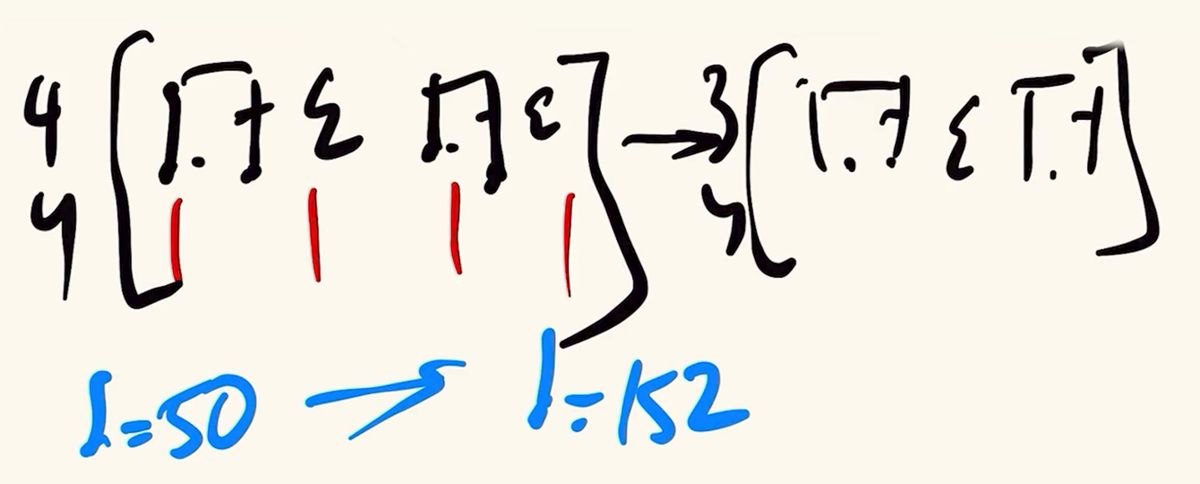
And that's just assuming I put a quarter rest in between. What if I put an eighth rest in between? What if I put a 16th rest in between? Now I can get even more combinations to use in my piece.
Let your imagination ask, what if?
Don't figure out exactly what the tempo is, or exactly what the time signature is, right in the beginning. If you say, "It's going to be quarter equals 84 and that's it," you don't let your imagination think: what could it be if it was slower? What could it be if it was faster?
It helps to know where the ear is comfortable. In Music, Language, and the Brain, Aniruddh Patel says that humans have a preferred tempo range for beat perception, somewhere between quarter note equals 84 and 120. You can go with that human nature or you can go against it.
Meter comes last
When I'm writing a piece of music, sometimes I don't even write the bar lines. I don't put the meter until the end, when I've figured out what the downbeats are.
That's how you get music with mixed meters: the downbeat is changing. Saying "I want to write a piece with 6/8 and 7/8" and going backwards from there is a lot more difficult than saying, "This is my rhythmic profile, and this is where I intrinsically hear the downbeats," and coming up with the meter after that.
What does your rhythmic profile want to happen?
3. Ties are your friend
Bartók's String Quartet No. 4, the fifth movement, from 1928, just highlights that you don't need anything super complex to begin a piece of music. It starts off with quarter notes in 2/4, and it's very, very basic.
Then he has these syncopated cello pitches on the "and" of the beat, going against those quarter notes. So you're setting up 2 rhythmic profiles.
He could have just gone straight through for eternity. Instead, all he does is add a tie.
Meanwhile the cello keeps maintaining that pace. The consistent pace doesn't die away just because the violins and the viola did something different.
So the moral of the story is that ties are your friend. They might be the simplest tool you can use to create these metrical perceptions that go against what we thought we were going to hear.
Combine what you already have
A few bars later he has straight eighth notes, and these eighth notes don't come from nowhere. If you put the quarter notes and the cello's eighth notes together on the same line, guess what they are? A bunch of eighth notes.
4. Change where the rhythm happens in the meter
People say all the time, how do I develop my ideas in music? One method is to just change where the rhythm is happening in the meter that you choose for that particular piece.
When I listen to Ysaÿe's Sonata for 2 Violins in A minor, I really just hear 2 rhythmic profiles. The first is subdivided in 3s, and the second is subdivided in 2s.
So what can you do with that dotted rhythm throughout a whole section? The very first thing is where it occurs. Track it through the first bars of the first violin: second beat, second beat, first beat, third beat.
In the very next bar it doesn't crop up at all, so the listener gets kind of a break. Then it comes back, and he adds it in the second violin too. He's growing this rhythmic profile in terms of where it is in the meter, and also in terms of the orchestration.
If it's on a weak beat, try the other weak beat
Handel does the same kind of thing in "He Trusted in God" from Messiah. You'd think the word "He" would be on a strong beat, beat 1 or beat 3. But there's a rest on beat 1, and "He" lands on beat 2, a weak beat. Finally we get a strong beat on the word "God."
When the tenors come in, "He" is on beat 4, and "God" is on beat 3.
If you look at the rhythm of the phrase, it's the same exact rhythm. What causes the development is that he's changing its placement in the meter. You don't feel bored by the same exact rhythm, simply because he changed where it lands.
5. Just add a couple of notes
My piece Sydegt, for soprano saxophone, electric guitar, percussion and keyboard, sounds like there's a lot going on. But the entire rhythmic profile for the whole piece is set up in the first system, and there are really just 2 main rhythms: a consistent 16th-note pattern, and two 16th notes and a held note.
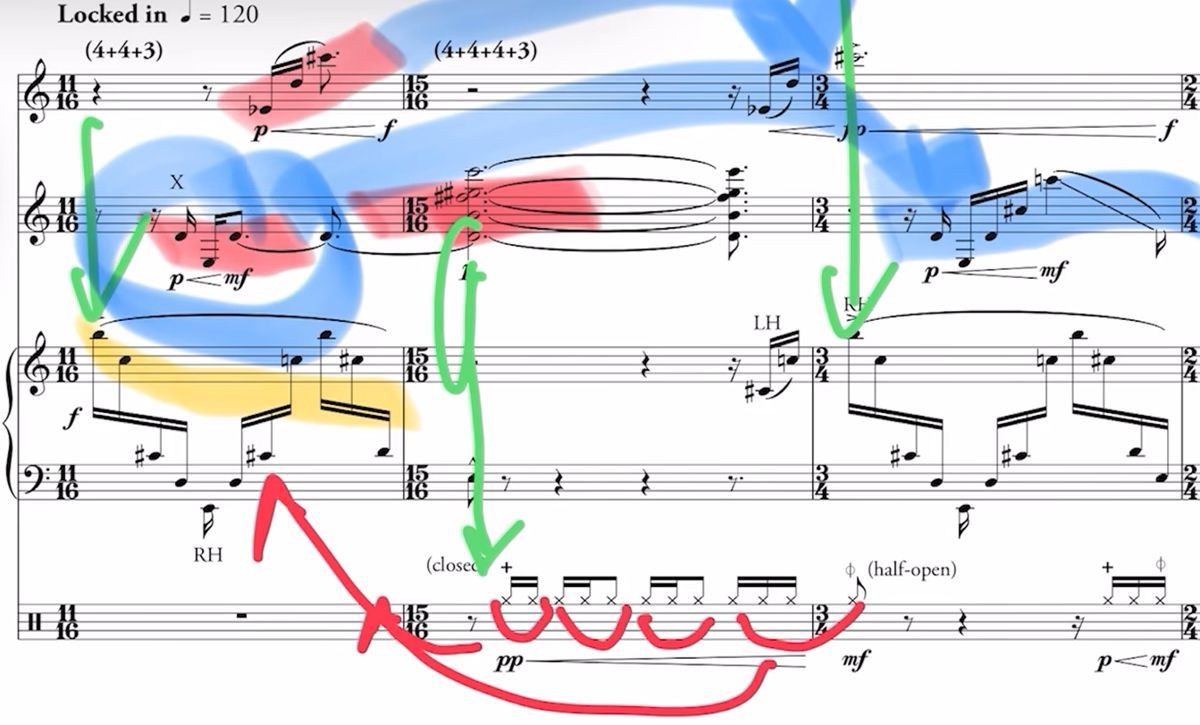
I say "a held note" because that's how our brain perceives it. Held notes don't have as much importance as the ones with a smaller unit of duration. When something else interesting is happening, our brain naturally goes and tries to listen to that.
Now look at how I develop them. In bar 3, all I did in the electric guitar was add a couple of 16th notes.
And in the soprano saxophone, all I did was lengthen that C sharp.
On the surface level it looks complicated, but once you get to the granular level and figure out the types of things you can do, it's really quite simple.
A lot of it is repeated as well, so you don't have to feel pressure to keep generating new material. Later on, the rhythm changes more drastically, but you can still think of it as short, short, long. It's just augmented a lot more than it was in the beginning.
Keep a memory bank of rhythmic profiles
Your rhythmic profiles don't have to come right after each other. You can use them as what I call a memory bank.
In Clara Schumann's Notturno, from Soirées musicales, the first time she uses a quarter note and eighth note pattern, she has 2 of them in a row. When it comes back, much later, it's just one by itself. Development happens with just slight variations. It doesn't have to be something drastic.
6. Superimpose one meter on another
The same Notturno is in 6/8, and she's already set us up with straight eighth notes and a clear downbeat. Then there's a section where it sounds like we're not really in 6/8 anymore.
The way she does that is with accents. There's an accent on beat 3, another accent on beat 6, then beat 3 and beat 6 again.
The left hand starts on the real beat 1, and the right hand is doing something else against it. And it happens at a very critical moment, right before the highest pitch of the piece that we've heard so far.
Don't feel compelled to do all of this. But there's a lot going on in pieces that seem superficially simple, and it all has to do with our way of perceiving rhythms.
7. Ask yourself: does there have to be a pulse?
There are 2 types of music when it comes to rhythm: pulsed and non-pulsed. Pulsed music has a beat that you can tap your foot to, and it can only be structured in 4 ways. That's freeing, because now the question is, which one is it? Or is it a spectrum?
You can also take the pulse away. My piano trio, Thulathi, sits on the spectrum between non-pulsed and pulsed music.
When the melody emerges in the violin, the page seems straightforward. We're in 4/4, and things are written out in a very clear manner. But look at where the notes actually fall: the third triplet 16th of beat 4, then the "and" of 1, the second eighth-note triplet of beat 2, the "and" of 3, the "and" of 4.
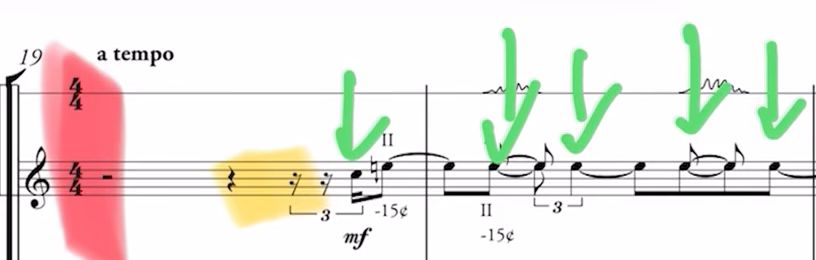
That really highlights the sense that there's no pulse going on. I was actively trying to figure out how to get this ethereal, atmospheric feeling, but at the same time have moments that are structurally sound, where I can feel a pulse coming through.
Use silence
If you have silences that aren't predictable, and that don't have a predictable length, you naturally lose that sense of pulse. I hear this in the taqsim, an improvisation in Arabic music that usually opens a piece. It can start out non-pulsed, and then as it gets closer to the cadence, you can really feel the pulse.
Just using silence can be the thing that you needed in that particular moment to give you the tension that will help you develop the rhythm.
If there is a pulse, what can you do with it that is personal to you? And if there isn't a pulse, what is there that you can do with it that is personal to your voice?
What to do next
Rhythm is only one piece of the composing puzzle, along with melody, harmony and timbre. If you want a framework that shows you how to apply everything here, grab my free guide to composing any piece in 4 steps.