
How to develop your own harmonic voice as a composer
As a concert composer, harmony is probably the hardest of the 4 main parameters we have to deal with. Most people who aspire to compose music would say they need to know all the rules of classical harmony to compose a piece of music, which is partly true and partly not true. Here's how I think about harmony, and how you can build a harmonic language that's all your own from 1 chord.
 By Saad Haddad, composer
Here's the video this post comes from (14 minutes), or you can read it below.
- Do you need to know all the rules of harmony?
- The spectrum of consonance versus dissonance
- How consonant do I want to be versus dissonant?
- Build a chord from the spectrum
- Build a harmonic vocabulary from that 1 chord
- Borrow from the harmonies of composers you feel inspired by
1. Do you need to know all the rules of harmony?
As a concert composer, there are 4 main parameters that we have to deal with when composing any type of piece of classical music. Those 4 parameters are melody, rhythm, timbre and, probably the hardest of the 4 to deal with, harmony.
When we're thinking about harmony in terms of music theory, the first thing that's going to come to mind is a chord. For example, C major, which is comprised of C, E and G.
When we're thinking of chords that belong in a piece we're creating as composers, there's obviously a whole breadth of chords we can choose from. We can choose C major, of course. We can choose a C minor. We can choose C major plus a sixth. We can choose C major with an A flat, or C major with a B natural, and so on and so forth.
So what makes these different harmonies unique to an aesthetic that we're trying to build as composers? Most people that aspire to compose music would probably say something like this.
I need to know all the rules of classical music harmony to be able to compose a piece of music.
The biggest thing, I think, and that I've seen in my studies so far as a composer, is that you have to be comfortable with what I call the spectrum of consonance versus dissonance.
2. The spectrum of consonance versus dissonance
On the consonant side of the spectrum is your octave, where we hear C but in different parts of the range of the piano, or whatever instrument you're using.
Next after that is the perfect fifth. By the way, I've been using C as the bottom note, but we can have D as the bottom note, E flat as the bottom note, F sharp as the bottom note. It doesn't matter. These are all part of that same level of consonance on the spectrum.
After the perfect fifth, I'd say the next interval is your fourth. We're not completely dissonant yet, but we're getting closer to the dissonant part of the spectrum.
The very next intervals are your major third and your minor sixth. After that, it's your minor third and your major sixth. The thirds and the sixths, whether they're major or minor, are kind of swimming in the same pond in terms of where they exist on the spectrum.
Depending on your taste, one of them might sound more or less dissonant than another. This is where it starts to get a little bit murky according to your own personal bias, which is part of the fun of being a composer.
The very next set of intervals are your major seconds and your minor seconds. You can argue the major second is more consonant than the minor second.
Then we move on to intervals like the tritone. They're basically the devil's interval.
That's basically the thought process behind this idea of consonance versus dissonance, and knowing where you are on the spectrum.
At this point you might be asking yourself, "Okay, I understand there's a spectrum between consonance and dissonance, but how is that going to help me write any music?"
3. How consonant do I want to be versus dissonant?
Imagine you're writing something on 1 staff. Just a treble clef, not even a bass clef. We want to figure out, in our harmonic world, how consonant or dissonant we want to be in our piece of music. That's one of the first questions I ask myself.
How consonant do I want to be versus dissonant?One of the first questions I ask myself
At first glance we might say, "I want to be as consonant as possible." Then you have to remember that a lot of the best music in the repertoire has moments of tension. For those moments of tension to exist, we have to have a little bit of dissonance.
Depending on your personal bias, and how much dissonance you personally can handle in your music, this is going to change drastically.
Draw out the spectrum
Let's say you're writing a piece of music and, just for the sake of argument, it's based off of C.
If I actually draw out the spectrum, just so we can see it, I get C and C, C and G, and C and F. At this point it kind of becomes a little to your taste: C and E, C and A, C and E flat, C and A flat. We also have C and B flat, C and B natural, C and F sharp, and then of course C and D, and C and D flat.
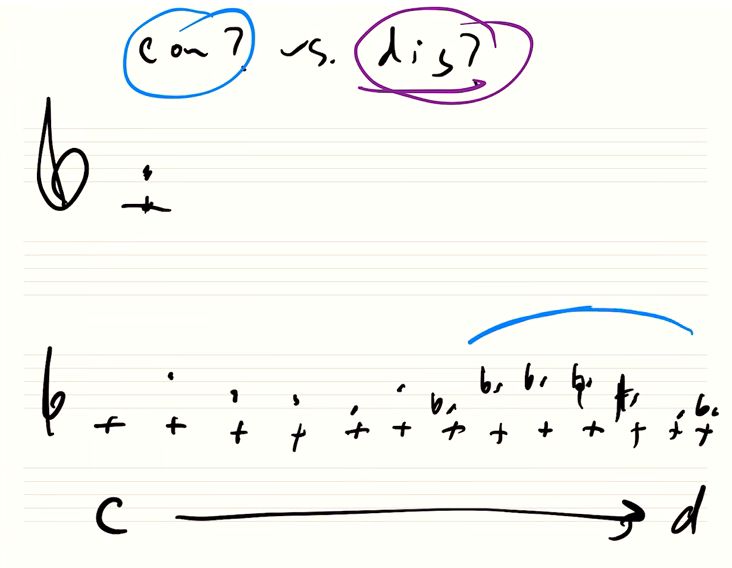
Of course, in terms of dissonance, you might have a different order for your own personal bias, your own personal aesthetic, of which of these intervals to you are the most dissonant.
4. Build a chord from the spectrum
Let's say I want to have a pretty consonant sonority, but I'm okay with going a little past that. Just a little bit, though.
I want a C. Let's say I also want a G, because that's on the one side of the consonant spectrum. I'm starting out with this fifth because I want something more on the left side.
I want to add a little bit of dissonance, but not too much of it. So I add the F. Now I have this chord: C, F and G.
Now I want to add another level of consonance to this, but I don't want to add another fifth. I want to add a third on top of it. So I'm thinking, what if I add a B natural at the top of the chord?
- 1I want a CThe piece is based off of C.
- 2I also want a GA fifth, on the one side of the consonant spectrum.
- ?How consonant do I want to be versus dissonant?A little bit of dissonance, but not too much of it.
- 3Add the FNow I have this chord: C, F and G.
- 4Add a B naturalA third on top, at the top of the chord.
That actually sounds pretty nice. As you can tell from listening to it in the video, it's not a very, very dissonant chord. The reason why is that we're using most of the intervals from the left side of the spectrum.
5. Build a harmonic vocabulary from that 1 chord
Now I can start building a harmonic vocabulary based on that 1 chord that I used. If I have C, F, G and B, I can start transposing it.
For example, I can transpose it up a fifth. If I go from C, F, G, B, I can do G, C, D, and then the last note would be F sharp. Now I have 2 chords that I created out of that 1 chord.
Just these 2 chords are enough for me to actually start writing some music. I can play around with the order of the notes. I can play around with the ranges of the notes. I can even start omitting notes from those chords, and I'll still feel like I'm part of the same harmonic universe.
- Orderthe order of the notes
- Rangesthe ranges of the notes
- Omittingnotes from those chords
That's what we're trying to do as composers: create a universe that's an aesthetic all of our own.
In the video, I go back and forth between the 2 chords just to get the pitches in our ears, and then I start changing it up a little bit.
All that I really did was go back and forth between those 2 sound worlds. I made sure to start omitting some notes here and there, and I changed the octave of some of the notes. That way I still feel like I'm part of the same harmonic universe while still developing the harmony in both of these chords.
Try this
I invite you to try this. Once you start thinking of harmony in this way, it's really hard to think about harmony in any other way, because you start to hone in on a harmonic universe that you personally connect with.
You're also not tied to so many stringent rules of classical harmony when you're thinking of harmony in this kind of way, between consonance and dissonance.
6. Borrow from the harmonies of composers you feel inspired by
There's a bonus way to level up your harmony, and that's by intentionally borrowing from harmonies of past composers that you specifically feel inspired by.
It's not enough for me to say, "Hey, you need to listen to Beethoven. You need to listen to Brahms." No. It has to be something that you personally are attracted to.
Here's an example. This is a piece by Frank Zappa called The Perfect Stranger, bars 43 to 46. The reason I'm showing you this specific passage is not because I'm personally inspired by Frank Zappa, but one of my students is.
He's a big Frank Zappa head, actually. Something I suggested he do to up his harmonic game in his work was to go back to some Frank Zappa scores that he himself loves.
I found an article on JSTOR titled "An Introduction to Frank Zappa's Chord Bible." I was just Googling away on my Columbia University database. I looked up Frank Zappa harmony, and there it was. It's a very music theoretical type of article about Frank Zappa's harmony.
What was interesting about it was seeing how meticulous some of these harmonies are, and how they're related to the consonance versus dissonance spectrum.
Basically every type of interval in 1 chord
The part I really want to hone in on is the last bar. We have the contrabass on the bottom, on B natural, then A flat. In the video I call that interval a seventh at first, but it's like a sixth.
Then a major second on top of that, B flat. Then the viola, in treble clef, has F. That's a fifth. Then a major second, G. Then a tritone, C sharp. Then a minor second, D. And then we have this held-over E that happens on the top line, in the first violin.
When you look at this chord in terms of the level of consonance versus dissonance, there's actually basically every type of interval in there, and they're all represented in this chord.
This tells me, as a composer, I have a lot to work with here.
I can explore the top part of this harmony, just these 3 notes that are separated by a minor second and a major second. I can really start playing around with that as a composer, and it will sound like the Frank Zappa kind of sound world.
I can play around with the middle of the range, which is this tritone and this minor second. That has its own sonority.
I can play around with the bottom of the range, which is really open sounding, as opposed to the very close voicing that happens at the very top.
Very close voicing
Its own sonority
Really open sounding
At the very least, you have a starting point
When you allow yourself to be inspired by these harmonies, you can really start to explore harmonic areas that you by yourself couldn't possibly have explored. It's really hard to generate a harmony like this out of thin air. You really have to at least hear it from somewhere else.
Then you say to yourself, "You know what? I don't like that kind of sound on the bottom there." Or maybe instead of the major second, I want to hear something else. You can start making your own little variations off of that.
At the very least, you have a starting point to start thinking about how you're going to create a harmonic soundscape.
- 1Something that you personally are attracted toGo back to some scores that you yourself love.
- 2Hone in on a chordLook at it in terms of the level of consonance versus dissonance.
- ?"You know what? I don't like that."Maybe instead of the major second, I want to hear something else.
- 3Make your own little variationsAt the very least, you have a starting point.
- 4Do that exact exerciseWrite it out and generate a harmonic landscape that's all your own.
Remember the 2 chords from before? You can still do that exact exercise with this exact chord. It'll be a little bit more complicated with this chord, but you can still do it, still write it out, and still generate a harmonic landscape that's all your own.
What to do next
If you want to shape your own harmonic language without getting lost in a sea of theory, start with my free worksheet on developing your harmonic voice.