
Your score's title pages shouldn't be an afterthought
Title pages are usually an afterthought, but these pages could potentially make a positive or negative impact on a reader's first impression of your score. I'll go over how to format them so that your scores come out looking professional and ready to be shared.
 By Saad Haddad, composer
Here's the video this post comes from (26 minutes), or you can read it below.
- The very first page
- The commissioner and the first performance
- The instrumentation page is your most important page
- Is the score in C or transposed?
- Performance notes and program notes
- The music starts on the right-hand side
- What's different for wind ensemble
- What's different for chamber ensembles
- What my own title pages look like
- Find a style that you like and stick to it
1. The very first page
The scores I'm pulling from come from major publishers like Ricordi and Boosey & Hawkes, as well as self-published composers who I find present equally compelling prefatory pages.
Let's start with an orchestral score by Georg Friedrich Haas, published by Ricordi. We have the composer's name first, then right below that, the title. Right below that, we have the orchestral forces in very small print, "for large orchestra," and then the date of composition.
In the middle, you see "Partitur." That just means score. In English, you can write "full score" somewhere in that section. And on the very bottom, if you have a publisher, you put the publisher's name there.
Other publishers put all these different things in slightly different places, but all of them have some combination of these things on the very first page.
My friend Patrick O'Malley, who's self-published, has the title of his viola concerto at the very top, then a subtitle, then the word "score," with his name on the bottom right. As long as all that information is there on the very first page, it's very, very good to go.
Don't worry too much about the fonts
The fonts, the way that it looks exactly, it's not going to be the same even across major publishers, let alone self-published composers. I wouldn't worry too much about this, as long as you have all the pertinent information and it looks consistent alongside your entire score.
As long as you have all the pertinent information and that it looks consistent alongside your entire score, that's the most important part of a professional representation.
2. The commissioner and the first performance
This next page is not completely necessary. It depends if you have these things for your piece.
If you have a commissioner, usually on a single page, without anything else on it, you'd put something like "commissioned by so-and-so orchestra," with the performance on so-and-so date, in so-and-so place. John Adams has all of that on one single page too, and he even includes the first recording.
A self-published composer can do it in their own particular way. Patrick puts the commission, the premiere date and the dedication at the very top of his instrumentation page. If you want to write a dedication, this is where that would go as well.
3. The instrumentation page is your most important page
At the very top, we have the instrumentation, and this needs to be in score order.
Put the doublings in parentheses
It's very, very important that you include doubling. On the John Adams score, the flutes have 4 separate players, but the 3rd and 4th players double piccolo. It's really important that you put that into parentheses.
There are 3 separate oboe players, and the 3rd oboe is going to double on English horn. There are 3 separate clarinet players in B flat, and the 2nd is doubling bass clarinet. Then there's a 4th player that only plays bass clarinet.
Often in German scores, they don't write the term flat. If they just put B, that actually means B flat. Typically speaking, if your score is in English, you want to keep everything consistently in English.
Percussion
Haas and Mackey list what each player is going to play right in the instrumentation. Adams writes the number of players with a little asterisk, indicating that there's something extra down below: all the different percussion instruments that are getting played, from percussion 1 through percussion 5.
If there are instruments that are repeating, Adams will put that here. For example, the 1st percussion has xylophone, but the 3rd percussion has xylophone as well.
All you have to do is write the word strings
With the string parts, you don't necessarily need to indicate how many people are playing each part. In Haas's music, it's really important, because each violinist typically has their own part. If you only have, let's say, 8 first violins in your orchestra, you're not going to be able to play this piece.
With the Adams score, this is not necessary. You could maybe play it with 30 string players, or 40, or 50. It's not totally crucial to him how many people are going to be playing on each of those parts. In that case, all you have to do is write the word "strings," and the orchestra knows exactly what that means.
On the bottom, we can expect to see the duration. For Haas it's circa 29 minutes, and for Adams it's circa 48 minutes.
4. Is the score in C or transposed?
This is one of the 2 very important pieces of information on the bottom of the instrumentation page, right with the duration.
For a big symphonic orchestral score, usually we don't want to see a transposed score. That's usually reserved for wind ensemble scores. So the Haas is a score in C: all the instruments in the score are at sounding pitch, not at written pitch.
All the instruments are at sounding pitch
The written pitches for the instruments
When there's no indication
On the Adams score, I noticed that throughout that entire page there's no indication of whether the score is transposed or not, which I found extremely odd. I'm not here to tell Boosey & Hawkes what to do at all, that's not my place, but it is strange that I had to go through the score to figure that out.
The way that I'd typically do this is to take a look at the clarinet line, which is normally going to be a transposed instrument. I'm looking to see if there's any way of telling if the harmonies are alike between the flute parts, the oboe parts and the clarinet parts.
- 1Take a look at the clarinet lineNormally a transposed instrument.
- 2Find a line in the flutes and oboesThey're written in C, they sound in C.
- ?Is it a major second lower than the clarinets?The sounding pitch of the clarinet is one major second lower than where it's written.
- 3The score is in fact transposedThe lines are in unison.
In this case, the flutes and oboes were playing a line in unison that starts on C sharp. I would expect the clarinets to be in unison with those 2 lines as well. But the clarinets started on E flat.
If we're playing an E flat on the clarinet, that means we're actually going to hear a D flat. And D flat is going to be the same thing as C sharp. So this is unison, and the score is transposed.
D flat, the same thing as C sharp
It would have been nice to see "transposed score" or "score is transposed" on that page. Any of those things would have been a good indication.
Another place that you can put the "score in C" or "transposed score" indication is at the very top left of your first page of music. That's what Patrick does. He writes "concert pitch score," so there are no transposition shenanigans going on in this particular piece.
5. Performance notes and program notes
The very next page before we get to the music is going to be our performance notes. Not every piece is going to have these. It depends on if there are any extended techniques or not.
In Haas's music, there are a lot of indications of microtones, so he writes what all the different accidentals are. He has a square-looking note head, which he calls soundless. These are all the different extended techniques that maybe a player wouldn't normally know how to execute.
If there are any other instructions that the administration of the orchestra needs to know, this is where they would go. Haas has an instruction for the sound engineers. Adams has indications about the guitar player and the speaker situation.
Some composers prefer not to write program notes
Not all composers are into writing program notes. The Haas and the Adams don't have one, and John Mackey's is very lengthy. Some composers like to tell the audience or the orchestra what the piece is about. It just depends on that particular composer.
If your piece has several movements, you can do what Patrick does. He writes those down along with the page numbers, kind of like a table of contents, and right below that he puts his program note.
6. The music starts on the right-hand side
When we get to the end of these title pages, the music starts on the right-hand side of the score. This is really important, because when a conductor opens up a score, they're always used to seeing an odd-numbered page on the right-hand side.
Page 1 is always going to be on that right-hand side. If they think about going to page 17, they know that in every score they have in front of them, page 17 is going to be on that right-hand side. It's important that you also follow this same standard.
That's the reason Patrick has a blank page on the left-hand side. John Mackey has one so that his first page of music could be on the right-hand side of the score. Cassandra Miller has one too, most likely so that the next page of music could be on the right-hand side.
7. What's different for wind ensemble
John Mackey's Haunted Objects, for concert band, has his name at the very top, then the title, the forces and the date. The commission is toward the bottom, and on the very bottom we have the copyright information, his publisher, which is just him, by the way, and his website.
On the instrumentation page, there are a couple of differences from an orchestral score. Wind ensemble music is going to have saxophones, typically speaking. In this case we have alto, tenor and baritone. If there was a soprano saxophone, you'd put that above the alto.
The French horns are after the trumpets in a wind ensemble score. In an orchestral score, the horns are before the trumpets. And you typically don't have euphonium in an orchestral score. In wind ensemble scores they're usually everywhere, and you put them right before the tuba.
- Horns
- Trumpets
- Trombones
- Tuba
- Trumpets
- Horns
- Trombones
- Euphonium
- Tuba
8. What's different for chamber ensembles
Cassandra Miller is one of my favorite composers out of the UK, published by Faber Music. Her Perfect Offering is for a chamber ensemble of 7 players, and it's very similar to what we've seen before: the name of the composer, the title, the forces and the date of composition.
On the next page are the commissioning information, the first performance, the duration and then the instrumentation. The score order is the same as we see in an orchestral score. It's just that a lot of instruments are missing.
She also lists the seating. It's really important for her that they're sitting next to each other in this exact configuration. If it wasn't that important to her, she wouldn't have listed this at all in the score.
Just like Patrick, she writes the transposition right at the top left of the first page of music. In the clarinet line, we have it written in D major while everybody else is in C major. That's a telltale sign that the whole thing is transposed.
Written in D major
In C major
9. What my own title pages look like
Here's an example of another self-published composer. This happens to be me, myself and I. This is Ta'amolan, a wind quintet I wrote for the Imani Winds. The title means 2 meditations in Arabic.
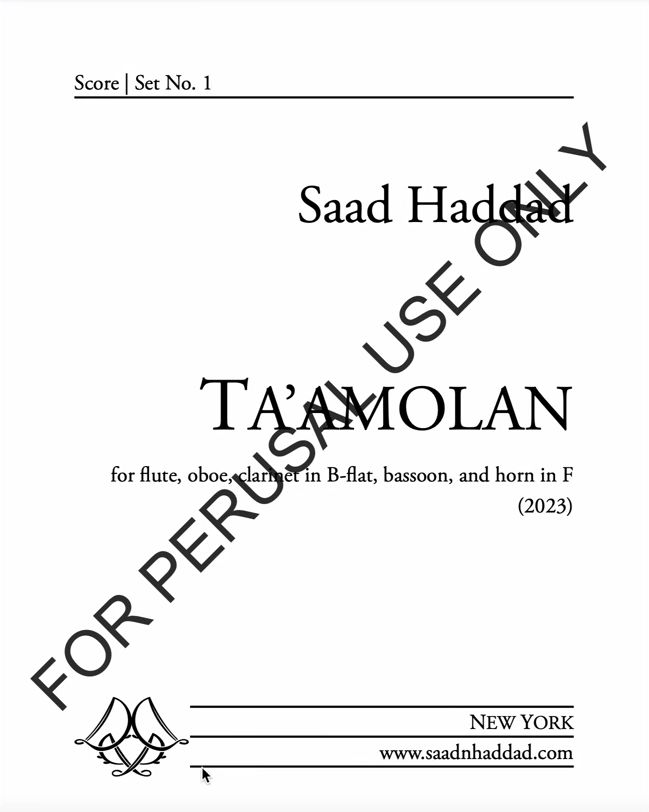
I like to say what set it is, because sometimes I do revisions, and I want to know which set of the score I'm looking at. I have a lot of scores that say set number 2, set number 3, set number 4 at the very top.
You'll see my name, the title, and then in very small print the instrumentation as well as the date. On the bottom I have the publishing moniker for Dib Press, my self-publishing company, then the city and my website, because that's where all my music is housed.
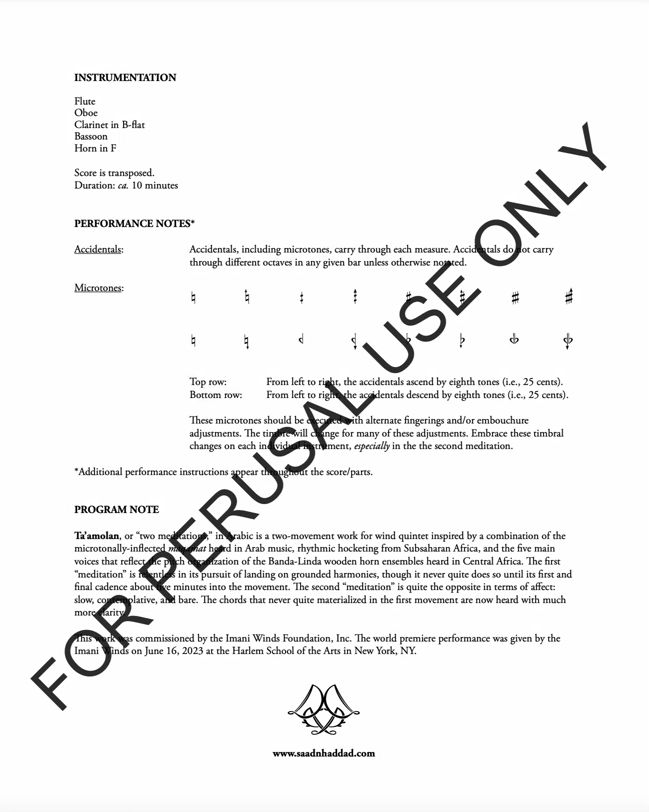
On the very next page we have the instrumentation in score order, and right below that I say that the score is transposed. Then the duration is 10 minutes. In the middle of the page, I go directly into the performance notes, where I mention something about accidentals and microtones.
On the very bottom, we have the program note. I myself like to write program notes. I sometimes even write them before I start writing the piece. That's just my personal way of doing things.
Then, as you'd expect, I have my first page of music, in the same score order that I showed on my instrumentation page.
Because I wrote that the score is transposed, we know that this score shows all the written pitches for the instruments. This would be really important, especially for the clarinet and the horn.
10. Find a style that you like and stick to it
The main takeaway here is to find a style you like for your own scores, and once you find one, stick to it for a few years and see how it goes. I've definitely changed my style across the years, depending on something that I saw or something that I studied.
But as long as you pick something and stick with it for a while, it shouldn't take up too much of your brain space. This is just something for you to have a professional first impression with, not something for you to go crazy with.
The main thing of course is what is my piece about, how do I write my piece, how do I get better at composing.
The prefatory materials are important, but they're not the most important thing, so don't obsess over it. Find some scores that you like, try to emulate them, and go from there.
What to do next
If you want simple ways to make the rest of your score easier to read, start with my free engraving checklist.