
3 part preparation mistakes that kill your performances
Ever wonder why your music doesn't quite sound the way you hoped? I've learned firsthand how poor translation from the page makes compositions fall short on the stage. Here are 3 of the most common part preparation mistakes and how to fix them, so your music actually sounds the way you intended.
 By Saad Haddad, composer
Here's the video this post comes from (16 minutes), or you can read it below.
- The 3-step process I use every time I engrave parts
- The staff and font sizes are just too small
- Unplayable page turns
- A lack of cues in your parts
The 3-step process I use every time I engrave parts
The first thing I'd do, before I do any engraving, is make sure that I can find a modern professional part to compare my work to. It's always easier to have a concrete example of what a professional part looks like for reference.
For this post I'm going to use a part from my piece Aysheen, which was premiered with the Los Angeles Philharmonic.
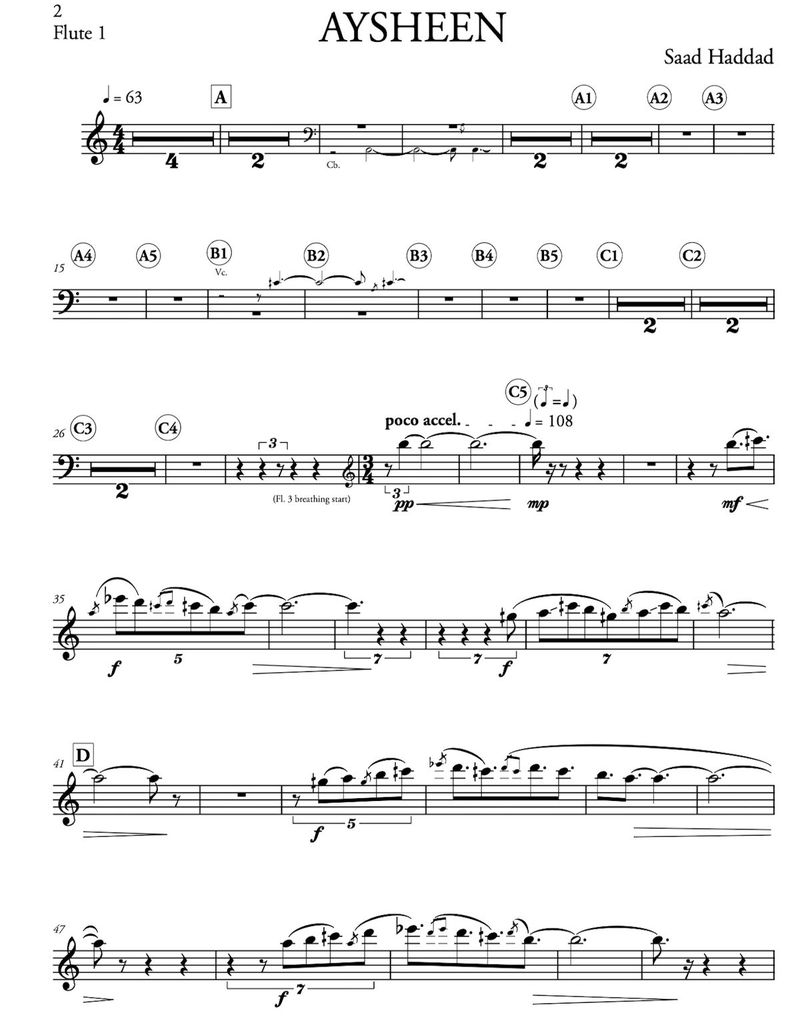
Step 2 is what I call the falcon view, and it's what it sounds like. We want to zoom out and take a look at the part as a whole, from a bird's eye perspective.
Make sure that you have good spacing in terms of the page margins and that there's no clutter on the page: no notes going on top of each other, no slurs clashing with each other, no dynamics clashing with each other. And make sure there aren't too many bars per system, or too few.
My last step is to refine. After the falcon view, we zoom in bar by bar and start making the necessary edits, according to the biggest issues that we saw in the first place.
- 1Find a model partA modern professional part to compare my work to.
- 2The falcon viewZoom out and take a look at the part as a whole.
- ?Can I spot any differences?Page margins, clutter, too many bars per system or too few.
- 3RefineZoom in bar by bar and start making the necessary edits.
If you have both parts right next to each other, you're kind of doing step 1 and step 2 at the same time.
If you're wondering what those specific issues are, they're also outlined in my engraving checklist.
1. The staff and font sizes are just too small
One of my subscribers sent in a cello part. I took a quick look at it, then took a look at my part to see if I could spot any differences. Right off the bat, I saw issues with the fonts and the staff sizes.
There are just so many staves on this page, and the reason is that the staff size is just so small. If I try to read this from a couple of feet or so, it's really hard for me to read the notes on the page, and it's really hard for me to read the text as well.
How much bigger they should be
The way to tell is to take a look at a model part. What would a professionally engraved part actually look like, and what sizes are they using? Then make sure that your part is looking the same way.
13 bars per system is quite a lot
Zooming in on the first few measures of that cello part, it doesn't look too bad, actually. The dynamics are in the right places, and everything looks how it should be. But 13 bars is quite a lot of music to cram on one system.
Typically you don't want to go past 5 to 8 bars per system. The most that I do in my part is in the second system, but that's because there's a bunch of rests. A line with a bunch of music, like the system at bar 52, has 6 bars.
The other side of the spectrum
Then there's the part with staff sizes that are a little bit too big, so there aren't enough bars per system. Another subscriber's horn part had 2 measures in the first system, 2 measures in the second, 2 measures in the third, and I believe it kind of goes like that for the entire piece.
That makes it really hard to read. Your eyes are so spread apart on the system that it's hard for a player to read ahead.
There isn't a single system in my part that only has 2 measures, even where the rhythms per bar are quite complex, like quintuplets or septuplets. I still managed to put 5 or 6 bars there.
On the horn part, I'd make the staff size a tiny bit smaller and then add a third, a fourth, and I think definitely a fifth bar per system. That way they can sight read the part much better, because they can see more information in a smaller space.
Make the fonts consistent
On the cello part, I also noticed a discrepancy between the bar number size and the font sizes of the tempo text and the technique text. The bar numbers are way bigger than the tempo and the technique. We want those to be pretty much similar sizes.
In my part, the bar numbers are just slightly smaller than the tempo text. If you look at the rehearsal letter D, it's about the same size as the tempo text.
2. Unplayable page turns
The second common thing that I see is really going to tick off players, and it's definitely happened to me on more than a handful of occasions: unplayable page turns.
First, take a look at how page turns are done in a professional part. In my piece, we have a page turn at the end of page 3, and I leave plenty of rest there for that page turn to happen. The player can easily turn the page, no problem at all.
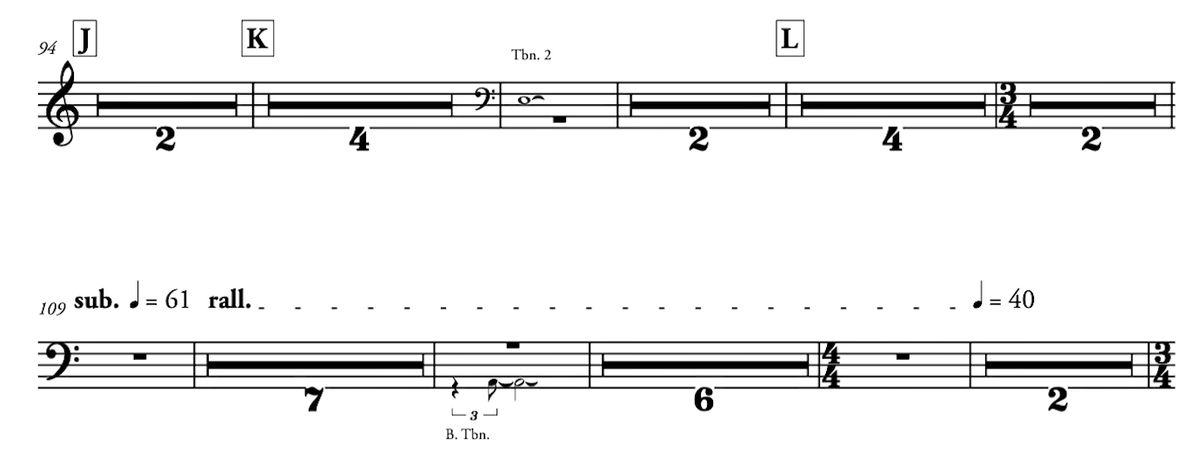
Then we have 2 full pages of music. Since there's a final bar line and no more music on the next page, there's no page turn needed. So there's only 1 page turn in my piece.
Odd numbers on the right, even numbers on the left
You want to make sure that the odd numbers are on the right and the even numbers are on the left. It's always like that. It'll make it much easier for you to distribute the page turns in your part.
I purposefully made sure that when a musician opens up the part, they see the first 2 pages up on their stand. That way they can turn the page after the second full page of music.
If I'd made that first page a right-hand page, I would have had a problem. At the bottom of that page, there are just 2 quarter rests. There was no way that I could have made a really good page turn.
No time to turn the page
A subscriber's double bass part starts with 1 page on the right-hand side. There's a bunch of music going on, then there's music happening at the end, and there's just no time to turn the page. Then we get to pages 2 and 3, and that's the end of the piece.
We could have easily had a page turn if the composer had just thought a little bit ahead.
How to fix it
What I look for is: are there any moments in the part where there's an ample amount of rest? There's definitely not any moment on the first page to take a page turn. But I can see clear as day that at measures 43 and 44, there's definitely a space to take one.
You might be thinking, well, how are we supposed to do that? There's already all that music before. What you can do, which I've done many times, is have the page with the rests be the odd number page.
The first page goes on the left-hand side, and the page with the rests goes on the right-hand side. The music stops right at those 2 bars of rest, and the next page starts with the music after them.
There'll be a bunch of gap after these 2 bars of rest, but then they'll be able to turn the page. And you can possibly have another page turn later, at another 2 bars of rest, so that the next open page would start at bar 99.
It sounds complicated, but when the player gets the music, they'll be very thankful that you did this.
Don't be afraid to have a bunch of blank space on a page.
If that means you can have a really nice page turn, it will make your instrumentalist really happy, and it will make sure that your music actually comes off better on the stage.
3. A lack of cues in your parts
The third mistake that's going to derail any rehearsal that you have is a lack of cues in your parts.
Cues are little notes that indicate what other players in the orchestra are doing before that musician enters. This is typically something you'd put into the parts, especially when there's an elongated period of rest.
In the flute part of Aysheen, the player comes in on a B, and before that there are a couple of bars of oboe cues. If I look at the section before, there are all these rests.
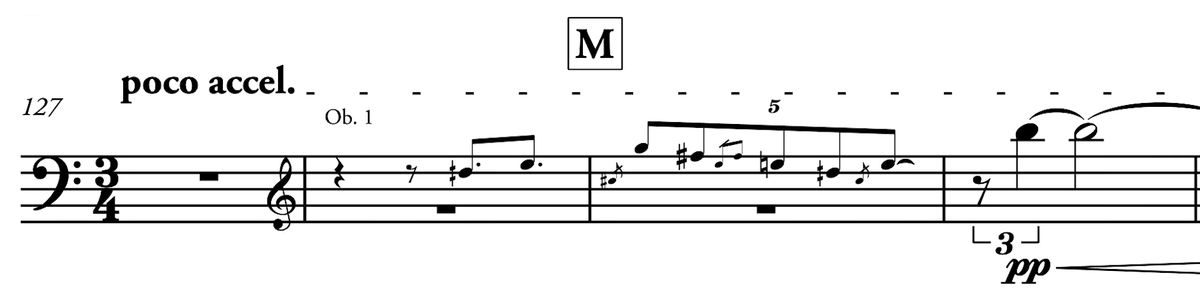
Even within the rests, I put cueing in, so that the flute player can keep track of where they are. You don't necessarily have to do that, but I decided to do it just to make things clear.
How to write a cue
What I typically like to do is make sure that 1 or 2 measures before the person plays has a cue. Sometimes you can even put 3, 4, even 5 measures. It just depends on what the phrase is.
- ?Is there a big area where the player doesn't play?Put a cue in 1 or 2 measures before the person plays.
- 1Make sure those notes are smallLike what I have in my part.
- 2A whole rest in the second voiceThey know that they're not supposed to play this lick.
- 3The actual playerPut in who's going to be playing that specific cue.
Make sure that you do that in every big area where the player doesn't play. That way it's really easy for them to get back on track with their entrances.
They're also really confident when they come in. They know, okay, I heard that oboe play that little melody, I'm confident to play this B.
17 bars of rest in the very beginning
A subscriber's violin part doesn't look too bad compared to some of the other things. But from my falcon view, I can see right off the bat that we have 17 bars of rest in the very beginning, and then this F sharp going into G in that first system.
If I were a violinist, I'd probably be not 100% sure where my entrance comes in.
When you have an elongated area of rest like this, put some cues in from a nearby instrument, or something that the violinist can obviously hear. That way they're very confident where that F sharp starts.
We want to get as many of these pitches and rhythms as we can happening on the first take in any rehearsal you have, especially when it's with an orchestra.
What to do next
To see the specific issues I look for, download my free engraving checklist.