
Your composer CV gets read next to 100 or 200 others
As composers, we inevitably have to make a CV and constantly update it throughout the years. It's really useful for contests, for applying to school, and for applying to a job after school. Here are all the different sections of mine, and how to format them.
 By Saad Haddad, composer
Here's the video this post comes from (13 minutes), or you can read it below.
- What goes at the very top of your CV
- Reverse chronological order
- Make sure that it sticks out
- The sections you don't have yet
- Radio, albums and articles
- List of works and performances
- Ask your references first
1. What goes at the very top of your CV
At the very top you're going to see my name, that I'm a composer, my website, and of course the word CV. Then my address, my phone number and my email.
The very next portion is always education. You've got to put that at the top. The rest of the sections on my CV come after that, in the order below.
Include who you studied with
Under each degree, I included all of my composition and electronic music teachers. That's really important, so that when people see your CV, they can see who you studied with. Maybe they have some mutual relationships with you through any of these professors.
2. Reverse chronological order
Every section on my composer CV is in reverse chronological order. In education, I start off with my DMA in composition at Columbia University. Right after that is my master's in composition from the Juilliard School. My first degree, the BM in composition from USC, goes last.
- 2023DMA in composition, Columbia University
- 2016Master's in composition, the Juilliard School
- 2014BM in composition, USC
Teaching experience works the same way. On mine, my teaching at Columbia came first, with all the courses that I taught in reverse chronological order. Then I had some ancillary places that I taught, Hoff-Barthelson Music School and Luzerne Music Center, and my private studio at the very bottom.
Put the year at the very left
I like to put the year at the very left. That way it's really easy to see. I also like to put it in bold, but you don't really have to do that.
There are a lot of examples of CVs, even from other professions, that you can take a look at and model. I just really like this format. It looks really clean.
3. Make sure that it sticks out
You have to realize that when people are looking at your CV, they're looking at like another 100 or 200 CVs. So you've got to make sure that it sticks out.
In my academic CV, I try to include as much information as possible. That version is really good for applying to a school or a professor job, because it shows everything that I did.
But if I was applying to some specific residency or contest, I'd delete the things that don't match it. If it's some orchestra competition, what I'd normally do is delete all the chamber music, solo music and choral music and just highlight the orchestral work.
It shows everything that I did
Just what matches that application
Put the word "selected" in parentheses
At the top of the section where it says fellowships, prizes and honors, I'd put the word "selected" in parentheses. That way they know these are not the only things that you've gotten. They're a selected number that match whatever contest or application you're applying for.
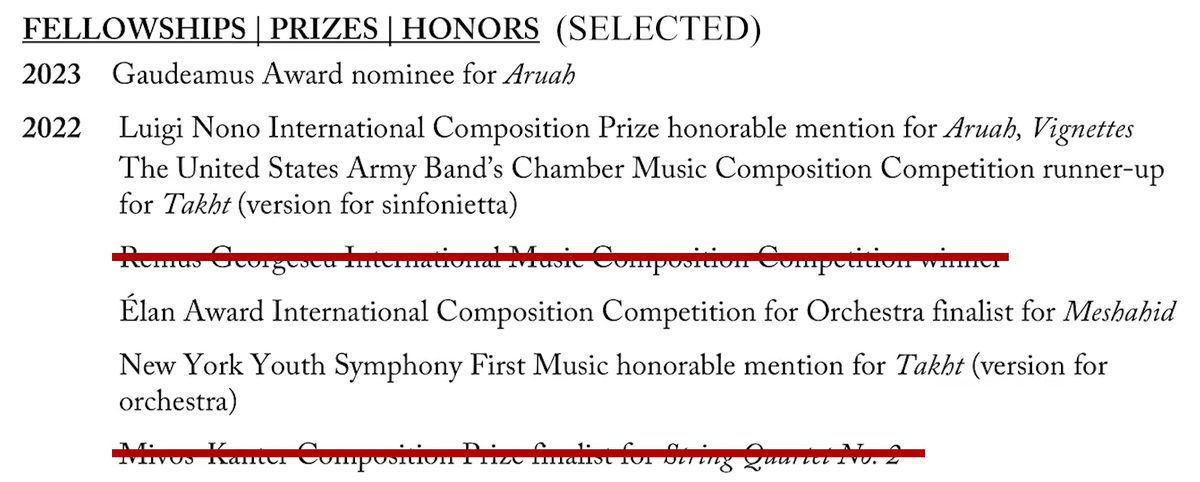
And of course, save the original academic version of your CV.
- 1Save the originalThe academic version of your CV.
- ?What are you applying for?Some specific residency or contest.
- 2Delete what doesn't matchJust delete it from the CV.
- 3Add "selected"In parentheses, where it says fellowships, prizes and honors.
4. The sections you don't have yet
There are going to be sections in my CV that you're just not going to have. Maybe you didn't win a prize yet. Maybe you haven't been to a residency yet. That's okay. All you've got to do is delete that portion.
Just remember that when you do get one of these things, add this area to your CV so that you can show the things that you've done. You want to make sure that this is as complete as possible.
Include the things you declined
In my residencies, I include the things that I declined, the things that I ended up not doing. I got accepted to the Cabrillo Festival Composers Workshop, but I had some conflict going on that summer, so I couldn't make it.
Instead of having it not be there at all, I want to show, hey, I actually got accepted to this thing, I just couldn't make it. So I put the name of that residency, and in parentheses afterwards I put "declined." When COVID happened and I couldn't be at something, I put "COVID postponement" in parentheses.

Lectures, juries and boards
As you continue with your career in composition, you're inevitably going to have a lecture on your music or present something at a conference. I like to put all this stuff in one area. When I had a lecture on my music coming up at Harvard University, I put that in my CV before I gave it.
There are some really fun ones too. I did a talk called "From Concert Halls to Your Game Room" at Fordham Law School, which was kind of different because everybody there was a law student.
Then there's service and administrative experience, in other words, stuff that doesn't really have to do directly with composing or teaching. It's important to include some of these things if you happen to do them.
5. Radio, albums and articles
The next section is broadcasts. In other words, has your music been played on the radio, and if so, when? I hadn't really been keeping track of mine, but since I did know about some of them, I included them.
Discography is fun. What albums have you released, or what albums have your music on them? When I made this CV, mine were all pending. They hadn't been released yet, but I wanted to show that they were going to be, that they had actually been recorded, and that they were just in the process.
Instead of just leaving this area blank, I think it's important to show what's actually going to happen.
This person doesn't have any discography right now, but look, it's going to happen in the near future.
Media coverage is when somebody writes an article about you or has a blog post about you, really anything written about you or your music. You want to make sure that you actually save that and include it in your CV.
For example, Bachtrack wrote an article about my premiere with the Callisto Quartet. I put the author's name and the date of the article, so that I have a record of when all of these things happened.
I also had a documentary released about my creative process that featured performances of my pieces Mai and Dohree. It wasn't an article written about my music, but it was some kind of media event that happened around my music, so I include it in this section too.
6. List of works and performances
Some people put performances in one section and their list of works in another section. I like to put everything in one section. That way all the music in my catalog is in one place on my CV, and it's really easy to see where all my pieces have been played and what sort of instrumentations I wrote for.
One complete entry
Let's take a look at one of my pieces, Meshahid, for solo piano and orchestra. The date is on the left-hand side, and to the right of that you see the instrumentation: 2 flutes, 2 oboes, 2 clarinets, 2 bassoons, 2 horns, 2 trumpets, 3 trombones, 2 percussion and strings. It lasts about 10 minutes. All of that information is in that first line.

The next line is where I'd write who the commissioner was or what event I wrote it for. Then I put a little space, and the very next area is for the actual performers, the conductor if there was a conductor, the location, and the exact date.
- 1The first lineDate on the left, then the instrumentation and how long it lasts.
- 2The commissionerOr what event I wrote it for.
- 3The performersAnd the conductor, if there was a conductor.
- 4The locationAnd the exact date.
A piece that's been played multiple times
Takht, for orchestra, is a piece I wrote in 2016, so it's had some time to mature and find different ensembles to be played with. You see the full instrumentation. You see the duration, 14 minutes. You see that I arranged it for the Sioux City Symphony Orchestra.
The very next line on this CV is its latest performance at that point, with the UCLA Philharmonic. After that come the Hangzhou Philharmonic in 2018 and the Minnesota Orchestra in 2017, all the way down to the last line, the world premiere with the Sioux City Symphony Orchestra in Iowa.
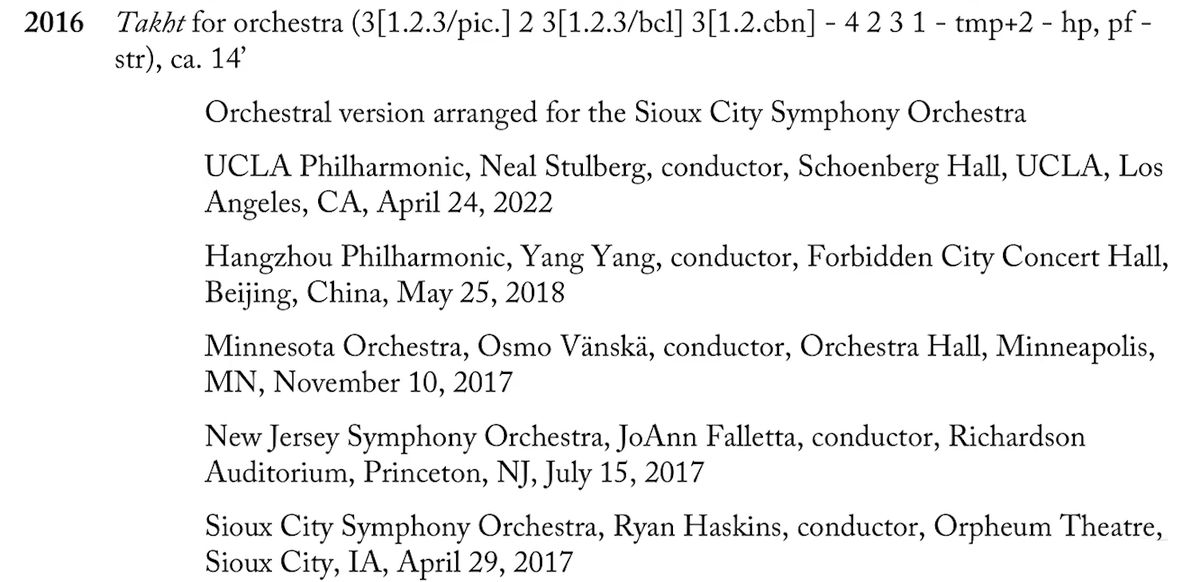
It's really powerful to have all of these pieces listed in one place with all the performances. And again, everything is always in reverse chronological order, so it's very easy to keep track of.
You want to see a big collection of pieces, or whichever pieces you have so far, and all the performances you've had with each of them.
7. Ask your references first
After that come your professional affiliations. On mine, that was ASCAP and the American Composers Forum.
The last section is your references, and this is really important to include in any CV. These are the people that would vouch for you if somebody looking at your CV wanted to talk to somebody, over the phone or in person, about you.
I like to include 3 professors. I was at Columbia at the time, so it made the most sense to include people at my school. If you're not in school, you can have your teacher, some close friend, a mentor, or really anyone in the professional field.
- 3 professors
- People that are at your school
- Your teacher
- Some close friend
- A mentor
- Anyone in the professional field
Make sure that they're okay with it
The only thing you have to do is make sure these people are actually notified by you that you're including them as a reference, and that they're okay with it. One day, one of these people could get a random phone call from somebody saying, "Hey, I'm interested in so-and-so for this opportunity."
If you included this person's name when they didn't want it there in the first place, that's not the best look for you. So just make sure that you ask them before you put it on your CV.
- 1Your referencesThe people that would vouch for you.
- 2Ask themBefore you put it on your CV.
- ?Are they okay with it?They could get a random phone call.
- 3Put them on your CVIn the last section.
What to do next
Once your CV is ready and you want contests to send it to, download my curated list of competitions for free.