
When performers don't say yes to your new piece
What are professional orchestral musicians actually looking for from a new piece and the composer behind it? I asked 5 musicians and conductors from the California and Kansas City symphonies. Here's what actually gets performers to say yes to playing your new piece, and one specific takeaway from each of them.
 By Saad Haddad, composer
Here's the video this post comes from (13 minutes), or you can read it below.
Both of those orchestras have premiered works of mine. Looking back at everything these 5 musicians told me, performers want to work with:
- Composers they actually know
- Someone who pushes the instruments they write for
- Someone who makes fresh sounds
- Someone who says something meaningful about being alive today
- Someone who believes in their music even when things get hard
1. Composers they actually know
The first thing most composers need to hear is that the way they're trying to get performances right now probably isn't working.
The number one issue I see from composers who aren't getting performed and commissioned consistently is spending all of their time on what I call cold outreach. That's submitting to calls for scores and contests, or sending emails to people you've never met asking them to play your music. It's super time consuming and it mostly doesn't work.
I know this firsthand because I emailed hundreds of administrators and conductors from orchestras all around the world asking them, well, begging them to play my music. For me, it was a complete waste of time.
On the competition side, I've tracked every contest I've ever applied to, which is more than 600 at this point. I've only won or been selected as a finalist about 10% of the time.
Compare this to what Michael Gordon, principal flutist of the Kansas City Symphony, had to say about how he picks new music to play:
Probably most frequently it's new music by composers with whom I have some connection, either a friendship or a professional relationship or just somebody I know. And that makes the experience, I think, so vivid.Michael Gordon
I've seen this same thing with performers in my own career too. If I go through my entire CV and all the pieces that I've written, I'd estimate that about 80% happened because of pre-existing relationships that I'd cultivated beforehand.
Start with musicians you already know
If you want to get more performances and potentially commissions of your work as soon as possible, start by connecting or reconnecting with musicians you already know. Set up a short casual phone call, Zoom call, or even a coffee meeting if you want to meet up in person.
The goal of this conversation isn't to pitch your music. It's simply to reconnect and find out what they've been working on and what they're excited about going forward. You're simply catching up with a friend or an acquaintance, not having a sales meeting.
However, if the conversation naturally shifts to what you've been composing, that's when you can offer up something. It could be a piece in your catalog that matches the kind of thing they've told you they're going to do next season, or you can offer to write something brand new for them.
- 1Connect or reconnectWith musicians you already know.
- 2A short casual call or a coffee meetingFind out what they've been working on and what they're excited about.
- ?Does the conversation naturally shift to what you've been composing?That's when you can offer up something.
- 3Offer a pieceEither one in your catalog or something brand new for them.
In that case you're offering a gift of some kind. You're offering a piece of yourself. It's not something that you're asking them to do for you. It becomes more of a collaborative type of experience and less transactional in that way.
And unlike all those cold emails and contest submissions, the person you're offering something to is a friend or an acquaintance that knows you, likes you, and is hopefully going to be excited about working with you.
2. Someone who pushes the instruments they write for
Getting commissioned by performers you know is often just half the battle. Once you've got a piece to write, what you put on the page is going to matter just as much.
This is another trap that many composers fall into: writing pieces that only use the most obvious features of an instrument, which can end up being totally boring for performers, quite frankly.
Here's what Justin Ochoa, who was acting associate principal percussionist of the Kansas City Symphony, had to say about this issue:
I would say really get to know a few instruments really well. What I see often is composers, they want to do so much with all these instruments, and it's very surface level, I feel.Justin Ochoa
Justin thinks "all the greatest parts I've played for percussion" had "something new that even I was unaware of on our instrument."
When I was studying at Juilliard, I developed a reputation for being the composer who was always coming to practice rooms to chat with performers, so I could soak up as much of their perspective on their instruments as humanly possible. I was that pest in a way.
I did this because I knew that we composers aren't going to be experts on every single instrument out there. But if you have a friend that actually plays that instrument, they're typically extremely happy to share their expertise and help you write music that shows their instrument in its best light.
Workshop with just one single performer
I found that the best way to develop this deep knowledge of an instrument is through a workshop, either in person or on Zoom, with just one single performer.
You can read through some material that you wrote for their instrument and ask them about what is playable, what is enjoyable, and what feels awkward to play.
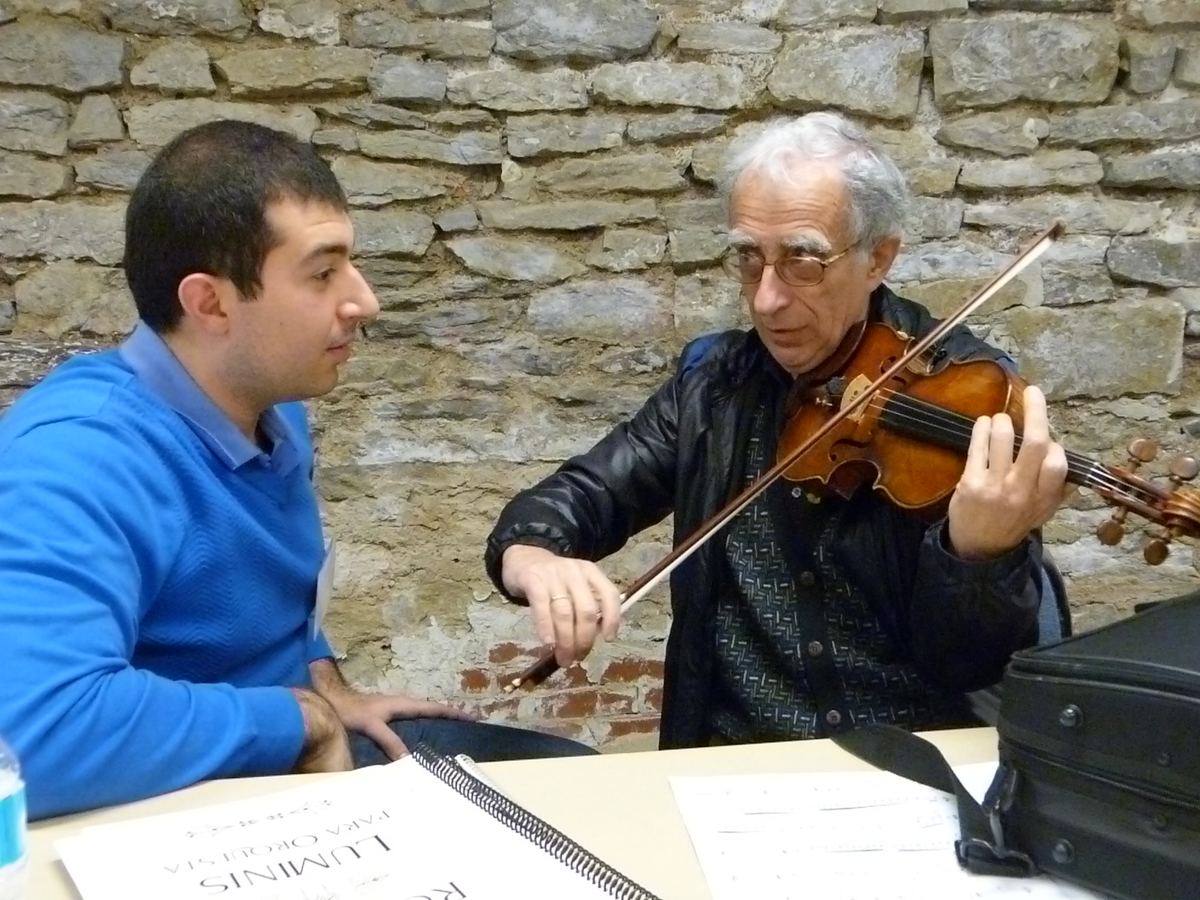
This doesn't have to be for finished material only. It could be for sketches that you're doing in progress. I'd say that the earlier in the writing process, the better, so you can incorporate player feedback into all the decisions that you make to shape the piece going forward.
As you do this again and again, you'll be building your skills at writing music that gets performers genuinely excited about playing it.
3. Someone who makes fresh sounds
Everything so far applies to instrumental and vocal performers you write for directly. But if you want a conductor to commission your music, they're looking for slightly different things.
One of the fastest ways to get a no to your music is to write something that sounds like a piece that they've already heard a lot. Donato Cabrera, the artistic and music director of the California Symphony, told me that one of the easiest things for him to say no to in a new piece is something that sounds like a redone version of John Adams' Short Ride in a Fast Machine.
Here's what he's actually excited by: "For me, I'm looking for something that I haven't heard before."
- "A new combination of instruments"
- "A new idea of how rhythm works within a piece"
- "A certain idea of shape or architecture that is unique"
- "Something that's somewhat fresh"
It's what I do with my influences
There's nothing wrong with taking inspiration from existing repertoire. I myself take a lot of influence from the work of spectralist and minimalist composers like Gérard Grisey, Giacinto Scelsi, and even John Adams himself.
But I find that what actually gets musicians excited to work with me specifically isn't my influences, it's what I do with them. My music blends aspects of those composers along with sounds from my own Arab heritage, but I'm only specifically working with just a few elements of that that I like the best.
One of these elements has to do with how I think about harmony, which often deals with how to rework spectral and Arab maqam frameworks into a landscape that fits within a functional harmonic schema that composers like Bach or Mozart would often do in their music.
I know that sounds like a mouthful. But if you just dissect each of those influences, identify moments of music that fit well with you and put them together, that's basically what ends up becoming your voice. That specificity is actually what ends up making your voice original.
4. Someone who says something meaningful about being alive today
If you aren't careful, achieving this stylistic freshness is where you can stop developing your composing altogether. If you stop here, you'll be cutting yourself off from writing music that gets the highest level musicians excited about your work.
This topic came up in a panel discussion before the premiere of the Genesis Project, a commission I was involved in that was put together by Matthias Pintscher, the music director of the Kansas City Symphony. Matthias commissioned 7 composers, including me, to each write a piece representing one of the 7 days of biblical creation.
Here's what he had to say about how he chose who to assign each day to: "I dared to assign the days to the composers, knowing their language, knowing their, you know, their world that they live in." He also said "it's beautiful to see that this diverse landscape is unfolding and telling us a lot about ourselves in the end."
Style is how you write, but what Matthias is really after is what you're writing about. And specifically, whether it says something true about what it means to be alive right now.
- How you write
- The influences that dictate that style
The mechanism for how I get there
- What you're writing about
- Something true about what it means to be alive today
My North Star
In my own composing, saying something true about what it means to be alive today is my North Star. It's what I'm striving to write about. Style and the influences that dictate that style are just the mechanism for how I get there.
5. Someone who believes in their music even when things get hard
All of this only works if you have the key quality that Jennifer Cho, concertmaster of the California Symphony, described to me: "More than anything, you need resilience and grit to come back and just start again and trust that you do have something to say."
Jennifer pointed to the great composers who "had total bombs in their premiere," and to amazing pieces "that we play all the time" where on opening night people booed, walked out, or it was a disaster.
You have to believe, I think, as a composer so deeply in the voice that you have and that what you have is worth saying that you're willing to sometimes fall flat on your face and just pick yourself up and go again.Jennifer Cho
What Jennifer is describing is something I've seen in every composer whose career I admire: a belief in their own voice that doesn't waver even when everything around them is telling them to stop.
It's hard to believe in what you have to say when the world tries to beat you down with subpar performances or audiences that just don't understand what you're going for. We need to be able to weather that storm and keep putting our music out there, even though a lot of the time it's scary or hard. Ultimately, this is something that performers respect.
The one thread that runs through every comment
Each of these traits is part of the same thing: being a composer who's willing to do the deep work. Getting your music commissioned and programmed requires this in every aspect of composing, from relationships and instruments to your sound, your message, and your conviction.
- Relationshipsopen the door to new pieces
- Instrumental technique, style, and messagingget people excited about our music here and now
- Confidencethat people can feel gives your catalog longevity
There's another thing that makes a huge difference in how much your music is actually getting played: whether it's easy to read and understand on the page.
What to do next
If you want to know exactly how to take the performer relationships you already have to land a commission in the next 30 days, get my free guide that walks you through my entire process.