
Why most composers never find their voice
Most composers never find their voice, and this isn't about talent. It's because they've never been truly honest about what music actually moves them. I'll show you how to get specific about your influences, how to isolate the exact bars and moments you love, then use them to write something that's entirely your own.
 By Saad Haddad, composer
Here's the video this post comes from (11 minutes), or you can read it below.
- Be honest about what music actually moves you
- Put together your composing hall of fame
- Make a greatest hits playlist
- Pull out your favorite snippets
- Figure out why you compose
1. Be honest about what music actually moves you
The number 1 problem I see composers run into when defining their voice is that they're simply not being honest enough about where their own influences come from. And I've made this mistake myself.
When I was an undergraduate student at USC, I felt like I needed to prove myself as a composer. So I tried to emulate the sounds of the most impressive composers that I could think of: people like Stravinsky, Mahler, Holst, even Eric Whitacre, one of the most famous living composers. Heck, I even wrote a piece based off of a Michael Jackson tune.
The music felt hollow to me
To be honest with you, the music that I was writing at the time felt hollow to me. It felt like the type of music that I was expected to write, not what I truly wanted to write.
I honestly felt really stuck, until one summer while I was just doing chores at my parents' house in California. My mom had asked me to digitize some old family VHS tapes, which I was really not looking forward to because there were so many of them.
But once I got listening to them, I noticed that in the background of these videos, there was a lot of traditional and popular Arabic music being played. I just hadn't heard really that much of it up until that point.
As I spent more time with these tapes, I found myself actually falling in love with the music by these artists, people like Oum Kalthoum and Fairuz, who my late grandmother would listen to all the time. They created soundscapes that made me feel even more connected to my own nuclear and extended family.
Felt hollow to me
Felt deeply personal
That's when I realized that I had just found a source of musical inspiration that felt deeply personal.
What I did with it
I immediately took this musical inspiration and wrote my piece Mai, which means water in Arabic, for string quartet and electronics. I blended microtonal Arabic scales and electronically modified snippets of my family VHS tapes into the modern classical aesthetic that I already knew I liked at the time.
This piece ended up winning several composition contests, including the BMI Student Composer Award. But looking back, the thing that I'm most proud of is how it helped me eventually define my compositional voice.
2. Put together your composing hall of fame
To do this for your own composing, you'll need to ask yourself what music you also truly can't get enough of. Specifically, what music do you love and see yourself wanting to make more of, for the years to come?
- ?What music can't you get enough of?Be honest about what music actually moves you.
- ?Do you see yourself wanting to make more of it?For the years to come.
- 1Pick out your favorite composersThe ones whose specific individual styles you love.
This means getting more specific than general styles of composing like romantic or minimalist, which can describe literally hundreds or even thousands of composers that are living today.
Instead, you'll need to pick out your favorite composers whose specific individual styles you love. I think of this like putting together your composing hall of fame.
3. Make a greatest hits playlist
I found myself not knowing what to do with my influences shortly after writing Mai. I'd just started my master's degree at Juilliard and had been spending a lot of time exploring different types of Arabic music. But as I dug deeper, a big doubt came up for me.
What right did I have?
I hadn't been born in the Middle East. I lived in New York City at the time, and I hardly spoke any Arabic at all. What right did I have, or do I even have right now, to use elements of Arabic musical culture in my own writing?
This musical culture felt totally different from the Western music culture I'd grown up in. The string quartets, concertos and symphonies I was studying at Juilliard seemed like they were from a different world than the Arabic music I loved. Quite frankly, I felt like a total imposter, until eventually 2 friends of mine at Juilliard helped me find a way forward.
These were Basma Edrees, an Egyptian violinist, and Ava Nazar, an Iranian-American pianist. What struck me was that both musicians were double experts. They were both doing master's degrees in classical performance at Juilliard, but they were also both experts in this other kind of music.
That's when I realized I might be able to take this doubling up approach too. I could lean into this fusion of the Arabic and Western music I love so much, and make that the point of what I wrote.
Getting more specific with my own influences
I put this idea into practice by writing my first piece at Juilliard, Kaman Fantasy, for Basma and Ava. It took the discoveries I'd had while writing Mai to the next level. I intentionally aimed to emulate specific pieces from the Western and Arabic canon that I loved.
On the Western side, I absolutely adored Ravel's Tzigane for its rhapsodic melodies and its lyricism, and Kaman Fantasy ended up having a lot of similar expressive ideas too.
On the Arabic side, I was heavily, heavily obsessed with the violinist Sami al-Shawwa, who showed off his freely ornamented playing style. That helped me craft the many, many different types of decorations that happen in my own piece.
- Ravel's Tzigane
- Rhapsodic melodies
- Lyricism
Similar expressive ideas
- The violinist Sami al-Shawwa
- Freely ornamented playing style
Many different types of decorations
What to put on your playlist
To get to this level of specificity in your own writing, move from your composing hall of fame to what I call a greatest hits playlist. Put together a list of 10 pieces by the composers from your hall of fame, pieces that you'd want to create something like.
4. Pull out your favorite snippets
After Kaman Fantasy, I had a clearer sense of my voice than ever before. But I knew that if I tried to just keep writing in the same way, I'd eventually stagnate. How do you keep pushing your voice forward once you've found it?
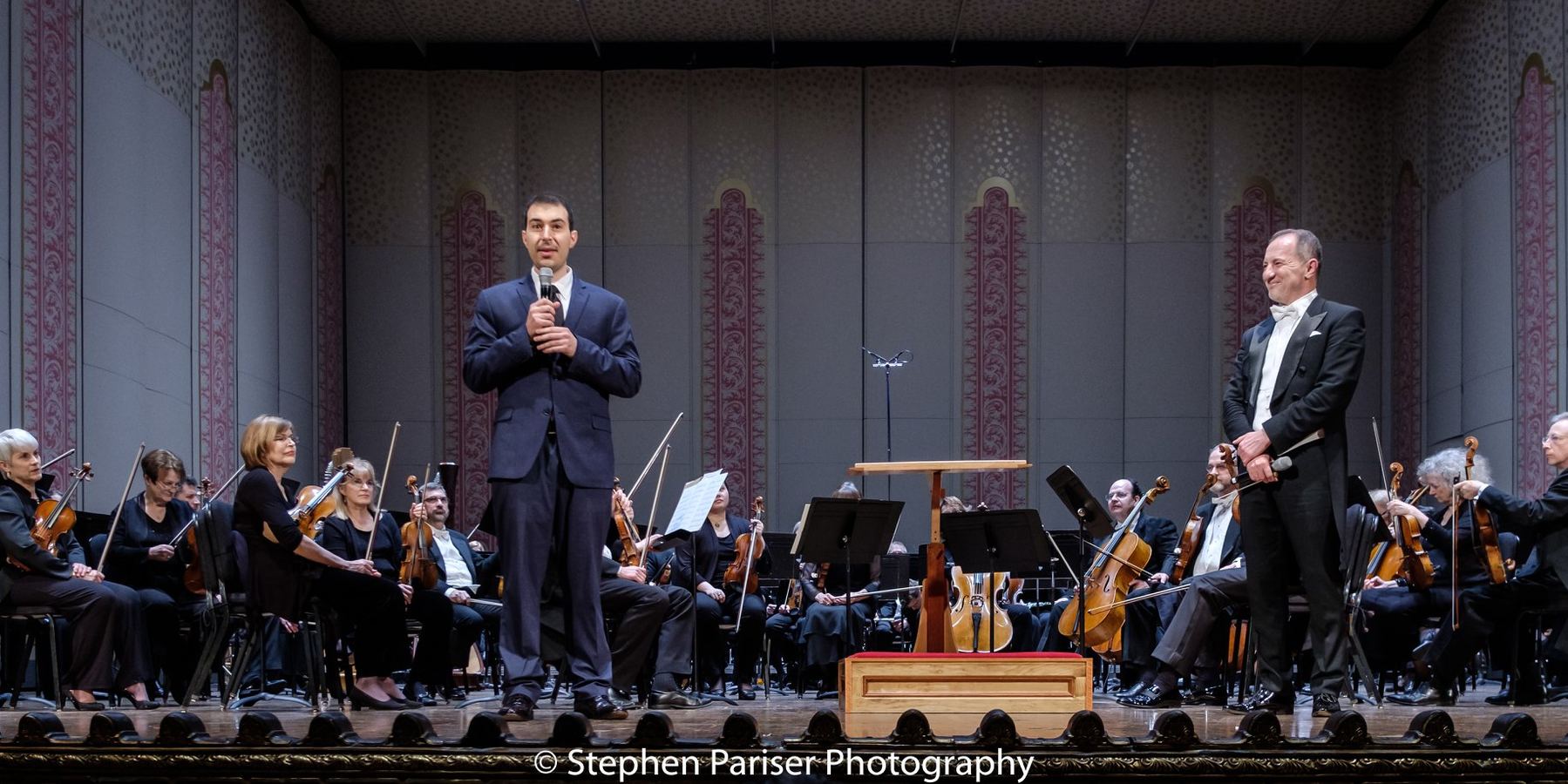
Soon after, I got the chance to work with the American Composers Orchestra as a way to test my voice with a much larger ensemble. The piece was Manarah, one of my first professional orchestral commissions.
10 seconds or less
As I started writing Manarah, I kept coming back to one of my biggest musical inspirations, Al-Atlal, which means the ruins, by Oum Kalthoum.
In particular, the things I loved most from this whole piece were the ways Oum Kalthoum used microtonal intervals, slides between notes, and changes to her own vibrato to fully express herself.
I realized that I could write all of Manarah to be centered around these 3 ideas, which each represented a 10 second or less fragment in one musician's part from a much longer track.
Different colors of paint on your palette
You can approach your own greatest hits playlist in the same way, by pulling out your favorite snippets of music from each piece. These tiny elements can become the building blocks of your unique musical language.
Once you've identified these fragments, you can treat them like different colors of paint on your palette that you can freely blend together to make new ideas you can use in all of your pieces.
After writing Manarah, I was able to continue iterating my compositional voice, writing commissions for the Albany Symphony, the New Juilliard Ensemble, the Columbus Symphony and the Princeton Symphony.
5. Figure out why you compose
As I wrote more and more pieces and kept developing my style, I started to ask myself what all this composing I was doing was actually for. I didn't have a clear sense of what my music was trying to accomplish, and being busy as a working composer didn't make this worry go away.
Then at the start of the COVID-19 pandemic, I suddenly found myself forced to answer this question head on. Musical performances basically stopped and commissions dried up. All that free time gave me a lot of time to think about why compose in the first place.
At the same time, I saw my composer friends struggling with the same problem. What scared me the most is that many of my friends ended up deciding to stop writing completely.
Something new started to come up in the piece
I knew that I didn't want to stop writing, but I still wasn't sure why composing felt so important to me. I responded to this by writing a new piece, which became Aruah, or souls in Arabic, for the International Contemporary Ensemble.
I was still feeling a lot of doubt, so I tried to counter that by making the writing process itself as enjoyable as possible. I worked in all the musical ideas I'd come to love working with: elements of Arabic traditions, spectral music and American minimalism.
But as I was writing, something new started to come up in the piece, a celebration of the humanity of the musicians themselves. I asked the performers to breathe audibly and use large performance gestures that emphasized their physicality.
- Elements of Arabic traditions
- Spectral music
- American minimalism
- Breathe audibly
- Large performance gestures
The humanity of the musicians themselves
It felt deeply important to celebrate the human aspect of music making at a time when I was stuck at home and seeing very few other people. That's when I realized that Aruah wasn't just incorporating my big stylistic influences and pushing my voice forward. It was exploring a big idea that felt important to me. What does it actually mean to be a human being in the moment I'm living in right now?
This was such a big idea that I knew I couldn't explore it in just one piece. I wanted to keep exploring this theme in as many future pieces as I possibly could, to see what else I could discover.
I know why I compose
Since writing Aruah and finding this compositional purpose, I've been able to write more consistently than ever before, and write many of the pieces that I'm most proud of having created.
Even on days when I'm tired, sick, or overwhelmed by work, there's a part of me that can clearly say I know why I compose, and I know I still have much more that I want to say. That strong sense of compositional purpose gets me to sit down and write, whether it's a good day or a bad one.
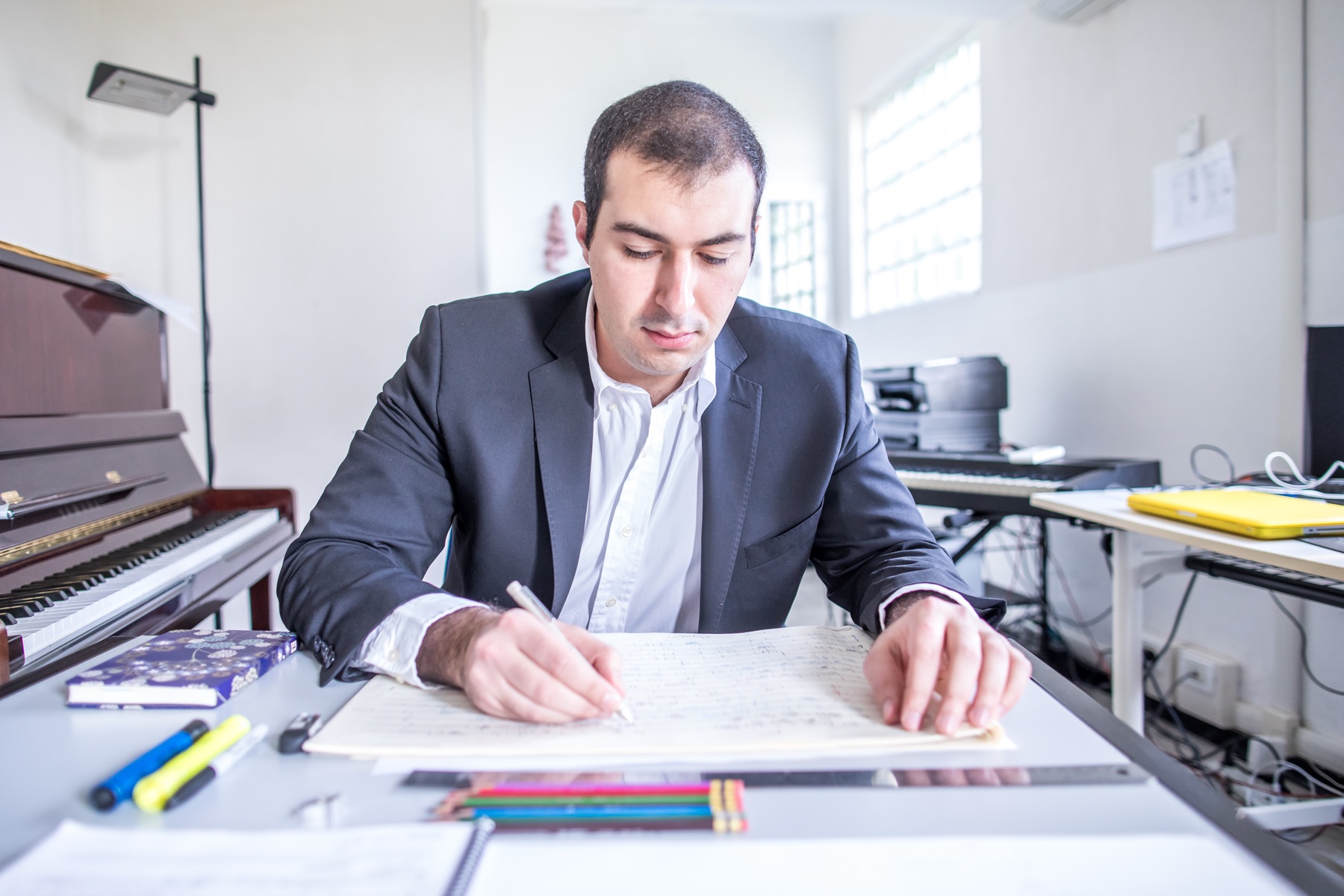
A general sense of stylistic inspiration can motivate you through a piece or 2. A clear sense of your aesthetic voice can keep you writing for several years. But if you add a strong sense of why you're composing, you can keep going for decades.
Your reason for composing will be entirely your own. The only thing that matters is that it's something you keep coming back to.
What to do next
I've put everything here into a free workbook that walks you through each step in more depth, so you can apply it to your own composing. Now that you have the tools you need to find your voice as a composer, the next challenge is building a composing career around your voice. And to do that, you need a system for getting your music performed and commissioned.