
Not sure what a doctoral composition portfolio looks like?
The doctorate is the terminal degree of composition, the degree to end all degrees. Here are the 3 pieces that got me accepted to the CUNY Graduate Center for a PhD and Columbia University for a DMA, and what's on the pages of each score.
 By Saad Haddad, composer
Here's the video this post comes from (9 minutes), or you can read it below.
- The 2 flavors of doctorate
- The first piece: orchestra and electronics
- The next piece: a completely different kind of piece
- The final work: solo piano and electronics
- What you can do with microtones with a piano
The 2 flavors of doctorate
The doctorate in composition typically comes in 2 flavors: the PhD, or doctor of philosophy, and the DMA, or doctor of musical arts. Traditionally, the PhD is more research-focused, while the DMA is more practice-focused.
You still have to compose music
You still need to conduct research and write papers
Keep in mind, if you're a PhD student, you still have to compose music. And if you're a DMA student, you still need to conduct research and write papers. It's just that one leans a little bit more than the other.
The 3 pieces below got me accepted to one of each: the CUNY Graduate Center for a PhD in music composition, and Columbia University for a DMA in composition.
The first piece: orchestra and electronics
The first piece is Manarah, for orchestra and electronics. The title means "lighthouse" or "beacon" in Arabic, and I wrote it for the American Composers Orchestra.
The pages before the music
The score has a title page. It has an inside page with the instrumentation, a percussion key and the technical requirements, because this piece does have an element of electronics in it. Then there are the performance notes, and the program note at the very bottom.
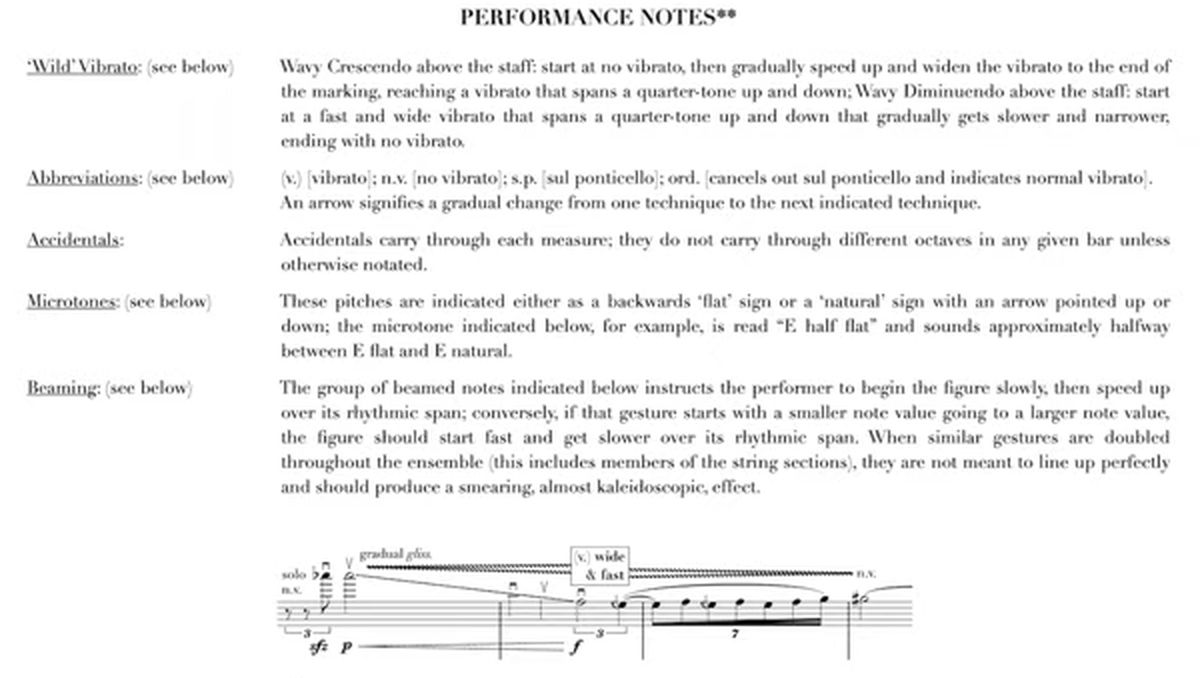
On the very next page is the first page of the music, with the title on the top, the composer on the top right and the instrumentation names on the left. And of course all those magical dots and lines on the page which we call music notation.
- 1Title pageMy name, the title of the piece and the instrumentation.
- 2Inside pageInstrumentation, percussion key, technical requirements, performance notes and program note.
- 3First page of the musicTitle on the top, composer on the top right, instrumentation names on the left.
The trumpets can't actually play those pitches
You might notice that the trumpets have these digital delayed signals on them. There are these microtones that are playing, and that's coming from the Max MSP patch that I made for this particular piece.
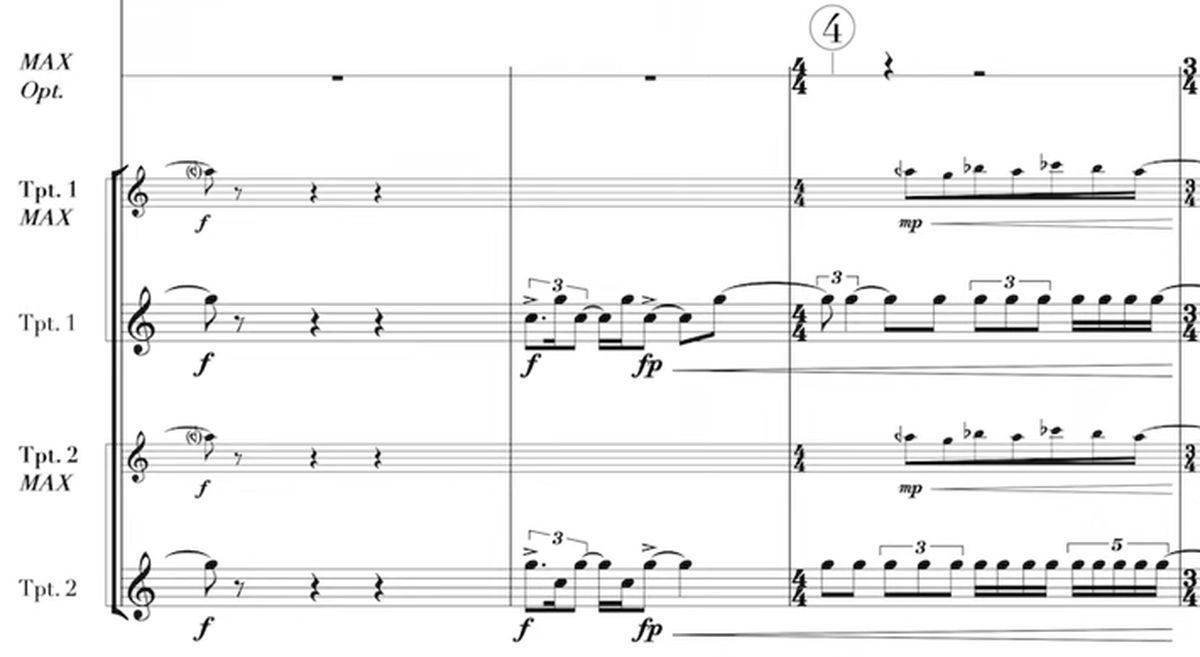
The pitches get higher and higher. The trumpets can't actually play those pitches in real life.
Then we have our first arrival point, with this big chord in the electronics, and a low chord with the electronics too. Another high chord, another low chord. All this stuff is being produced live, with the trumpet being recorded and then processed through my Max MSP patch.
It's a really crazy piece. It's meant to be a fanfare. It's meant to open a concert.
The next piece: a completely different kind of piece
Even though the instrumentation of the next piece is fairly similar, I do use the instrumentation in a very different way, and I do have a very different mood. It's not a fanfare. And it's completely acoustic, there are no electronics in it.
Takht is a piece I wrote for sinfonietta, for the New Juilliard Ensemble. Very similarly to Manarah, you'll see the title cover first. On the next page you're going to see the instrumentation, the performance notes, the program note and my website down at the bottom.
This is very, very standard stuff to do at the beginning of your scores.
Then we have the first page of music. Notice that it's a lot less busy than the beginning of Manarah.
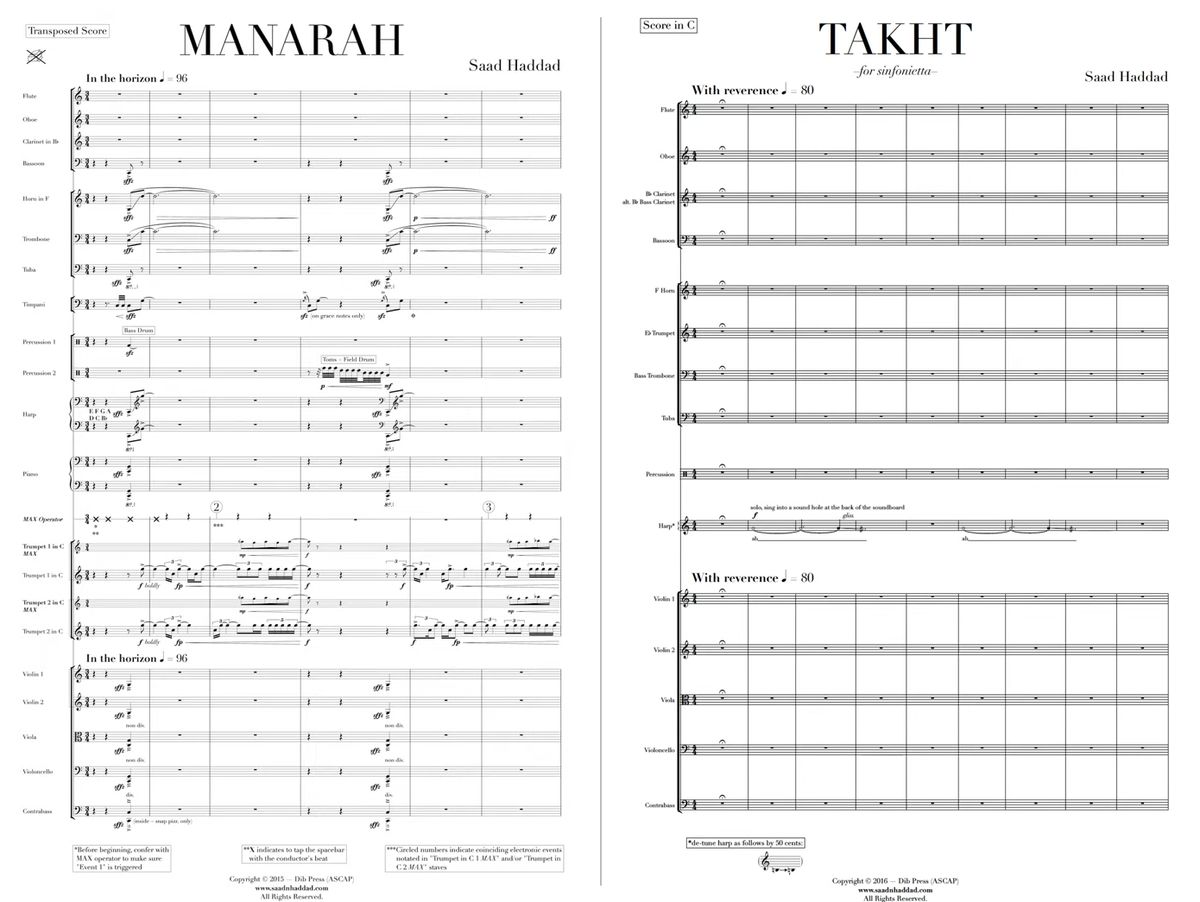
This kind of ghost soprano
There's no voice in this piece. What you hear at the very beginning is actually the harpist singing into the back of the harp, all alone.
The reason I did this is I thought it would be a nice way to have an homage to Oum Kalthoum, this big-time Arabic megastar from Egypt. You have this kind of ghost soprano in the background that starts up the whole piece, and then she kind of disappears as all these microtonal melodies start to emerge.
Spoiler alert: at the very end she comes back, and the harpist is singing this G, F sharp thing as we end the entire piece.
All this stuff that's happening in the violins, the flute and the clarinet is just an ornamentation of this G, F sharp from the very beginning of the piece. It's very like Beethoven in that way, of just taking what you see in the very beginning and expounding on that, developing that initial idea.
Spreading out the pitch content
Then I'm introducing a few more notes, up and down. So not just G and F sharp, but sometimes this B half flat, sometimes the D below, the E flat, a little bit above that. We're starting to spread out the pitch content in these first few pages.
I'm introducing more instruments too, not just strings and winds. We have some brass coming in, like the horn, and later on we'll have the trumpet enter as well, and the trombone. It's just kind of like a blossoming flower that starts from this solo harpist singing into the back of the harp.
The final work: solo piano and electronics
The final work, Shifting Sands, is a piece for solo piano and electronics, written in a very minimalistic style. It's a style I didn't really work in usually, but I thought it fit the bill for what I wanted to achieve with this particular piece.
Just like the other pieces, no surprise, we have a title page with my name, the title of the piece and the instrumentation. Then on the inside cover we have the technical requirements, because this piece does have electronics.
Then we have the note for the pianist, basically how to practice the piece, the notes for the electronics technician, and then this notation here, which reads E half flat and is used constantly throughout the piece.
A bunch of staffs, not just the piano staff
In the first page of music, it's really important to notice that there are a bunch of staffs, not just the piano staff.
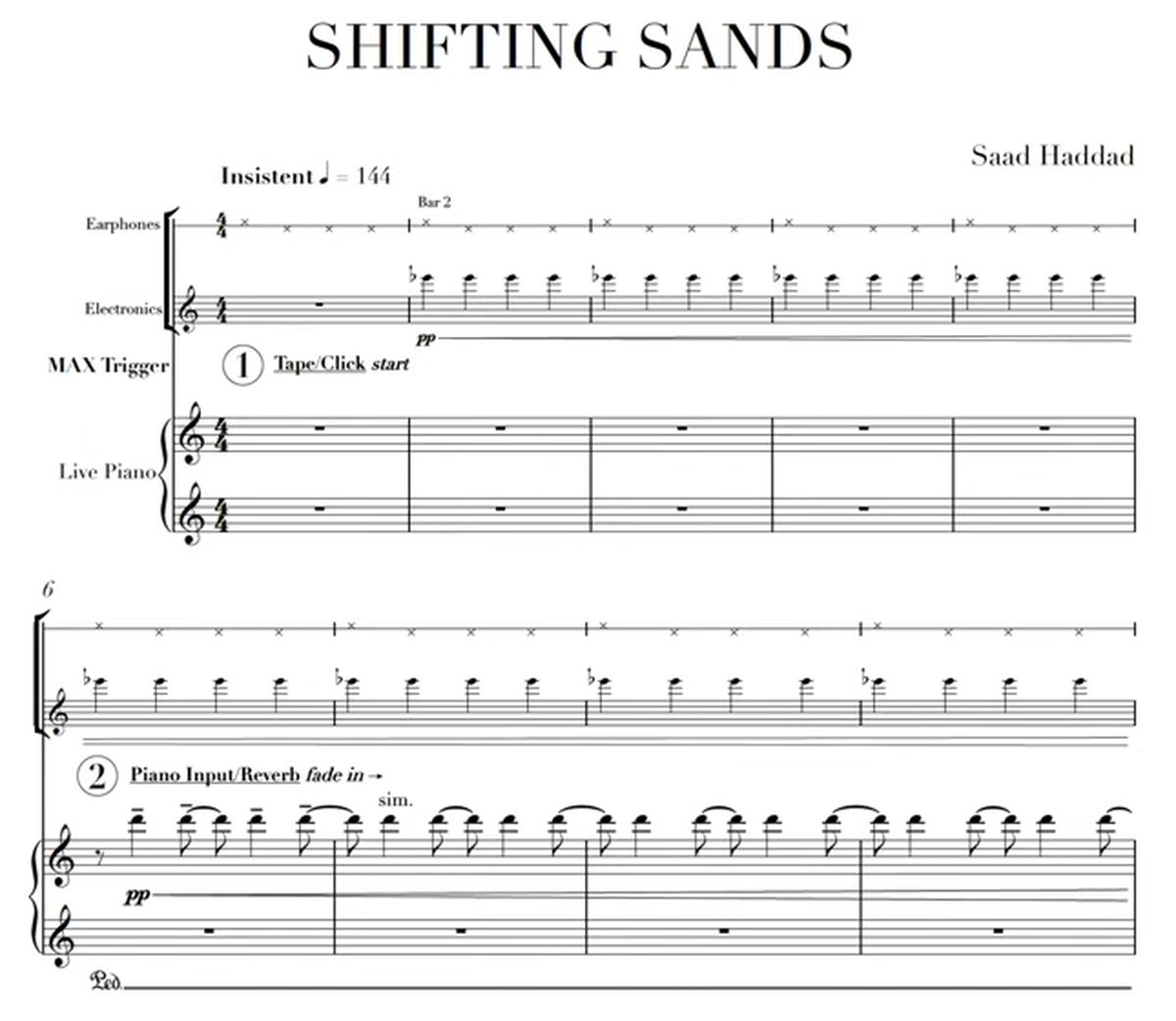
- 1Earphone staffAll the different clicks that the pianist is going to hear. The top X is the first beat of every single measure, and the bottom X is all the beats that are not the first beat.
- 2Electronics staffAll the stuff that's coming out of the speakers.
- 3Max triggerWhat event are we doing at this moment in time?
- 4Grand staffThe notes that the pianist is actually playing in real time.
With the earphone staff, the pianist doesn't get lost. They know exactly where they are. And we don't hear any of those X's, because that's the sound of the headphones.
The Max trigger is right below the electronics. In measure 1 we see "Tape/Click start." In other words, this is when the electronics start. If you head over to measure 6, that's trigger number 2, "Piano Input/Reverb fade in." And then we have 3, 4, 5, 6, et cetera. These dictate what the electronics are doing throughout the piece.
What you can do with microtones with a piano
I like this piece a lot because it shows what you can do with microtones with a piano. Because of course, the piano doesn't play microtones.
I put all the microtones in the electronics part, and all the pitches are quite close to each other. So you can't really tell what the live piano is doing and what the electronics are doing. It's all kind of mixed in together, which I like very much.
A bit later we have a little bit of the piano just playing the regular E flat, instead of the electronics doing the E half flat. So there's this kind of sliding between the E flat and the E half flat that's going on throughout this whole piece.
What to do next
Before your own scores go into a portfolio, get my free engraving checklist. And if you're applying a degree earlier, here's my master's composition portfolio.