
What a master's composition portfolio has to show
They need to see that you care about your score and how it's presented before they even care about how it sounds. Here are the 3 compositions I submitted for my portfolio, the ones that got me into the master's programs at Juilliard, Rice and the New England Conservatory, and what each one was there to show.
 By Saad Haddad, composer
Here's the video this post comes from (23 minutes), or you can read it below.
- 3 out of 4 is not bad
- If you don't care, they don't care
- The first piece: solo guitar
- The second piece: an entirely different ensemble
- Show contrasting styles and mediums
- The final piece: a large orchestral work
- They want to know that you have the chops
3 out of 4 is not bad
In my life, I've applied to a music composition degree 3 times. My first application was way back in 2010, and it led me to a bachelor's degree at the University of Southern California.
My second application happened 4 years later. It led me to the East Coast, where I pursued my master's degree at Juilliard. That second application is the one I'm going to focus on, namely the compositions that I submitted for my portfolio.
Fair warning though, it did not get me into the Yale School of Music.
Hey, 3 out of 4 is not bad
You just gotta get into one
Hey, 3 out of 4 is not bad, I'll take it. And by the way, you're going to end up at only one of these schools anyway, so you just gotta get into one.
If you don't care, they don't care
It's very important at this stage, for your master's degree, that your score actually looks professional, that it looks like a publisher actually published the music. This way they have a sense of, well, you take your music seriously.
Why would they take your music seriously, as someone that is admitting you to a school for a master's degree in composition, if you don't take your own music seriously?
That first eyeball glance of what the music actually looks like, believe it or not, is a big indicator of how your application will do.
- 1They're dealing with so many applicationsYou're competing for a few slots in a master's degree program.
- ?Does it look like a publisher actually published the music?What the music actually looks like.
- 2You take your music seriouslyMake yours stand out in the crowd.
You've got to imagine they're dealing with so many applications. You're competing for a few slots in a master's degree program, so make yours stand out in the crowd.
The title page and the inside page
On the score to my Guitar Etudes, the title page has my name, the title of the piece and what the instrumentation is. A very basic thing. Everything on the top and the bottom is pretty much extra.
Then on the inside page you have the instrumentation and the duration. This piece is organized into 6 etudes, so I actually mark what the 6 etudes are. And then of course I have my program note.
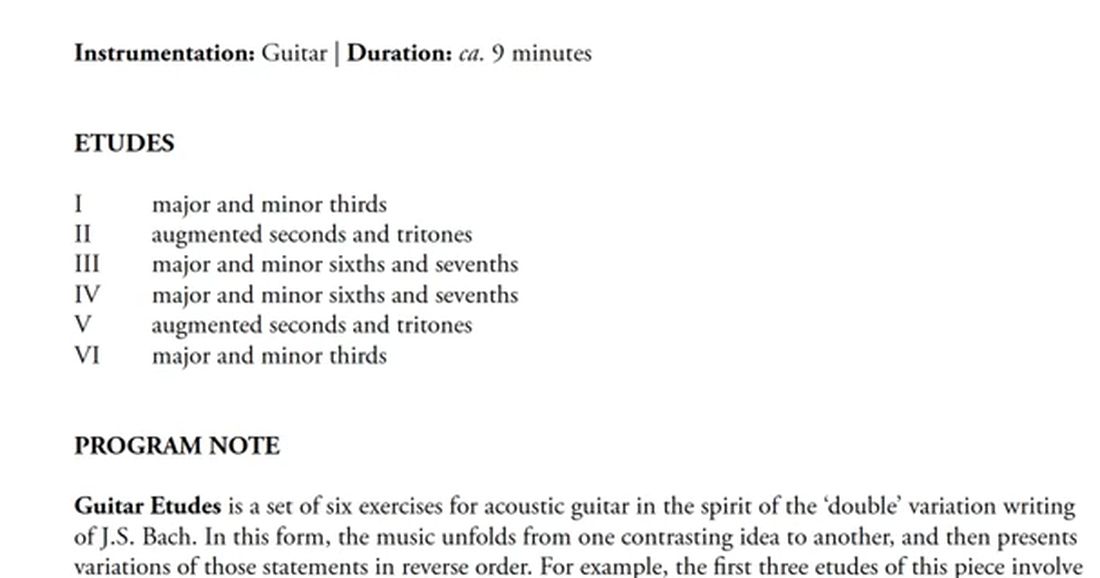
On the bottom I have my little logo for Dib Press, that's my publishing company, and my website. You don't need to put those things down there. I do it because I have a logo and I have a website for my compositions.
The first thing you should notice on the first page of the score is that it's very well laid out. You have 7 staves on the page, with a lot of white space in between, but not too much white space.
The first piece: solo guitar
In the first etude I set up this motive, this E minor, F sharp major motive, and then I develop that idea. So it's a very traditional score in that way.
There's a little bit of rhythmic complexity. It's not always those triplets going over and over and over again. It goes back to the beginning, basically, then it turns around to do something else, and it ends with this tag.
Using the guitar in a very idiomatic way
The second etude is a lot slower, a lot more open. The important thing is that I'm using the guitar in a very idiomatic way. I'm showing a committee that I'm not just doing fast single-note stuff with the guitar, I can also do these long chords.
I know how the guitar works: where the double stops occur, how to do the arpeggios, what those circled numbers mean, what the Roman numerals mean. And there's an artificial harmonic, so I have a grasp of what that possibility is on the guitar.
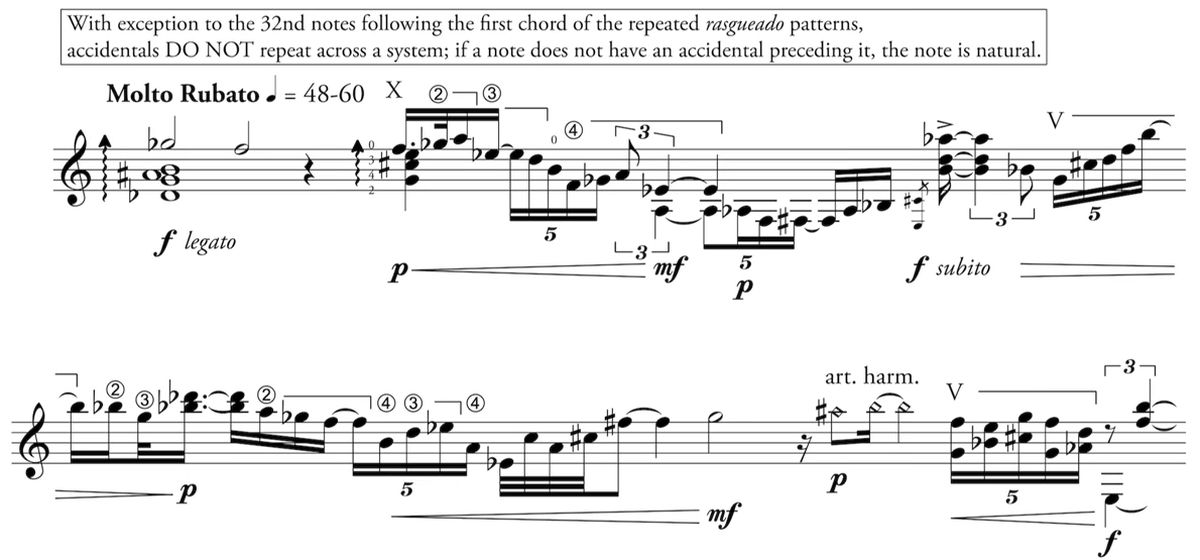
But it's not throwing all these different things for the guitar to do. You're still trying to make a musical argument out of the guitar itself.
When I introduce a new technique, I do it in a slow way, in a developmental way, in a way that doesn't make it something that's just randomly there. The artificial harmonics come back later, but more in a melodic way instead of just those 2 notes.
Playing around with expectations
Just like the first movement, I have a little tag at the end of the second movement. This is a recurring theme throughout all 6 etudes.
The third etude also starts out slow, even slower than the second etude. You might think, oh, for the third movement, he's going to go back to being fast. But actually no, I go even slower.
And then, playing around with expectations again, nope, we're going to go fast again. I actually forgot that at this moment it gets to be fast, so it even played with my expectations a little bit, even though I wrote the freaking thing.
If you're going to write a solo piece
If you're going to write a piece like this, especially a solo piece, these are really important to make sure of.
- 1Well recordedMake sure it's going to be well recorded.
- 2ProfessionalIt looks like a professional, presentable score.
- 3IdiomaticYou're doing things that are idiomatic for the instrument.
- 4All your ownYou're doing it in a language that's all your own as well.
If you've already seen my undergraduate portfolio, you can already tell that this piece is a lot better than any of those pieces. It's better in terms of the ideation of the overall piece, the sense of form and, most importantly, the way that I'm actually writing for the instrument.
You can tell that I actually spent some time with the instrument, with the player, actually getting to know how the guitar works in my language. I'm still very proud of this piece. I don't cringe at all with it like I do with all my pieces from my undergraduate portfolio.
The second piece: an entirely different ensemble
The second piece in my portfolio is for a choir. It's called The Little Boy, and I used the text from William Blake's Songs of Innocence.
I have a title page again, and on the inside page I again have the instrumentation, the duration, the text and my program notes. You want to have a consistent kind of feel with all your scores, so it all looks like it was the same composer that did all that music.
For rehearsal only
Since this is an a cappella choir piece, usually what they expect is that you have a piano staff below the soprano, alto, tenor and bass, and you'd only use it for rehearsal. Instead of a normal size staff like the rest of the staves, it says "for rehearsal only" and it's in a very small staff size.
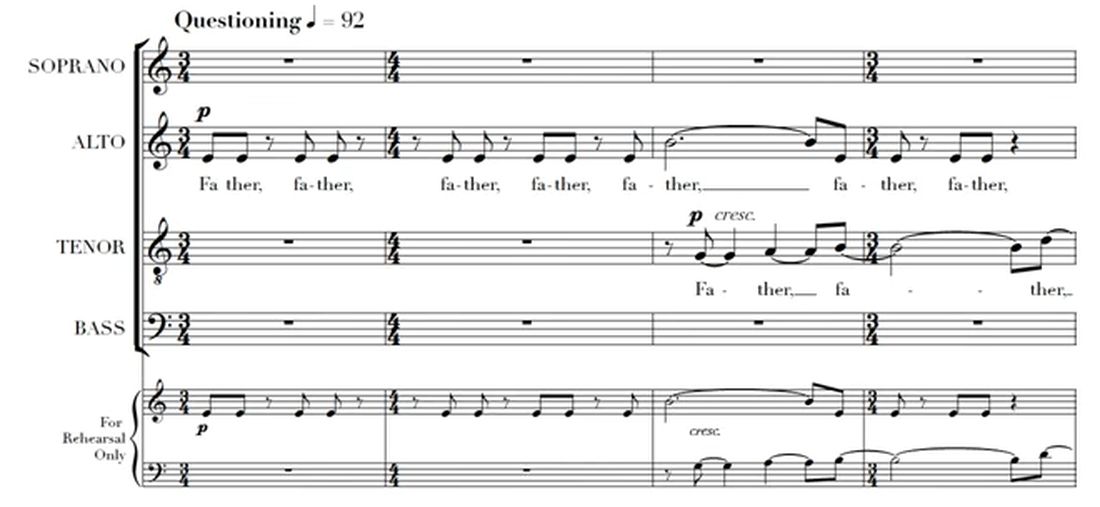
Every time the word "father" comes
Instead of just having the text play out, I do stretch some things here and there. I'm using my creative license to mold the text in the way that I want to, especially with the word "father." I use it a lot as a rhythmic kind of figure.
Every time the word "father" comes, it has that same rhythmic motive, even in passages where you wouldn't think that rhythmic motive would need to occur. Later on it comes back, but it's a lot slower, a lot darker, because no father was there, as the text is telling us.
Completely different text, completely different music
The harmony is pretty consistent. I'm using these big seventh chord and major second kinds of sonorities all throughout.
Then all of a sudden we switch meter, and we switch meter because of the text, "The night was dark." Completely different text, completely different music.
From there it goes back and forth between the sopranos and altos and the tenors and basses.
This is a big step up from the choral work in my undergraduate portfolio, which I'd written a few years before. If you keep at it, your works are obviously going to get better, but you've got to keep working on it. You can't just assume one piece is magically going to get better than the last piece. It's a constant process of improvement.
Show contrasting styles and mediums
Those 2 pieces are already very different from each other. It's very important to show contrasting styles and mediums in which you can work as a composer.
Showing that you can work with text is definitely a plus, but it's not a requirement at all for your portfolio. In both my undergrad and master's portfolios I just happened to have choral works. It was a coincidence. It wasn't something that I did on purpose.
The main thing is to make sure that these pieces are recorded and engraved to a somewhat professional standard by this stage of the game.
The final piece: a large orchestral work
The final piece of my master's degree portfolio is a large orchestral work called Maelstrom, which the USC Symphony recorded. It's a very short orchestral work, with a duration of 7 minutes.
It has a lot more fancy of a title page. This is not needed. I just happened to have a friend who designed the cover art for me, with a ship, the water and a big fire kind of scenario to depict this maelstrom, this storm.
The wrong order of instruments
On the inside page we have the instrumentation, and that's very, very important in an orchestral score. This is how they know for sure you don't know what you're doing: if you put the wrong order of instruments.
You want all the woodwinds at the top, and they're always in that order. You never have clarinets above the oboes, or bassoons above the clarinets. Next after that are the brass. The horns go first, not the trumpets.
- 1WoodwindsPiccolo, flutes, oboes, English horn, clarinets, bassoons.
- 2BrassHorns, trumpets, trombones, bass trombone, tuba.
- 3TimpaniIf you're using timpani.
- 4PercussionPercussion 1, percussion 2, percussion 3.
- 5Piano and harpI have the piano doubled with celesta, then the harp.
- 6StringsYou just write the word "strings."
You can list the percussion instruments in a variety of ways. I listed what instruments each percussionist is playing. You can also just list all the percussion instruments and have the percussionists figure it out. They won't be too happy if you do that.
For strings, you don't have to write violins, viola, cello, double bass. If you just write the word "strings," they know that you mean violins, violas, cellos and double basses.
The first page of music then has the instrument names on the left, in the same exact score order as on the inside page. Make sure that you stay consistent. That's one way they're going to know that you weren't really paying attention when you were making your own score.
They want to know that you have the chops
I start out with just strings, and they're all doing something completely different. We already know that we're in the eye of the storm just from the get-go.
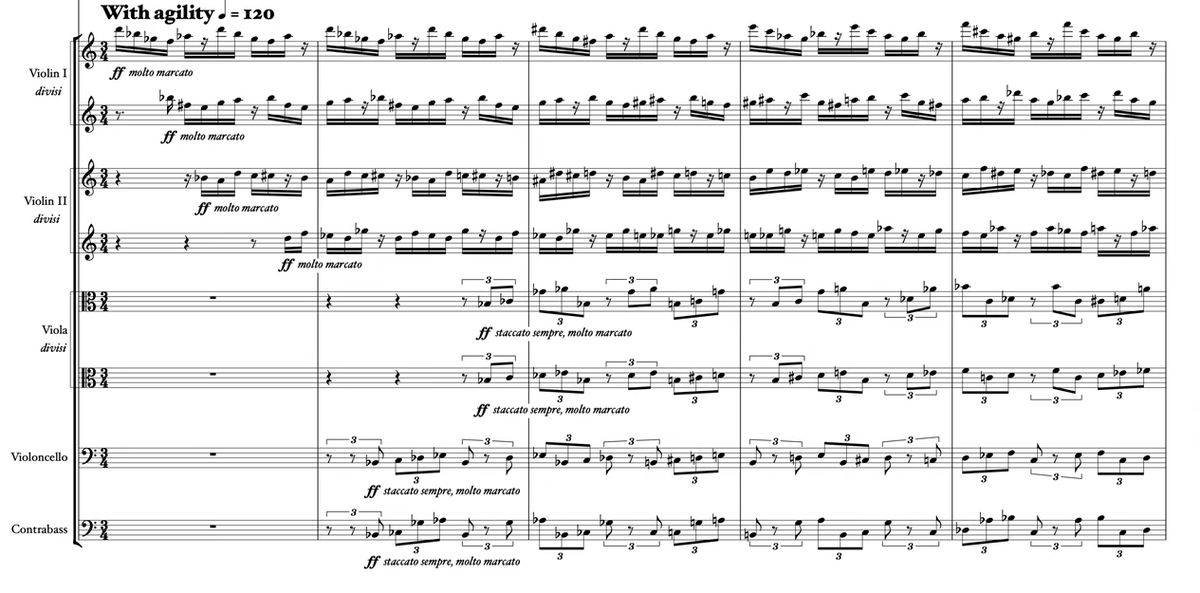
It's a little more cinematic than I tend to write these days. But the main thing is that it showcases that at this time I knew how to write for the different families of instruments, and I showed it right at the beginning of the piece too.
The strings have their role, the brass have their role, the woodwinds have their role, and the percussion has its role as well. Especially with an orchestral piece, it's really important to show that at the get-go of your piece.
You don't need to have everybody playing all the time
In one passage the score looks very sparse, but the texture still seems full. And I have space to put in this trombone and tuba melody.
Then I have space to put in a horn melody. We haven't heard from the horns for a while, and now we have this kind of Mahler-esque strings melody that emerges out of nowhere.
Stick to an idea
I'm showing that I want to stick to an idea. I don't change ideas all of a sudden. The woodwinds still have that same idea, but now it's in the forefront. Before, it was in the background.
The strings are more in the background there, and then they start to emerge from the texture again. Just a little bit of an orchestrational play.
You're not just a beginner
The reason I'm showing a piece like this is not because this is the way you should write. When they see an orchestral work, they want to know that you have the chops to deal with the different kinds of instruments, and that you have something to say, even if it's not something you'd necessarily write 10 years from now.
I don't write music like this at all anymore. But at least it's showing them that you're not just a beginner when it comes to dealing with the orchestra. You have some chops in terms of dealing with the different families, how they go together, and keeping all these ideas organized in your mind so you're able to put them down on paper.
That's it for now. Now get to writing.
What to do next
That first eyeball glance is a big indicator of how your application will do, so before you send your portfolio, get my free engraving checklist.