
You could be losing commissions over your program notes
If your program notes don't immediately give performers a reason to be excited about you, you could be losing out on commissions. Here are the exact 3 steps I use to write program notes that give performers a reason to choose you.
 By Saad Haddad, composer
Here's the video this post comes from (9 minutes), or you can read it below.
A flutist I'd never met found one of my pieces, and that led to 2 commissions. The reason he had picked me wasn't just because he liked my music, it was because he had read my program notes.
- What program notes actually are
- I used to just describe what happened in the piece
- Step 1: Name the composers and works that influenced it
- Step 2: Articulate why you wrote the piece
- Step 3: Shape it around who will be in the room
- Program notes are a passive strategy
What program notes actually are
The way most composers think about program notes is exactly what's holding them back.
At the basic level, program notes are a written description of your piece that can be included in a concert program, in the front matter of the score, or on your website.
But a lot of composers don't like writing or speaking about their composing, and they treat program notes as an afterthought. I'll admit, this is definitely how I used to approach program notes.
I used to just describe what happened in the piece
Take a look at this note from my orchestral piece Maelstrom. I didn't know how to talk about my music in a way that would be interesting, so I assumed I should just describe what happened in the piece.
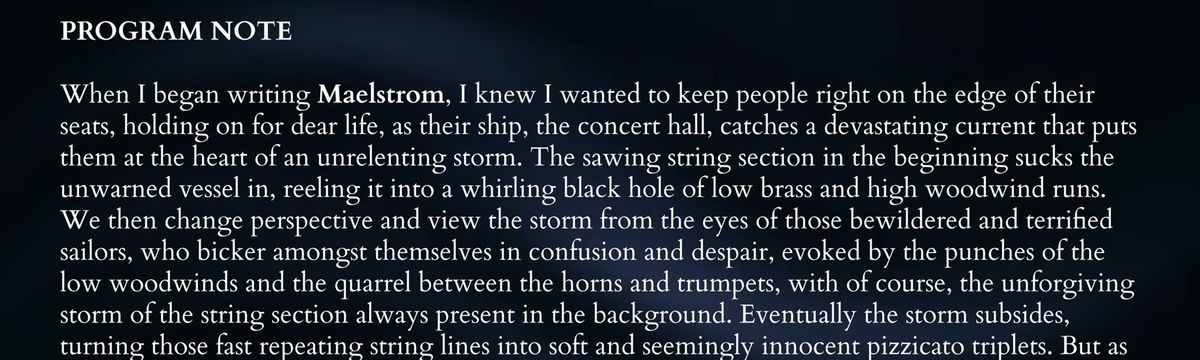
- "The sawing string section in the beginning"
- "a whirling black hole of low brass and high woodwind runs"
- "the quarrel between the horns and trumpets"
The program note for Maelstrom told musicians looking at the score what the music would be like. Looking back, I wanted to use the program note to encourage the music to speak for itself.
But it didn't give them a reason to actually be interested in my particular piece versus another fast-moving, turbulent orchestral piece by a different composer.
What I know now that I didn't know then is that a program note isn't just a description of a piece. It's the first conversation you have with a performer who hasn't heard your work yet. And that first conversation determines if they want to learn more about you.
It's the first conversation you have with a performer who hasn't heard your work yet.
Step 1: Name the composers and works that influenced it
Now compare that to the program note for a solo flute piece I wrote years later, Tasalsul I. This program note says almost nothing about what happens in my piece.
But even though I don't describe the music, someone reading this has a much more vivid understanding of what the piece is actually like, because I list specific influences of mine: Luciano Berio, Schoenberg, Wagner, C.P.E. Bach, Yan Maresz, Michel Baklouk Merhej and Abdo Dagher.
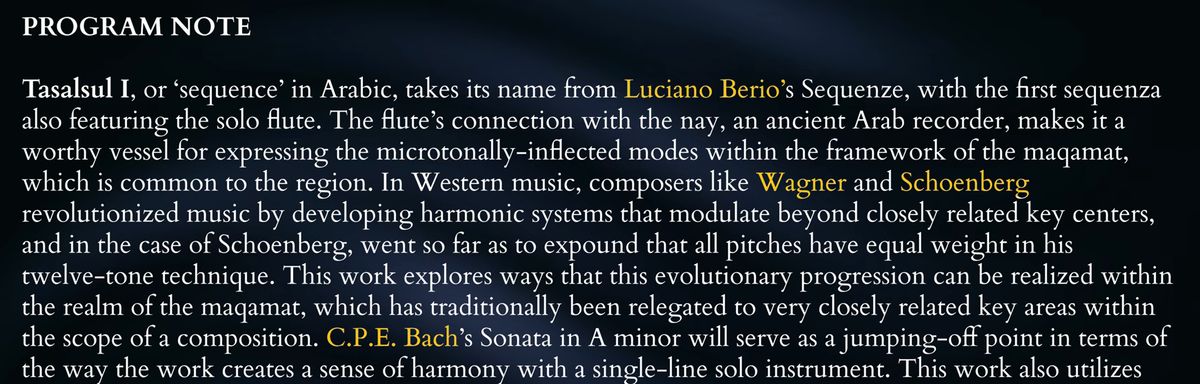
A musician who is familiar with some or all of these names immediately has a picture of what my music will sound like. And if they like the music by those people that I name, they now have a specific reason to be excited about my music.
No reason to be interested in my particular piece
A specific reason to be excited about my music
Whether they're browsing a website or looking at a perusal score, the program note is going to be immediately visible for them before they even click on any audio or even look at the notes on the page.
How to do it
For every piece that you write, be able to name the specific composers and works that influenced it, and put them in the program notes.
That's what turns a performer from someone who's just browsing into someone who feels like your music was written just for them.
The composers who can describe their influences in the most compelling way are people who have done the deep work of mapping their influences consciously, not just feeling them intuitively.
Step 2: Articulate why you wrote the piece
Just being able to name your influences in program notes isn't enough to actually get your music played. Performers have lots of pieces they love the sound world of, but that doesn't mean they're actually playing those pieces all the time.
The big decision performers make, after figuring out if a piece matches the styles they like, is whether or not it fits the concert program they're putting together. If it doesn't, no matter how much they might like your piece, it's not going to get played.
- 1Your program note is immediately visibleBefore they even click on any audio.
- ?Does it match the styles they like?Name the specific composers and works that influenced it.
- ?Does it fit the concert program they're putting together?If it doesn't, it's not going to get played.
- 2The right performers will take a closer lookAnd some of those performers will end up reaching out.
My program note for Tasalsul I also shows the solution to this. Even though it lists a lot of influences, that isn't the only thing that's there.
The deeper level is presenting the influences I have in Western classical music, like C.P.E. Bach and Berio, alongside my Middle Eastern influences, like Dagher and Merhej.
Beyond even just listing those influences side by side, I'm also connecting the instrument of the flute with the instrument of the nay, an Arab recorder. And I'm drawing connections between the maqamat system of Arabic music and the 12-tone system of Schoenberg.
What caused Brandon to pick up this piece
Drawing connections between Western classical music and Middle Eastern music is exactly what caused the flutist Brandon Patrick George to pick up this piece. Brandon isn't someone I had met before he asked me about playing Tasalsul I.
At the time he reached out to me, he was putting together an album based on pairing works from the solo flute repertoire with contemporary pieces like mine that brought in new aspects of identity. I happily agreed to him playing this piece and including it in his album, and assumed that that was the end of it.
So I was really surprised when Brandon wrote back to me through his role as the flutist of the Imani Winds, the Grammy-winning wind quintet. He let me know that he had asked the group to commission a brand new piece from me, and the group had agreed.
They actually wanted me to write both a piece for their ensemble to play and a second piece for the Harlem School of the Arts.
- The notedraws connections between Western classical and Middle Eastern music
- The albumBrandon plays the piece and includes it
- Imani Windsa brand new piece for their ensemble
- Harlem School of the Artsa second piece
The influences I described in my program note got Brandon to find my piece, but it was the why behind the music that made him want to perform it and eventually commission something new.
How to do it
When you're writing your program notes, articulate why you wrote the piece and what your music is exploring thematically. The more specific and concrete you can be, the better.
If you can give performers that bird's eye view in just a couple of paragraphs, the right performers will take a closer look. And some of those performers will end up reaching out.
Defining your compositional why is something even experienced composers find very, very difficult. And it's not because they don't have one, but because it's hard to actually put it into writing. If you want a structured process for doing that, it's the final step in the free guide above.
Step 3: Shape it around who will be in the room
Even if your program notes clearly articulate your musical influences and why you wrote the piece, you might still be sending a message to the type of performer you want that your music doesn't fit them.
For example, take a look at the program note for my piece Selig Licht, written in 2023. As you can see, it's quite academic. I go very much in depth on specific techniques I use, like spectral pitch groups and the maqsum rhythmic cycle of traditional Arabic music.
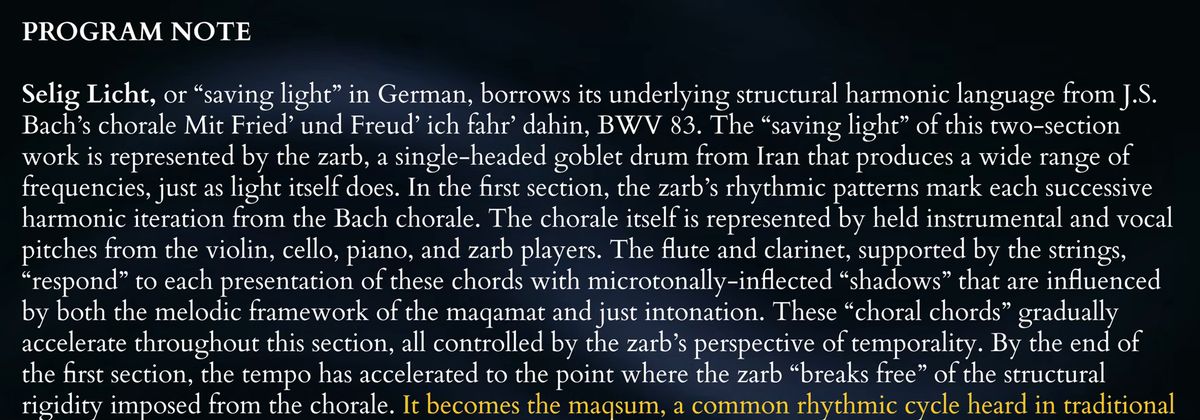
The reason I included all of this detail is knowing that this piece would be played in the Netherlands at the Gaudeamus Festival, which is totally focused on experimental music that combines elements of different genres. I knew that anyone actually attending this festival was somebody who would be really interested in all those details.
For the local community at large
Now compare that to the program note for my Violin Sonata, commissioned by the Knoxville Symphony. As I was writing this piece, I was keeping in mind that the symphony had let me know it was going to be premiered at a concert aimed at reaching the local community at large in Knoxville.
Because of that, I didn't want to assume that the people who would hear my music knew a lot about classical music.
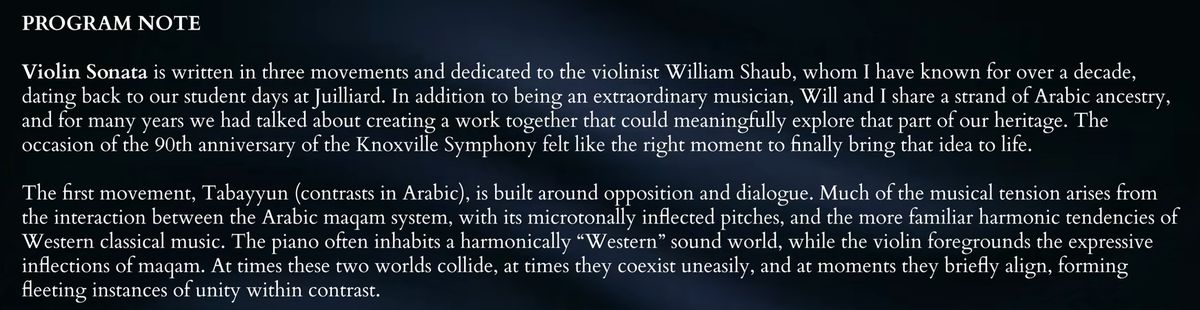
Even though this program note is actually longer than the one for Selig Licht, it's doing something very different. Rather than going in depth on the musical techniques that I use, it tries to tell a story of the piece as a whole and give people reading the note a sense of general things to look for as the piece progresses.
But even though this program note takes a more narrative approach, it still explains why I'm writing the piece and what my big influences were.
They want technical depth
They want to know why the piece you wrote matters to you
How to do it
Even though program notes need to get performers excited about our music, program notes also go in programs, so they need to match the type of audience that is likely to hear that music.
Take your ideas about influences and your reason for writing and shape them around who will actually be in the room reading that note, whether that's a new music crowd that wants technical depth or a general audience that wants to know why the piece you wrote matters to you.
Program notes are a passive strategy
Program notes are how your music speaks to musicians who will never meet you. If you write them this way, they can become one of the most powerful long-term tools you have for generating performances and commissions without constantly chasing new opportunities.
But program notes are a passive strategy. They work over long periods of time, and they require that someone has actually found your music in the first place.
So if you want to accelerate your progress and start getting your music in front of musicians as soon as possible, you need a different, active approach to getting your music performed.
What to do next
If you want to build that map of your influences for yourself, grab my free guide to consciously defining your compositional voice.